Pulitzer Center Update October 1, 2026
Philadelphia Students Explore the Critical Role of Journalists in Connecting Audiences to Global Issues
Country:

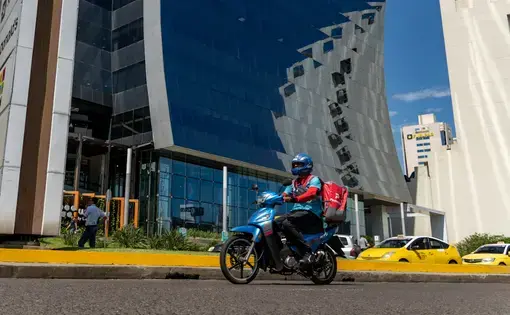
Students explore how climate change affects delivery workers, then write persuasive op-eds to raise awareness and advocate for local solutions.

Ken Hung is an IB Global Politics teacher at Central High School in Philadelphia. Hung created the lesson plan “Global Issues, Local Contexts Workshop” as part of the Spring 2025 Pulitzer Center Teacher Fellowship “Global Issues, Local Contexts: News for Civic Knowledge and Engagement,” reaching 33 students directly and over 300 through students’ final projects.
At the conclusion of the Fellowship, Hung shared the following reflections on his experience developing and teaching the lesson.
How did you build this lesson with your community in mind?
I teach at an urban magnet high school in Philadelphia with a college preparatory focus. My students come from all across Philadelphia and are of racial and ethnic groups that reflect the diversity of my city. There are about 2400 9-12th grade students enrolled. Students are highly motivated and very much driven by grades.
The lesson was implemented in my IB Global Politics class. The majority of students in the class are 12th graders (there are two 11th graders enrolled). Students in the course study political issues around the world and analyze them using concepts such as power and levels of analysis (e.g. local, global).
The class is organized as a seminar where students select current events that they wish to study that adhere to prescribed units in the IB Global Politics curriculum (e.g. development, human rights). Each week three students share two news articles on a chosen political issue with the class and then lead a discussion on those articles. With this in mind, I wanted to create a lesson that would not only fit the mold of the class, but also allow students who are not in the class to partake in the spirit of shared learning we have been cultivating.
What is the focus of your lesson plan, and why did you write this lesson for your community?
I wanted to create an end-of-the year activity that would enable my IB Global Politics students to take political issues we studied that were important to them and present them to students in other classes at my school. This would allow my students, who are mainly 12th graders on the verge of graduation, to give a parting gift to the larger school community by sharing what they learned to 9th graders who were finishing up their first year at my school. Doing so would allow the 9th graders to take part in that culture of shared learning that I have tried to inculcate in my IB Global Politics class throughout the year.
The students in my lesson collaborated in groups of four to create 45-minute interactive workshops connecting a local political issue facing a community in the U.S. to its larger global context. They did so by picking and studying an article written by a journalist from the Pulitzer Center, taken from this list.
Each group was asked to identify a specific political issue in the article, evaluate different local and global stakeholders impacted by the issue, and then research how journalists covered the political issue on local and global levels. Each group was then tasked with developing a 45-minute workshop for a 9th grade world history class with at least one interactive activity (e.g. discussion, simulation).
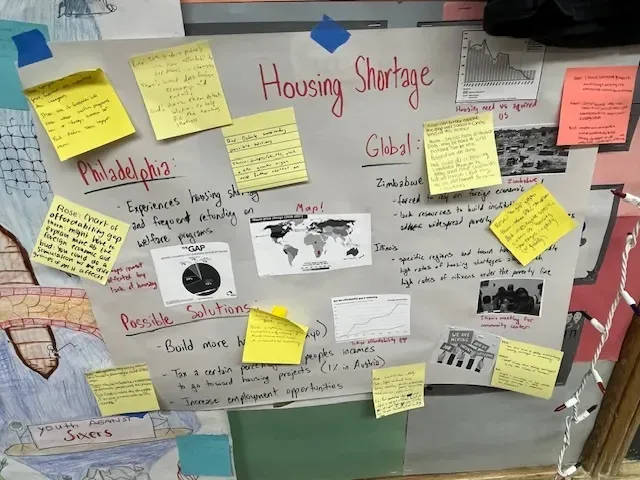
In order to figure out how to create their workshops, the IB Global Politics students first presented their research in class on a poster, which was displayed during a whole-class “Gallery Walk” activity. Students went around to each poster and left sticky notes with ideas for how each group could turn the content of their poster into a 45-minute workshop for 9th graders. In doing so, they gave feedback on what aspects of the political issue would resonate most with a 9th grade audience. They also gave feedback on what type of activities might go over well with 9th graders based on their maturity level and familiarity with the topic.
After reviewing their feedback, each group of IB Global Politics students wrote a lesson plan for their workshop. Next, they tried out selected portions of their workshop in front of my class. After getting additional feedback from their classmates, they taught their lessons to different 9th grade World History classes and received feedback from the 9th graders.
What did your students learn while engaging with this lesson?
My lesson allowed students to explore the dilemmas that journalists face when they investigate and present a political issue. In particular, they explored the decisions that journalists make when they connect global issues and their local contexts. For example, should journalists highlight a global issue by zooming in on how it impacts one specific community? Would doing so enable their readers to relate more? Or would it cause their readers to not understand the breadth of an issue?
My students had to address similar concerns when they had to decide what aspect of a political issue they wanted to focus on in their workshop. Given that they were presenting in front of an audience of 9th graders, and that they only had a 45-minute time limit, they had to make decisions not only on what to emphasize, but also on how best to emphasize it.
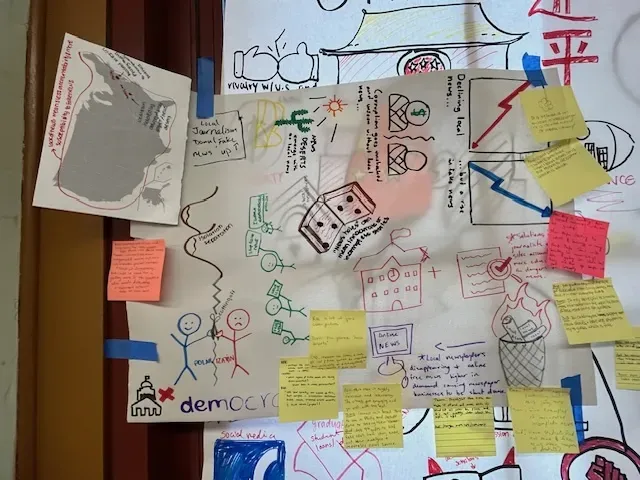
For example, one group of students chose to develop a lesson around the around the Us & Them podcast episode “Another Small Town Paper Down.” This podcast explores how the changing nature of the news business led to the closure of small town news outlets. To illustrate this, the podcast focused on the impact of the closing of a newspaper in rural West Virginia.
When conducting their research and presenting their findings, students in the group initially examined how the growth of “news deserts” has led to a decline in democracy around the world by causing fewer stories about corruption to be reported. However, when they presented their findings during the gallery walk activity, other students in my class suggested that they emphasize how this was also leading to the growth of fake news, a topic they felt the 9th graders would be able to better understand and relate to.
This led the group to create a workshop (slide deck below) for the 9th graders that focused on the local and global impact of fake news. During the lesson, the group had the 9th graders do activities where they presented real and fake news stories. Then, they had the 9th graders not only guess which were fake, but also determine criteria for determining fake news. Afterwards, they connected the activity to their chosen news article by examining how the decline of local news has also led to the growth of fake news, which has colored how local, national, and international news is now covered.
My students felt proud about their ability to have younger students examine the local and global impact of a political issue. One student wrote, "I think it's very interesting to see other people being exposed to the concept of analyzing political issues on different levels... They (the 9th graders) were quick to learn, and seemed excited about our lesson, which made me happy.”
Another student wrote, “I was glad the kids were able to look at an issue from multiple perspectives & also thought it was interesting how sometimes regardless of what an issue is, there are overarching solutions & stakeholders. Also this was like a lesson for me in a way as well, since I was able to learn how to explain broad topics in a purposeful way.”
Finally, one student wrote about the way that the assignment made them think more about the impact of fake news on their own life.
“Another takeaway I have from this project is a personal lesson that it is really important to check for fake news. I used to believe a lot more things I have seen on social media but this has made me realize how much fake news is on there.”
I’m really proud of the work my Global Politics students did on this project and the impact it had not only on the 9th graders, but also on their own understanding of how to analyze political issues.
What did you learn by creating and teaching this lesson?
I felt that the lesson was engaging for students in that it allowed them to apply skills that we had been developing throughout the year and take them to the next level. For example, students wrote a year-long research paper earlier in the year in which they had to study a local community issue by partaking in authentic experiences (e.g. interviews, volunteering) and make connections using academic research to how that issue impacted people on a national or international level. My lesson allowed them to deepen this framework of analysis by working with other students to explore how to analyze a political issue on different levels, and also figure out the best way to share this analysis with younger students.
While my lesson was created specifically for my IB Global Politics class, I feel that it could be easily adapted by other teachers. Teachers at other schools may encounter challenges having their students conduct projects outside of their students’ designated class period or may have trouble finding other classes to whom their students can present. If so, they could probably just do Parts One and Two of the lesson and have the culminating activity be the Gallery Walk activity.