Pulitzer Center Update October 15, 2026
As Midterms Near, Local Letters Contest Invites Students To Suggest Solutions

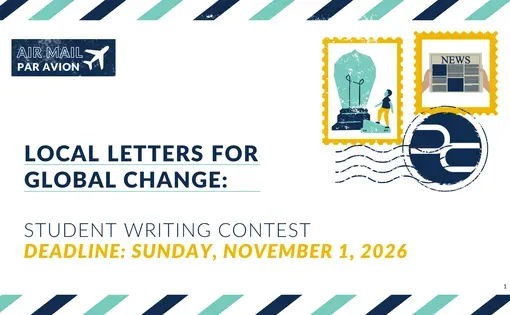
Students are invited to make their voices heard this election season by writing a letter to a decisionmaker that explains the global issue they want to see prioritized. Deadline: November 1, 2026.

Midterm elections are drawing near in the U.S., and at the Pulitzer Center, our annual Local Letters for Global Change contest is in full swing. For nine years, we’ve invited K-12 students around the world to write letters to local decision-makers that offer community-based solutions to global issues, inspired by Pulitzer Center-supported stories.
Students are taking up this task at a time of cliff-diving faith in U.S. institutions. In a spring 2026 Gallup poll, around 69% of Americans reported being dissatisfied with how their democracy is working. Among young people specifically, a Harvard Kennedy School poll found only 15% trust the government to do the right thing at least most of the time, and 50% agree with the statement, “People like me don't have any say about what the government does.”
Yet young people use the Local Letters for Global Change contest as an opportunity to learn more about who makes decisions in their communities, and how to hold them accountable. They engage in a broadly applicable thinking routine that starts with identifying the systemic issue at the heart of a news story and ends with proposing a concrete, informed solution. They read and discuss one another’s arguments and those of past contest winners, building out a growing global community of youths who believe in the power of civic engagement, and the role of journalism to inform action.
This year, we’re excited to be piloting a new Train the Trainers Program through which participating educators are amplifying Local Letters and the student voices that power it. The 20 educators in the cohort project that they will engage some 150 educators and over 2,300 students directly, and will share tips for implementing Local Letters in diverse learning contexts with the Pulitzer Center’s education community.
One of our cohort members, a high school teacher in Florida, shared why she is participating in the program: “[Local Letters] has the potential to change the way we teach by creating a classroom environment where authentic questions drive learning, diverse voices are valued, current global issues become meaningful, and students learn that education is not only about understanding the world—it can also help them participate in shaping it.”
This year’s contest deadline is Sunday, November 1. Please share the opportunity with students and educators in your life. We can’t wait to learn about participants’ visions for change, and to share the winning letters with the world.
With care,
Hannah
Hannah Berk
Senior Program Manager, K-12 Education
This message appeared in the October 16, 2026, edition of the Pulitzer Center's weekly newsletter.