Pulitzer Center Update September 2, 2025
Health Advocacy Projects Take Many Forms in Michigan High School Class
Country:

Lesson Plans
Objects in the Mirror are Closer Than They Appear: The Global Health Threat of International Conflict
Students examine the ways that anti-microbial resistance grows during conflicts around the world. Students imagine approaches to advocate for soldiers to receive testing and treatment and explore how...
Amy Frontier is an English teacher at Pioneer High School in Ann Arbor, Michigan. Frontier created the lesson plan “Objects in the Mirror are Closer Than They Appear: The Global Health Threat of International Conflict” as part of the fall 2024 Pulitzer Center Teacher Fellowship program "Making Local Connections to Global Health Stories.” Click here to view her full lesson. It reached 146 12th-grade World Literature students.
At the conclusion of the Fellowship, Frontier shared the following reflections on her experience developing and teaching the lesson.
When I first considered the best way to integrate a contemporary global health article into a 12th-grade World Literature unit on World War II, I was concerned students might find it to be a bit of a stretch. After all, I was asking them to examine the brief references to illness during the deportation of Lithuanians in 1941, then step outside of the text and into a different century with a very different illness landscape. But I was hopeful that they would be willing to make this leap, especially since their memory of life during a pandemic continues to occupy their minds.
Since most of my students, 17- and 18-year-olds in Ann Arbor, Michigan, spent an entire school year learning in isolation at home, then wore masks to school for the next year of in-person school, I thought they might be able to make the leap. More than any other generation for over a century, these students know the impacts of a pandemic. They understand the fear of illness, the loneliness and isolation of lockdowns, and the long-lasting global impacts of a pandemic. So I decided to draw the proverbial dots between our 1941 Lithuanian text and a 2024 Pulitzer Center-supported article.
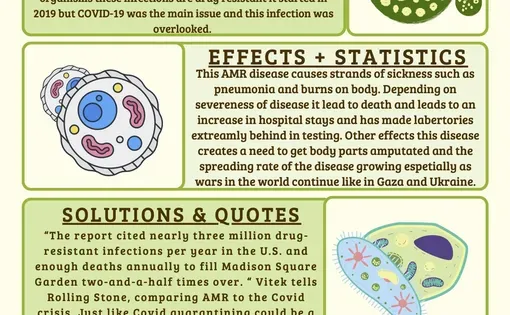
As I hoped, they connected the dots and embraced the concept of reading the World War II text Between Shades of Gray through a global health lens. The Pulitzer Center story “Could a Conflict-Borne Superbug Bring on our Next Pandemic?” by Eli Cahan for Rolling Stone indeed hit close to home, and the students eagerly got to work raising awareness and advocating that more attention and funding be allocated to this issue.
I also knew that many of my students plan to go into science- or health-related fields of study after high school, and I imagined that reading literature through a global health lens would tap into their interests.
The lesson itself was fairly straightforward. After previously emphasizing that Between Shades of Gray novelist Ruta Sepetys sought to bring light to underrepresented history, I eased into the idea that we would continue to explore underreported stories via the Pulitzer Center’s work. Once we reached the point in the novel where characters began to suffer the health consequences of deportation and work camps, I introduced the concept of reading through a global health lens.
Students brainstormed infectious diseases that are most likely to spread during conflicts, reviewed excerpts from the novel in which disease is present, read blog posts about infectious disease spread during conflicts, and studied maps of contagion. Next, they read the Pulitzer Center article, answered content-related questions, and reflected using critical-thinking prompts. Finally, I introduced a global health advocacy project and asked them to bridge the divide between conflict-borne disease from the past with that of the present, as mentioned in the article.
Their reflections offered immediate insight into the power of the Pulitzer Center article. One student reflected, “One concern I have is that people or officials won’t take this issue seriously until it is too late. AMR [antimicrobial resistance} is a threat, and I believe that people who suffer from it or have loved ones who suffered should speak out.” Another student wrote, “I realize that I still have a lot to learn about the world of medicine and how war affects it. Just because a country 'won' a war doesn’t mean that the country doesn’t bear the effects of the war. I learned that disease can escape war and lead to widespread infection if not addressed immediately.”
Many students also reacted with fear, using phrases like, “I am concerned,” “this is scary,” and “it sounds very dangerous.” While fear and concern were common reactions to the article, many concluded their reflections with calls to action. One student wrote, “more needs to be done,” and many others commented on the importance of AMR awareness, screening, and preventive work.
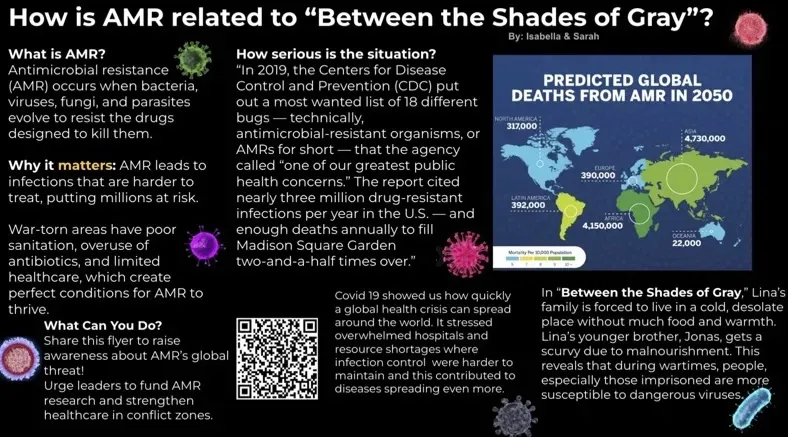
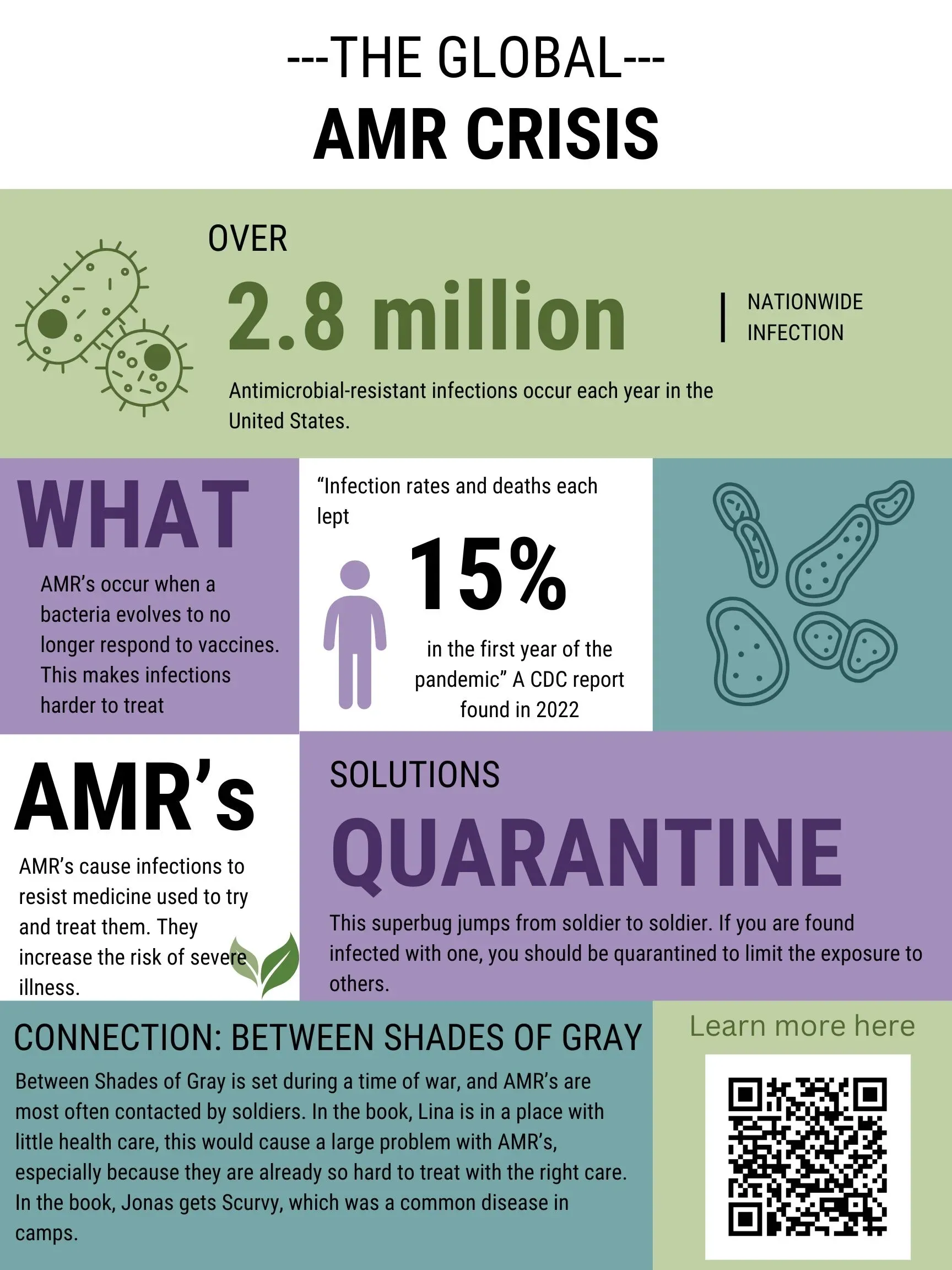
As we moved from education to advocacy, students were offered the option to compose a letter, design a flyer, or record a video. Students worked alone or with a partner, and their products reflect their knowledge, personality, and area(s) of expertise.
One student, upon learning that she could use Canva to create an infographic-style flyer, said, “Oh, this is going to be so much fun. I love creating flyers.” Another student said, “I felt that writing a letter best allowed me to explain the connections I made between the text of Between Shades of Gray and the 'Conflict-Borne Superbug article.'”
Students who worked with a partner found that they developed closer relationships and a sense of community, whether it was because they could teach and learn design skills from their partner or because they had to record multiple takes of a video after catching the giggles mid-video.
When I asked students to “like” and comment on their choice for the top three most effective advocacy projects, I was pleased to see that students made comments that were respectful and truthful. I also enjoyed reading a few young men’s comments on their own muted presentations; they accidentally left their microphone off during their recording and commented on how much they enjoyed the audio portion. There’s nothing like a project with bloopers, outtakes, and a bit of humor. Needless to say, they did indeed re-record their presentation, and the third take was a charm (with a few bloopers mid-video).
Developing and implementing this lesson emphasized that students are eager to learn about real-world, contemporary issues, and are absolutely open to taking a leap from one century to another if the content and task address an important, relevant, and globally significant topic.
I was also gratified to watch my students choose to extend their learning after this global health advocacy lesson. Just two weeks later, I introduced a more involved research project during which students identify and research a person who is making a difference in the world. As I walked around the class, several students shared that they planned to choose a person who is making a difference by advocating for global health in their home country.
As I walk away from this global health unit, I hold onto the idea that, with just a small nudge, students can and will embrace what may seem like unrelated readings. And perhaps more importantly, students welcome opportunities to use their literacy skills to advocate for issues that may first seem shocking and scary, but they feel a sense of satisfaction and comfort when they can get involved and raise awareness about issues that may at first seem out of their control.
As one student most astutely recorded both in his reflection and advocacy piece, “One concept that I take away from reading Between Shades of Gray and ‘Could a Conflict-Borne Superbug Bring On Our Next Pandemic?’ is that we should open our eyes to underreported stories that may affect us in the future.”
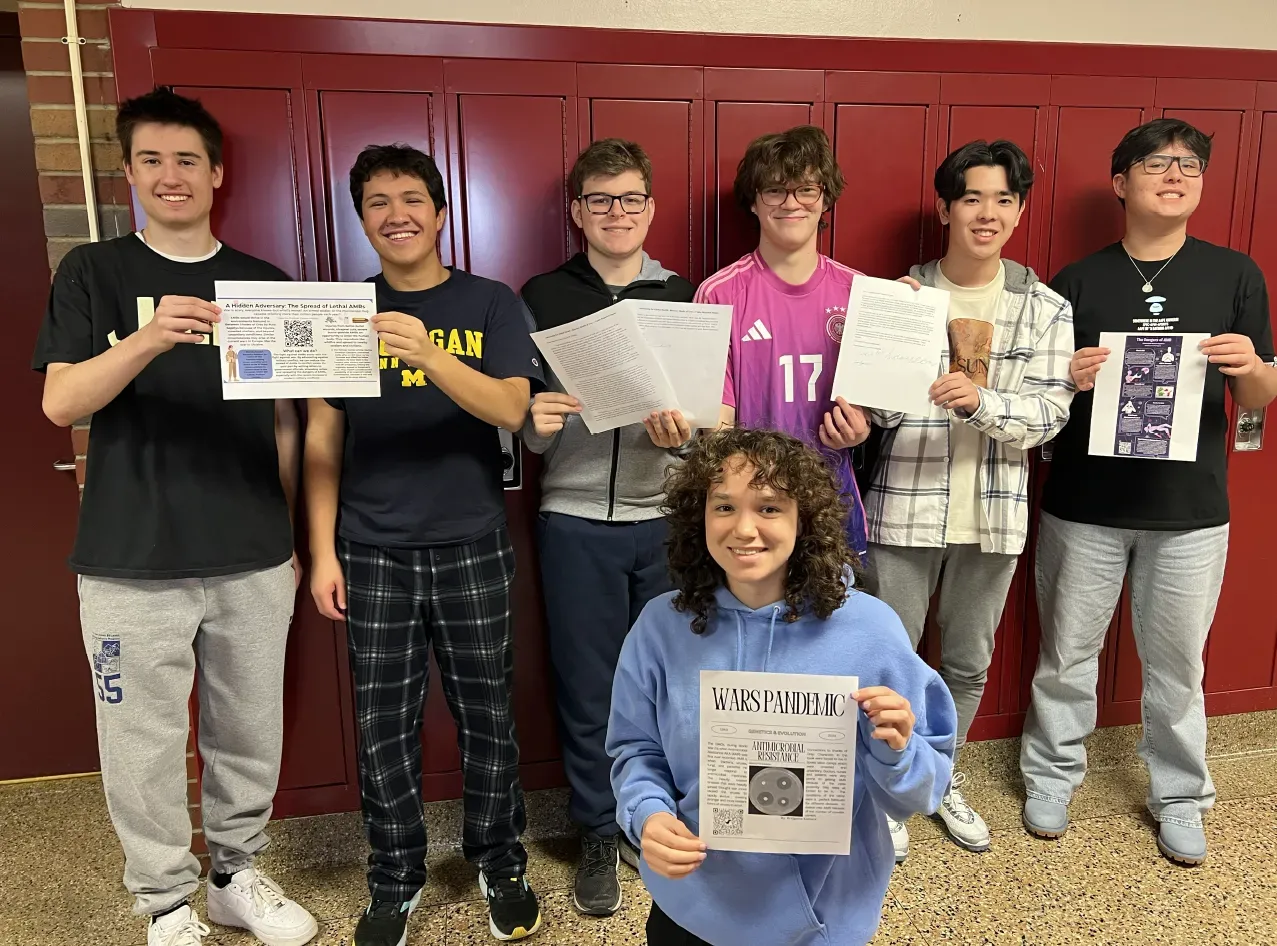
Finally, in a serendipitous moment, it turns out the students read about and created advocacy projects about AMR during the World Health Organization's World AMR Awareness Week. Needless to say, more than 150 World Literature students were surprised and delighted to learn that their work was unexpectedly part of a larger campaign fighting against a global health threat that they had never heard of before.
In November, I hope to introduce 150 new World Literature students to the ways that they can raise awareness about AMR and other global health threats. For, as this unit title points out, “objects in the mirror are closer than they appear.” We hope to make those objects in the mirror disappear entirely.
As part of the fall 2024 Teacher Fellowship program “Making Local Connections to Global Health Stories,” 14 educators from nine states created and taught lessons to engage their over 1,500 students. Click here to learn more about the Fellows and their collective impact.