Story
 July 17, 2026
The Squad of Motorbike-Riding Women Fighting Wildfires in the Jungle
Country:



Orangutans once thrived in the rainforests of southeast Asia; now, numbers have plunged. After over...
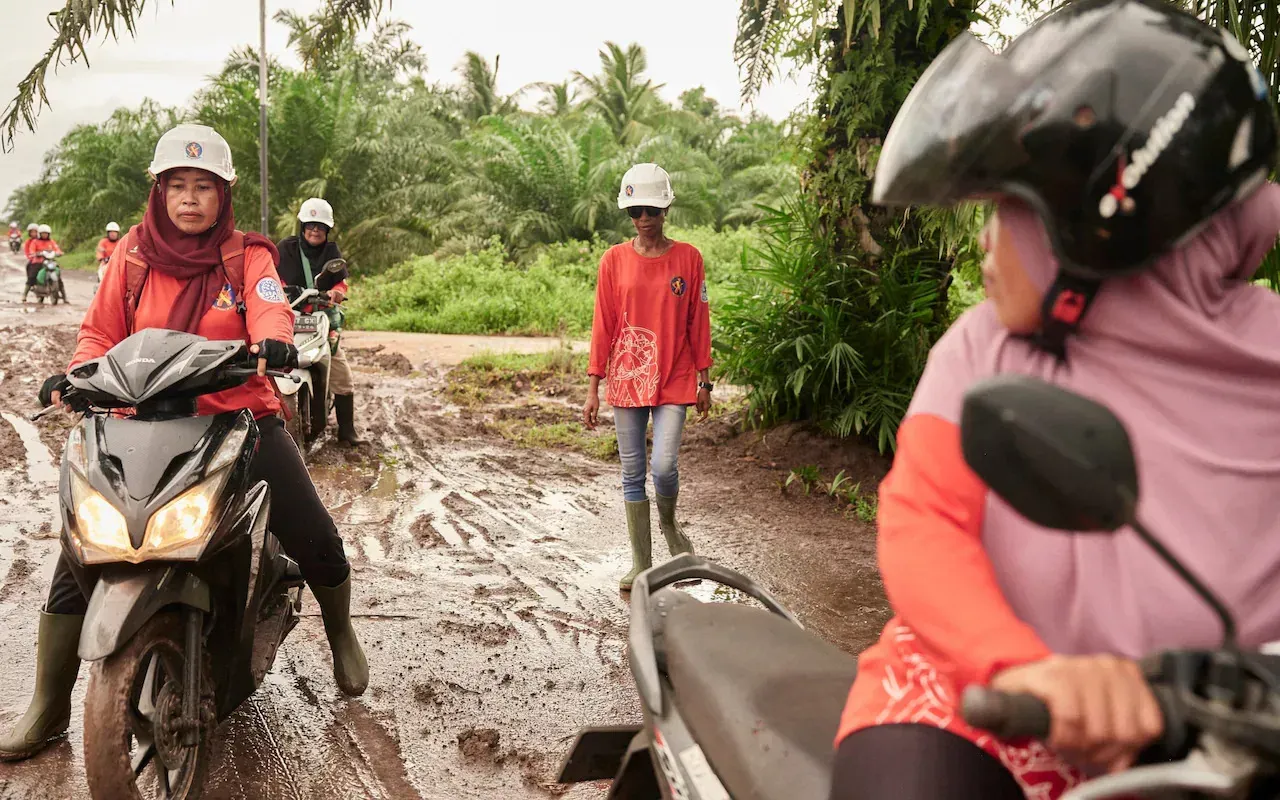
An all-female surveillance team patrol the forest to protect their homes and the environment.
Indonesia’s fires are bad. Siti Nuriani knows this. Seven years ago, a terrible haze suffocated her village in Kalimantan, the southern, Indonesian part of the island of Borneo.
The acrid smoke travelled through the air. It flowed into houses, and wended its way into people’s lungs. For some, things took a frightening turn. The toxic particles exacerbated respiratory diseases: asthma, chronic bronchitis; increased heart problems and cases of cancer.
Siti’s son, then 14, was admitted to hospital with severe asthma. Luckily, he survived, but many didn’t. There were more than 87,000 excess deaths in Indonesia in 2019 due to exposure to the haze, according to one study.

As a nonprofit journalism organization, we depend on your support to fund more than 170 reporting projects every year on critical global and local issues. Donate any amount today to become a Pulitzer Center Champion and receive exclusive benefits!
Now, there are fears another monster fire is about to hit Indonesia. The UN has warned the world to prepare for a Super El Nino which could trigger extreme weather – for example, heavy rainfall in the American south, or drought in sub Saharan Africa – and a shorter rainy season in Indonesia this year and next.
The dry season in Indonesia typically lasts from July to October. But the weather has been unusually dry this March and April.
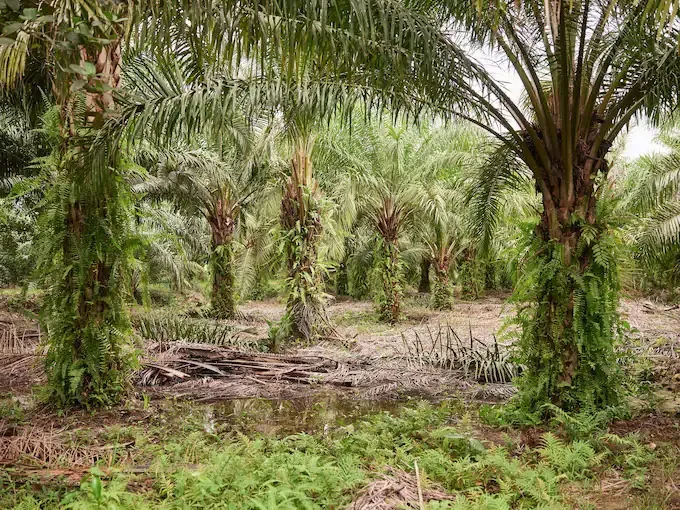
This is a worry because of Indonesia’s highly combustible land. Tropical peatland covers 20.6m hectares or just over 10 per cent of the country. Peatland is usually too wet to burn, but not in Indonesia where it is cleared and drained and dried to grow crops, such as oil palms which make people rich. Slash-and-burn agriculture is a common catalyst of wildfires.
“People don’t realise tropical peatlands are a big feature of our tropics and when those fires get going they’re impossible to put out and they have in the past created a horrible smoke haze over the whole of South East Asia,” said Professor Myles Allen, head of atmospheric, oceanic and planetary physics at the University of Oxford. They also put a lot of carbon in the atmosphere, he added, “which doesn’t help us either”.
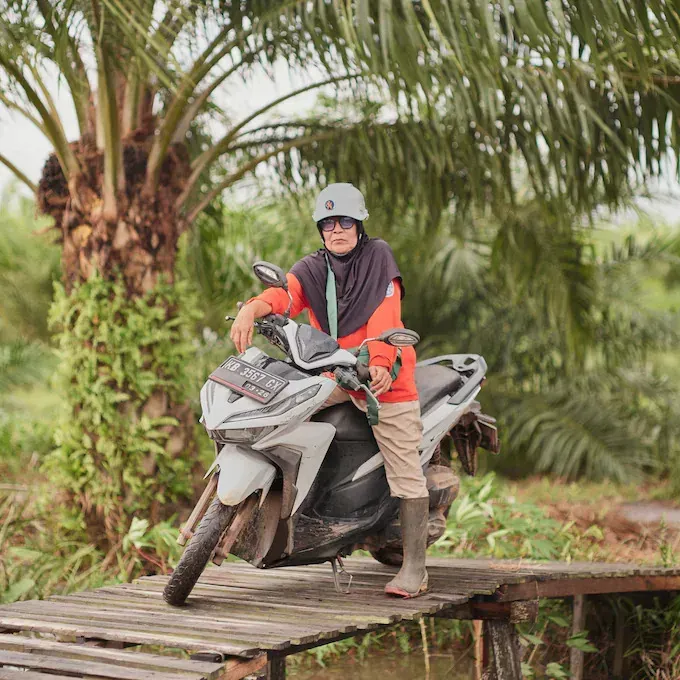
This is why Siti is taking decisive action.
She has joined a surveillance team of 123 local women from eight villages who take turns to patrol the forest on motorbikes to check for wildfires. Now, some are being trained as firefighters.
“The haze shut down airports, closed schools, made people sick, I felt I had to do something about it,” said Siti.
It was a hot morning in October and we were in Siti’s house, which stood out as being larger than most in the area.
Ordinarily, homes in the village of Pematang Gadung, in remote west Kalimantan, did not have space for a motorbike in the living room.
This was the headquarters of the firefighting organisation, known as the Power of Mama. And Siti, a lively woman in her early 50s, was its unofficial leader.
The Power of Mama had brought material benefits to her life: the motorbike, for example, and a smartphone to log data from patrols, but it also appealed to her independent nature. She was a strong believer in the value of education and in the resourcefulness of women. It was a great comfort that her three sons had done well at school: one worked in a palm oil plantation; another for an aluminium company; her youngest was in college.
The main local employer was the illegal gold mine. Even Siti had worked there for a month or so. “A friend told me about it. I was curious to see what it was like.”
It was unbelievably depressing, she said, because she met women who had few other options. “They’d follow their husband to the mine and bring their kids and there is no school there.”
The Power of Mama was a chance to change the narrative about what’s possible in the village.
“The idea is the wives will come back to the village, the kids will follow and they will go to school,” she said.
She rarely mentioned her husband. Only that he’d never learned how to ride a motorbike. “He is scared and not brave enough. I am the only one who can use it.” She was proud of this.
Indonesia is the biggest palm oil producer in the world. At the peak of palm oil expansion in west Kalimantan in 2012, an area of ancient forest slightly less than the size of Greater London was cleared in one year, piling pressure on the region’s endangered orangutans.
Fire is the other reason orangutans are on the critically endangered list.
“One of our main goals is to protect the forest and fire is a big threat to the forest,” said Karmele Llanos Sanchez, from Yiari, the orangutan conservation charity which set up the Power of Mama in 2022, in the belief that “women are central to communities in rural areas and can help change attitudes to fire prevention”.
Wildfires can be divided into two types.
One is a ‘flaming’ fire, which plumes high in the air and consumes trees and plants and just about everything else at great speed.
The second is a ‘smouldering’ fire. This type of burning can happen in the peatland soil itself, spreading deep in the layers beneath your feet. It creeps slowly, smouldering for weeks, sometimes months, releasing clouds of methane, carbon monoxide, ozone and exotic gasses such as ammonium cyanide – the ‘haze’ – as well as very large amounts of ancient carbon stored in the soil.
One type of wildfire can transition to the other. A typical example is where the flaming fire has burned its way through a forest and died out. The danger is over. Except, it’s not.
“It is really hard to extinguish fires in peatland because the fire is underneath the soil,” said Llanos Sanchez. “You don’t see the flames, but it’s still burning. Very often, if there is a little bit of wind, the fire lights up again.”
In 2015 (also a super El Nino year) an area half the size of Costa Rica was destroyed by fire in Kalimantan. The fires were the most severely polluting of this century and affected countries as far away as Thailand and the Philippines.
The flames would have advanced further had it not been for a fire fighting team on duty 24 hours a day for six weeks to stop the smouldering fire from reigniting.
The air in Siti’s house was clearer than during the haze of 2019. “But we experience fires every year,” she said. Her village sits between two large areas of peatland, spanning 27 square miles.
The threat is always there.
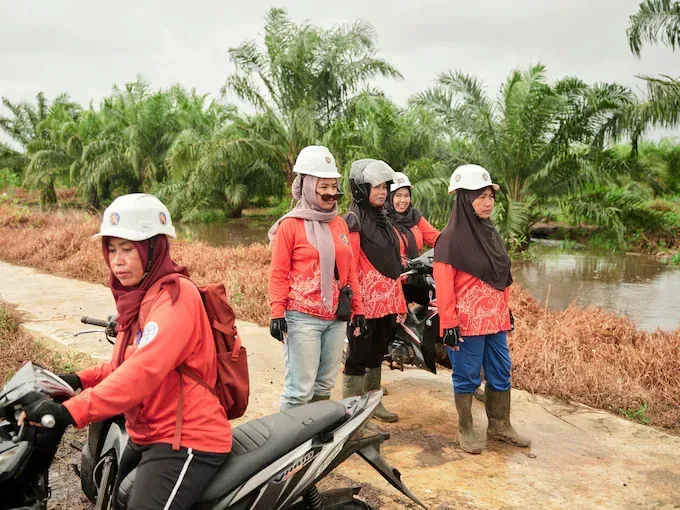
The Telegraph joined a patrol with a group of ten or so ‘mamas’.
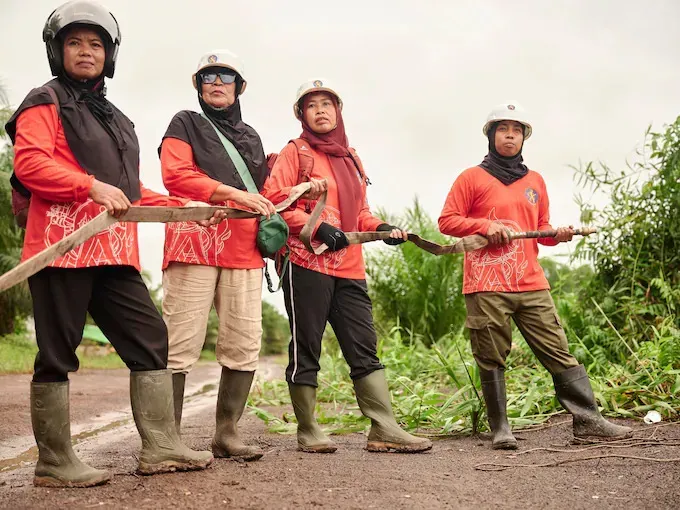
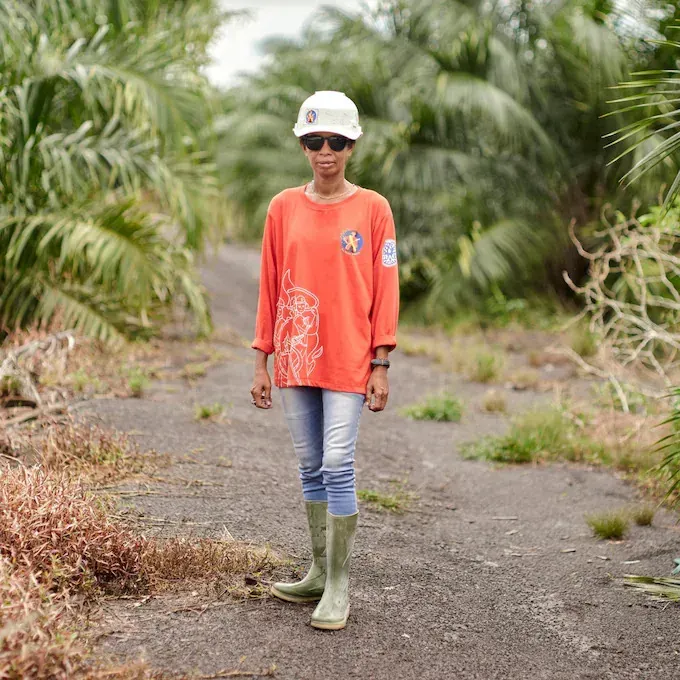
Most were housewives, the oldest was a grandmother of 62, the youngest, 23. They wore hijabs under hard hats and wellington boots.
We rode on motorbikes down tracks and each road opened up new vistas of development: oil palm plantations; wild places filled with downed trees and jagged stumps.
Around one corner we found the track blocked by a mound of palm oil heads: harvest time. Around the next was a large digger churning up sopping peat and allowing its precious moisture to escape in the process.
Maimunah, a 49-year-old housewife in aviator sunglasses, got off her bike to warn its operator of the dangers of peatland fires.
At first, the women were ridiculed when they joined the Power of Mama.
“Men in the village would say: ‘You’re wasting your time and why are you going into the forest? You’re a woman. Don’t you have better things to do?’,” said Siti.
Now, farmers, generally, will listen as they talk about indigenous fire management. Sometimes, they’ll ask the women to wait while they burn the land, just to make sure the fire doesn’t get out of control.
The organisation has a rota system. Women take turns to patrol the forest in pairs. They are unpaid volunteers. But they learn to use drones, smart phones, ride a motorbike – and now use a portable water pump.
“They are being trained for the front line,” said Llanos Sanchez.
“Normally, I’m a housewife stuck at home all day,” said Siska, 42, whose husband spent long periods away in the illegal gold mine, leaving her to care for their three children, aged 25, 17 and 12. “Now I ride a motorbike and meet people. I feel more confident.”