Story
 July 8, 2026
Inside English Football’s Academy System: Where Dreams Meet the Balance Sheet
Country:


Students report on various issues around the world.



Football academies have increasingly become financial assets and mechanisms for generating revenue rather than the development and education of youth players.
LONDON—In England, football is everywhere.
The sport is woven into every thread of daily life: in schoolyards, on street corners, in conversations at pubs, and in the stands on matchdays. You hear it before you see it—the smack of a ball against brick walls, the rattle of metal fences in small neighborhood cages, the shouts of kids pretending to be their favorite Premier League players.
Here, football isn’t something children discover. It’s something they inherit. Weekend plans revolve around fixtures. Allegiances are passed down like last names. And for many kids, the dream of becoming a professional footballer doesn’t feel distant or hypothetical. It feels tangible and achievable.
“I’d always be out when it was light outside, after school, playing football—if I wasn’t playing for whatever teams I was playing for, I’d be in the garden with a net,” Luke Merrill, a former academy player at Manchester United, Manchester City, and Blackburn Rovers, said. “I just got hooked and got obsessed with football at that age. That was my dream.”

As a nonprofit journalism organization, we depend on your support to fund more than 170 reporting projects every year on critical global and local issues. Donate any amount today to become a Pulitzer Center Champion and receive exclusive benefits!
For players like Merrill, the transition from informal football to the professional level begins with the English academy system. This football academy system is the way professional clubs in England develop young players from childhood into potential first-team professional players. Most top clubs will begin recruiting players as young as seven or eight years old, providing these kids with elite training and coaching in the hopes of teaching them the necessary skills, fitness, and tactics required to make it to the professional level.
While many in the academy system primarily framed it as a developmental pathway, rule changes regarding Brexit and cost control have reshaped the way professional clubs approach youth players. Academies have increasingly become financial assets and mechanisms for generating revenue, rather than the development and education of youth players.
From the player perspective, less than 1% of academy players will make it to the professional level. Nevertheless, these rule changes incentivize academies to stockpile hundreds of youth players knowing that only a handful of them will make it professionally. Despite the almost certainty of not making it, many young players feel immense pressure with the quiet understanding of how rare this opportunity is.
Scouting youth talent
Before a child ever puts on an academy kit, someone has already been watching. Ethan Adams, a pre-academy scout for Arsenal FC, is tasked with identifying youth talent in South and West London. Adams often begins watching players as young as five or six years old, before they’re even eligible to sign.
“We effectively scout players who are too young to sign for an academy currently,” Adams said. “But when they’re ready to sign, we want to be on top of the best talent in London.”
Academies are run under the Elite Player Performance Plan (EPPP), which is a framework jointly developed by the Premier League, the English Football Association (FA), and the English Football League. According to these rules, academies can only recruit players within 60 minutes of their training center for the youngest age groups, extending to 90 minutes for players 12 years and older. The plan is meant to protect children’s education and well-being from excessive travel demands.
For Arsenal, that catchment area stretches across one of the most densely talented football regions in the world. Adams explains that within London’s seven Category One academies—the FA’s designation for the highest funded and well-resourced programs, including those of Chelsea, Tottenham, Crystal Palace, and Fulham—are competing for the same pool of local talent.
“We fish in a really rich pond with a lot of fish, but there’s an awful lot of competition,” Adams said. “Chelsea offers fully paid private school education for kids that sign for their academy. Arsenal don’t have the budget to do that, so with different resources we’re competing for the same talent.”
At such young ages, Adams explains it’s less about finding the finished project than reading potential with nuance. Physical development can be misleading. A child with an early growth spurt may dominate a match not because of talent, but simply because he’s bigger than his peers. A seemingly average player, on the other hand, may have started playing football mere months ago.
“Context is massively important,” Adams said. “A big part of my job is talking to coaches and parents to find out the background of this player.”
Adams adds that attitude is an attribute that matters just as much as ability.
“If they make a mistake and their head drops straight away, that’s probably not a good sign in terms of wanting to play at the very highest level in the future,” he said.
Unpredictability of the system

For those fortunate enough to make it inside the academy system, the unpredictability of success is a common theme. An academy coach from Manchester, who has worked in youth football for nearly three decades, highlighted how randomly and rarely opportunities arise. He has agreed to speak on condition of anonymity given the sensitivity of his role at a top-flight club.
“It’s a crystal ball,” he said. “Everything has to align for that player. It’s kind of like the 1% of the 1% that make it.”
He referenced Marcus Rashford as a case study in the random variables that can determine a career. Rising through the ranks of Manchester United’s academy as a teenager, Rashford made his first team debut at 18 only because injuries had decimated the senior squad—a series of events that was entirely out of his control.
“He wouldn’t have got a shot at the first team unless they were ravaged with injury. So, he took his chance, took his opportunity, and now he’s playing for Barcelona,” he said.
Starting as a youth player who potentially never would have gotten his moment, Rashford has gone on to become one of England’s most notable footballers.
When scouting youth talent, the Manchester coach reveals what he looks for above all else is for something he calls a “super strength.” One quality that sets a player apart from their peers.
“Are they brilliant dribbling the ball? Electric in terms of their pace? Very technical, looking to receive the ball and turn and make passes?”
The key to developing talent is identifying what a player does better than anyone else and then building around it.
He also notes where players come from. In his experience, kids from more densely populated urban areas carry something that is harder to coach than technique.
“Street football’s hard. There’s no parents there to watch. If someone fouls you, you have to get up and get on with it. It’s just a different kind of beast,” he said.
Players that grow up in these urban environments who compete in neighborhood football cages from an early age, often develop a toughness and technical sharpness that structured training can’t fully replicate.
The Manchester coach likened it to South American football.
“You find the same in Brazil and Argentina with the favelas. Football is their escape and it’s their life. They’re just literally playing as much as they can, no rules, it’s just street football,” he said.
But that grit and determination come at a cost. In many instances, kids carry the weight of making the most of their talent and opportunity.
“The pressure on these children, especially at the top clubs, it’s not a nice environment,” he said. “I’ve seen parents shouting at their kids in a car park after a game because the kid hasn’t done as well as they normally would. There’s a lot of pressure from parents now if they think their kid’s got a chance. It’s the horrible side of the game.”
In his opinion, contracts and commitments come far too early.
“I actually think they sign too young. I don’t think they should sign until maybe under 12 or under 14. I think they should still be kids,” he said.
Financial changes and effects
To understand why the academy system has evolved in the direction that it has, it’s critical to understand the financial motivations behind it. Kieran Maguire, a professor of football finance at the University of Liverpool and author of The Price of Football, is one of Britain’s leading voices on the economics of the game.
The shift in the academy system can be traced to two converging pressures. The first was Brexit. Before Britain left the European Union, clubs could recruit players from across Europe at any age. Post-Brexit, foreign players can no longer be signed before the age of 18. This single change exponentially increased the value of homegrown youth talent.
“The value of child talent in England, Wales, and Scotland has gone up, because you now want to make sure that you get the best of the young domestic talent, and you’re going to fight,” Maguire said. “There are scouts who will go to watch under-10, under-11 matches. You try to poach the talent. You’re not supposed to offer financial inducements, but they do.”
The second pressure resulted from cost control. In 2013, English football introduced financial regulations, which later became known as Profit and Sustainability Rules (PSR). These regulations were designed to prevent clubs from spending far beyond their means. Under these rules, clubs will face points deductions or other sanctions if their losses exceed certain thresholds. Academy players, as it turns out, are one of the most efficient ways to generate the profit needed to stay compliant.
“If you are selling a player who has come originally from the academy, profit is the sale price less the book value,” he said.
Unlike a player bought from another club, where the purchase price is subtracted from any future sale, academy players cost nothing to acquire.
“You don’t actually pay a transfer fee for an academy player,” Maguire said. “So therefore, when you sell academy players, you get pure profit. If I sell for 40 million, I get 40 million profit.”
A textbook example is Cole Palmer. The midfielder who joined Manchester City’s academy at the under-eight level was sold to Chelsea in 2023 for £40 million.
The academy coach from Manchester described a similar practice.
“Players will definitely get put in games just to put another zero on the end, just to sell them for profit,” he said.
The result is a fundamental shift in how academies see themselves. Once a place to nurture and develop players, academies now serve as a profit center for the club as a whole. Maguire also notes the important detail regarding academy costs being exempt from the very cost controls that are meant to rein in club spending.
“You can spend more and more on your academy, and that’s not going to impact upon a potential points deduction or other sanctions from the governing authorities. So there’s always a case for expanding your academy as much as you can,” Maguire said.
The statistics
The logic of spending freely, recruiting widely, and hoping a handful of players emerge as stars has a serious adverse effect on the kids swept up in it. Maguire frames it simply.
“If you’ve got a 0.5% success rate, if you recruit 50 kids, 0.5% of 50 is a quarter of a player. If it’s 200 kids, it’s one player. So there is an incentive for clubs to recruit,” Maguire said.
Maguire recalls asking an academy manager what clubs do with players they know won’t make it.
“His reply was, ‘We keep the others on, even though we know they’re not going to make the grade because you still need 10 players to be alongside the best kid in training,’” Maguire said. “Those children still forgo their education, their social development, all while the clubs know—nice kid, good footballer, but you need to be more than a good footballer to become a professional.”
Adams believes Arsenal attempts to be honest with players about their chances and doesn’t hold players purely for training numbers.
“We try to be really open and honest about where players are at, what future we see for them,” Adams said.
However, he acknowledges that sometimes there is competitive pressure to keep borderline players on.
“It definitely happens,” Adams said. “Hopefully the communication is right so that we set expectations and we’re not going to crush dreams later on.”
The cost to youth
The effects of this system on children extend far beyond just football. Maguire discusses research suggesting that children who join academies tend to enter above the national average in academic performance and leave below it.
“Every child that joins an academy wants to be a professional footballer, and therefore they will focus more on football and less on education,” Maguire said. “And that might be encouraged by their parents. Some parents might say: He’s going to be a professional footballer, he doesn’t need to worry about school.”
The social cost of the academy system compounds over time. Knowing that less than 1% will succeed, academy players sacrifice friendships, healthy social lives, and educational focus to try to gain a competitive edge. And if they very likely won’t make it, they exit academies without important skills and experiences. Maguire references research that shows elevated rates of depression, divorce, and financial distress among retired professional footballers, which he links to a system that encourages players to think about nothing but football.
The academy coach from Manchester has seen the mental health effects firsthand. He believes release players can struggle immensely and the game still doesn’t do enough on the psychological side.
“There’s not enough done to help these kids mentally when they don’t make it. There has to be a different avenue to help them,” he said.
At top clubs, he mentioned 11-year-olds with football boot deals from global sportswear brands, and 17-year-olds earning hundreds of thousands of pounds who have yet to make a first team appearance. When young players are given such significant wealth and online attention, it becomes a distraction from getting the player to the highest level.
“We give them too much too young. There’s too much money involved,” he said.
A player’s perspective
For Merrill, football was more than just a neighborhood game. Growing up in Manchester, it was an obsession that started at home and has followed him through his life.
Merrill’s path through the academy system began the way it does for many promising youth players in the northwest of England, through a grassroots club with ties to a bigger one. His local Sunday league team, Fletcher Moss Rangers, had an informal link with Manchester United. This kind of feeder arrangement allows scouts to keep an eye on standout kids with the goal of moving them up to the United academy program. Merrill was one of them.
By the time he was old enough to sign at eight years, he was in United’s system.
He would spend the next eight years moving through three academies—United, then Manchester City, then Blackburn Rovers—before making the decision at 16 to step away from the professional pathway and focus on higher education. He spent nearly a decade of his childhood in England’s most recognized youth programs, without ever making it to the first-team level.
“It was more about working for that next contract,” Merrill said. “It was almost a survival of the fittest sort of thing.”
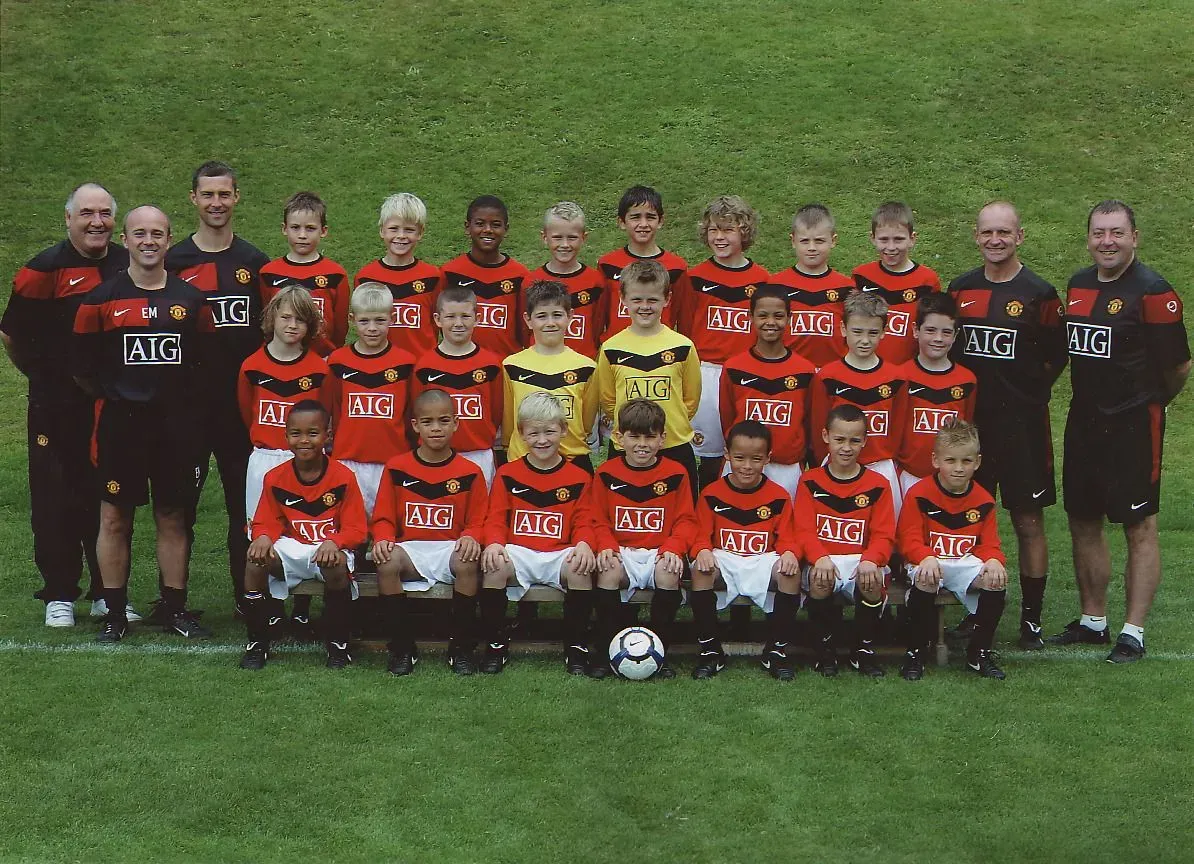
United’s squad was bigger than most at that age, with around 20 players where other academies might field around 15. To manage the numbers, they would often put out two teams on a weekend. But when opponents couldn’t facilitate two separate games, it was the players like Merrill at the bottom of the pecking order that missed out. Development, he found, favored those already at the top.
Merrill was released by United at 10 years old, when his two-year contract wasn’t renewed.
“What you’re hearing, especially as a 10-year-old, is they don’t think you’re going to be good enough to be a professional footballer,” Merrill said. “It’s almost like them shutting down your dream, or crushing your dream, really, in your eyes at that point.”
He moved across town to play for Manchester City, which was a club in transformation. Newly infused with Abu Dhabi investment, the club was beginning to find its footing as an elite academy.
At City, training intensified and the pressure sharpened. A day-release program meant players could miss school once a week to spend the day at their club’s training ground. And every weekend fixture carried weight that went far beyond the result.
“Football dictated my mood,” Merrill said. “Football’s going well, I’m in a happy place. Football’s going badly, I’m mentally not very happy, or feeling anxious. Because that was kind of my life.”
He described the internal calculations that came with every match. It wasn’t just whether he played well, but how he played relative to teammates and opponents. It was about whether the coaches were watching, and ultimately where he sat in the invisible pecking order that determined who stayed and who didn’t.
“You’re competing for a contract at the end of that season,” Merrill said. “It’s not just about how you’re doing. It’s also what are the other kids doing? Are they doing well? And it’s almost like working out in your head where you are in this pecking order.”
Despite his several years spent inside the academy system, Merrill explained that nothing much was done to address life outside of football at the three clubs he played for.
“There’s a lot more that could be done. There’s definitely a duty of care when you’re looking after young kids,” he said.
After Merrill’s under-13 year at City, his contract wasn’t renewed. He moved to Blackburn, his father’s club, and continued until he was 16. The slide down the ladder was something he was aware of, even if he tried not to dwell on it.

“The proof is in the pudding when you play those fixtures,” he said. “When I moved to Blackburn, we’d win a lot less games than when I was at City. It’s the better teams that often win those games, you’re definitely aware of it.”
At 16, with his national exams approaching and a realistic outlook on where things stood, Merrill made a choice that most academy players are unable to make on their own terms—he walked away.
A system at a crossroads
“I think the academy system can definitely be a plus—the commitment it takes, the fact that you’re sacrificing weekends or nights out with your mates, it teaches you valuable skills for future life,” Merrill said.
“But I think that’s not always the case for everyone,” he said. “If you’re not naturally academic, if your parents don’t come from that background, and you let that fall to the side. If you don’t make it, you’re left with no football career and not particularly set up for a career in something else. That’s when it becomes a major issue.”
The gap between what the academy system promises and what it delivers is something the academy coach from Manchester has sat with in his nearly three decades of experience.
“For me, you’re developing people. You’re not just developing football players. [The goal should be] to create a better person, rather than a better player,” he said.
His philosophy is one that is rooted deeply in care and the belief that clubs have an ethical and moral responsibility to children. However, as Maguire warns, this responsibility becomes increasingly difficult to honor when finance is driving the decisions.
With 25 Category One academies now in England, and academy spending exempt from the financial regulations that govern every other area of club expenditure, the framework of the system makes expansion not just optional but rational. The math is simple: the more children recruited, the greater the chance clubs will have a player that makes it to the professional level, who can ultimately be sold for pure profit on the balance sheet.
For those who don’t make it—and almost all won’t—the consequences can be lasting. Formative years spent pursuing a dream that didn’t materialize equate to sacrifices in education and social development that leave many former academy players poorly equipped for life outside the game. Seemingly, that is the cost of doing business. Clubs move on quickly, and the next generation of potential academy players are already being watched.
“If you’re in, you should be all in,” Merrill said. “But if you’re not doing it 100%, you are better off just probably doing something else and enjoying your spare time. It’s not something you could do half-heartedly. But, if you can look back and say you gave it your best shot—that’s never a waste of time.”
Whether the system can be reformed, or whether the financial incentives are now simply too ingrained to shift, remains an open question. Meantime, what is not in question is who bears the cost when the system fails.