
How expectations can shape what adulthood looks like for girls.
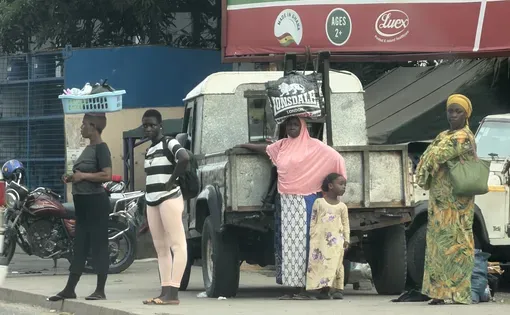
Dust clung to my shoes and ankles as women and girls moved quietly toward the stream with buckets balanced on their heads. It was early morning, the hour before the day’s heat settled fully into the air in Doboro, Ghana. Roosters called from somewhere in the distance. Children ran barefoot between chores and play, their laughter cutting through the steady hum of insects waking with the sun. Some followed behind their mothers with smaller containers, learning the rhythm of responsibility before they were old enough to question it.
Watching them, I was struck by how familiar the scene felt.
Not because I had grown up in a village like this, but because I had grown up understanding what it means for childhood to carry adult weight too early. I am a Black woman who grew up low-income, and my earliest memories include seeing women who looked like me spoken about with a kind of casual cruelty. Young mothers were whispered about. Women with multiple children were judged. Some were labeled as prostitutes or dismissed as irresponsible. Society told a story about Black women that had little to do with the realities of our lives. It was a myth that Black women were hypersexual, that we had too many children because of reckless desire, and that early motherhood was evidence of moral failure rather than structural neglect.

As a nonprofit journalism organization, we depend on your support to fund more than 170 reporting projects every year on critical global and local issues. Donate any amount today to become a Pulitzer Center Champion and receive exclusive benefits!
Those narratives were everywhere in the communities I grew up around—in classrooms, in media, and in policy conversations that treated Black women’s lives as statistics instead of stories.
Being in these villages in Ghana to report on the poverty-to-pregnancy pipeline forced me to confront those myths in real time.
The girls I met in Ghana had their own moral codes, their own belief systems, and their own understanding of responsibility. They were not reckless, and they were certainly not immoral. They were just surviving, as their mothers and grandmothers had survived, inside a system that gave them very little room to choose differently.
Their days were filled with labor that was both necessary and invisible. They carried water, tended crops, cooked meals, washed clothes, and cared for younger siblings and children of their own. Many learned herbal remedies for illness and childbirth from older women in their households before they learned anything formal in a classroom. Knowledge in these communities was passed down through lived experience, through observation and memory, and through traditions that had sustained families for generations.
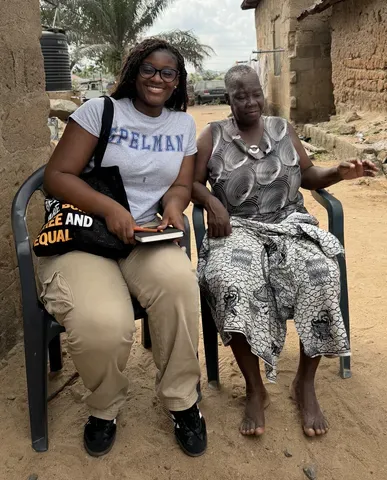
Motherhood was woven into daily life in a way that was both ordinary and immense.
Women gave birth and returned to work within weeks, instead of going to school, because survival required it. Food still had to be grown. Water still had to be collected. Children still had to be fed. The body rested only if the household could afford it—and most could not.
Watching this, I was reminded of what I had witnessed growing up in low-income Black communities in the U.S. and the assumption that girls would inevitably fail, that their futures would be defined by motherhood alone. This was never the full truth. That story erased the systems that shape those outcomes. Poverty narrows options long before personal decisions are ever made. Geography limits access to schools and hospitals. Infrastructure determines whether information about reproductive health reaches a village or remains a rumor carried by word of mouth.
In the evenings, when the day’s labor slowed, the village shifted. Music carried through the air, sometimes from a drum, sometimes from voices rising together in song. Children gathered in open spaces to invent games from stones, sticks, and imagination. Elders told stories under the shade of trees. Laughter moved easily through compounds that, by outside measures, had very little. These moments mattered because they complicated the narrative of deprivation that so often defines how rural communities are portrayed.
That tension stayed with me throughout my reporting: the coexistence of scarcity and abundance, of structural barriers and human strength. It reminded me that telling this story required care. Communities like Doboro are often spoken about as problems to be solved, as places that must be transformed or pulled into modern systems in order to be saved. But many of the people I spoke with did not frame their lives that way. They valued their traditions, their relationships with the land, their spiritual beliefs, and their ways of caring for one another.
The goal, then, is not to erase those systems or force communities back into a version of society that may not reflect their values. The deeper question is whether girls who grow up here are given the resources necessary to expand their choices.
Because geography should not determine whether a child has access to education. Poverty should not determine whether a young mother can return to school. Distance from a hospital should not determine whether childbirth is safe.
What carried me through this reporting was the understanding that this story is not confined to one country or one culture. Wherever poverty intersects with limited access to education, healthcare, and economic opportunity, childhood becomes shorter, and responsibility arrives earlier. Girls learn to navigate survival long before they are given the chance to imagine different futures.
My heart in this reporting is rooted in a simple belief: Survival should not be the ceiling of a girl’s life.
Girls deserve the time to remain children long enough to imagine who they might become. They deserve the resources that allow opportunities to exist alongside tradition rather than in opposition to it. And they deserve a world willing to see them fully and not as statistics or stereotypes, but as people whose futures are still unfolding.