

For the better part of 15 years the Yukon River Chinook salmon stock has been in significant decline...


The conversation at the Octagon was driven by the Porcupine River caribou herd. Studying it. Managing it. Protecting it. The Porcupine River herd was last counted in 2001 and is being counted as I write this in early August. I had never considered how to count a wide-ranging herd of large animals such as caribou; the method's simplicity surprised me.
The caribou are photographed from small airplanes; these photos are then pieced together and the population is estimated from counting the animals photographed. Taking a census from the photos doesn't sound like an activity I'd ever engage in willingly. At last count, the herd was figured to be 125,000 strong, but on a slow and steady decline. Rough estimates for 2010 put the total between 90,000 and 100,000. These numbers come from the Porcupine Caribou Management Board (PCMB) which is comprised of members of tribal, state and territorial governments in the Yukon, Northwest Territory and Alaska.
In response to the herd's declining size, the PCMB established a rough guidelines for caribou hunters. When the count is greater than 115,000 animals, native hunters face no restrictions and non-native licensed hunters are allowed two "bull tags," or male caribou hits, per year. When the herd is between 80,000 and 115,000 strong the PCMB sets a voluntary bulls only restriction upon native hunters while others are allowed only one bull. When the population dips below that, the bulls only restriction applies to all hunters. If the herd ever falls below 45,000 animals, no hunting is permitted.
On the surface, this plan makes sense. Some may disagree over specifics, but it sets guidelines to follow under a range of circumstances. Yet the state of Alaska hasn't agreed to the PCMB's harvest plan. Unit 25, a district encompassing the Yukon Flats and southern portion of the Arctic National Wildlife Refuge (ANWR), allows resident hunters to harvest 10 animals and non-residents one in all areas but the unit's extreme southern portion, according to the 2010 edition of the Alaska hunting regulations. There, the Fortymile caribou herd roams and all hunters are allowed one animal.
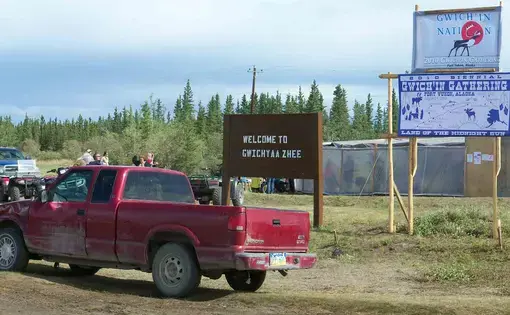
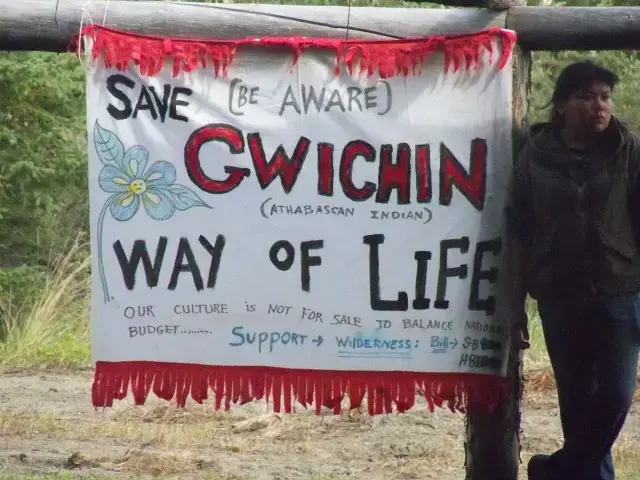
Some sort of agreement needs to be reached. The prevailing sentiment at the Gwich'in Gathering, a group established to protect the caribou's coastal plains habitat, especially among those associated with the Gwich'in Steering Committee, was frustration towards the Alaska Department of Fish & Game (ADF&G) for contradicting the PCMB's plan. I have yet to reach anyone in ADF&G who could speak to the issue.
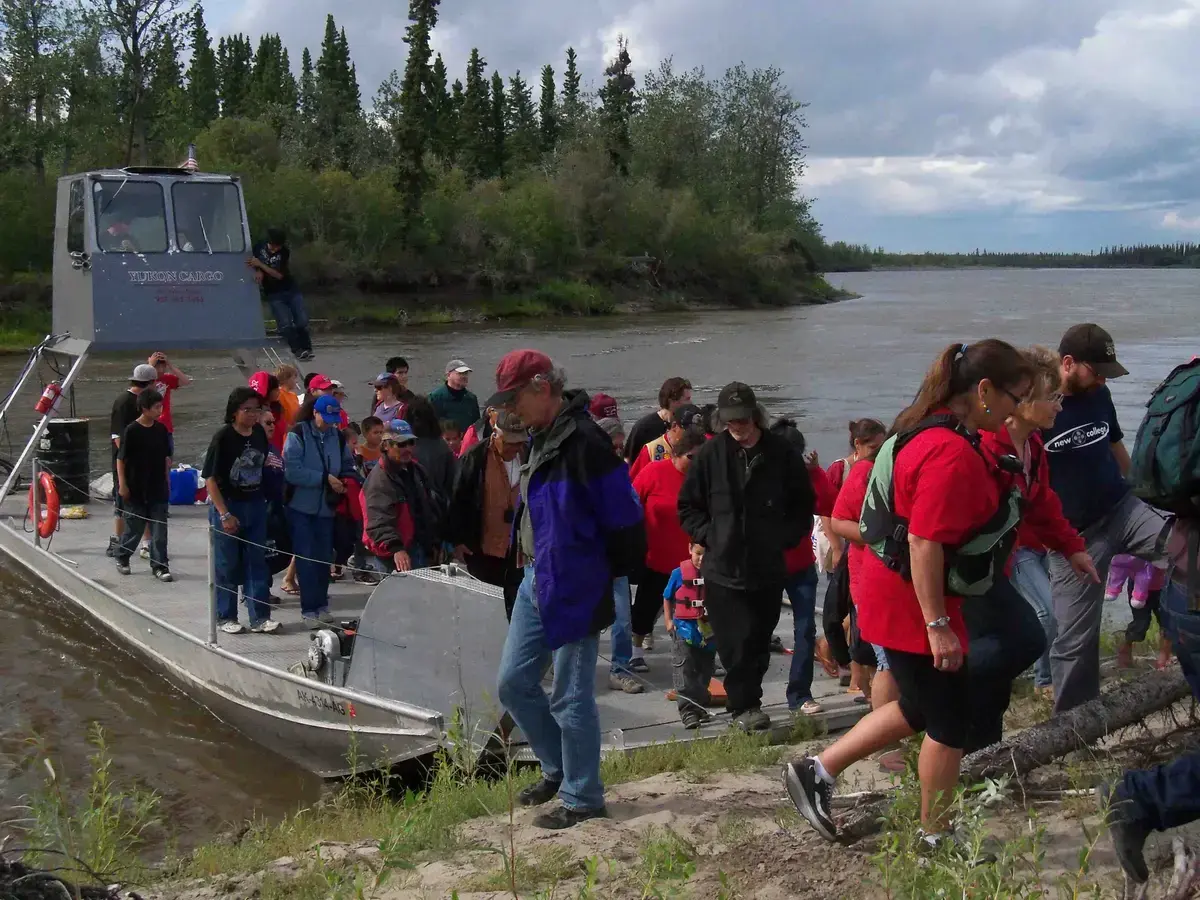
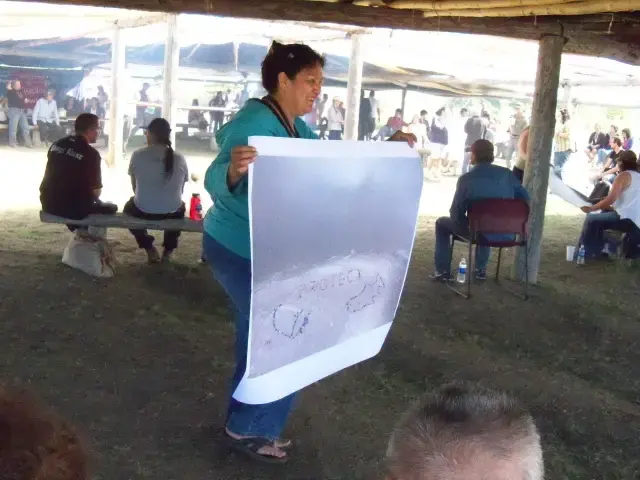
There was a strong consensus at the Gathering upon the necessity of preserving the Porcupine River herd as well as the Yukon River salmon. In an effort to publicize their cause, John Quigley, a Native rights activist from St. Paul, MN, organized a demonstration on a gravel bar at the mouth the Porcupine River a couple miles downstream from Fort Yukon. People from the Gathering, dressed in red, packed onto Dave Solomon's barge and set afloat on the Porcupine. On the bar, Quigley arranged the 150-odd people to form the shapes of a caribou antler and a salmon, and to spell out "PROTECT."
About the time everyone was in place, a helicopter arrived and began snapping photos of the protest. I couldn't help but wonder if the time and money spent on the exhibition could have been better spent to serve their cause in other ways, but it was an attractive display, nonetheless.