Story
 August 11, 2026
Alabama's Death Penalty, Part 2: The Pastor Who Stands With Condemned Inmates at the End
Country:

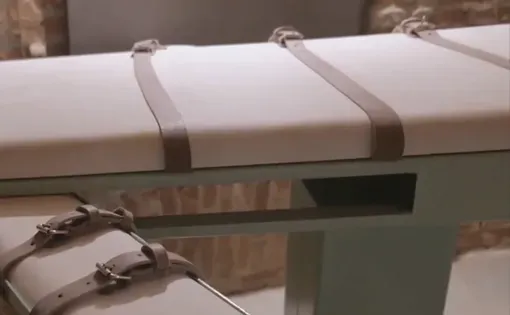
Alabama remains one of the nation’s most active death penalty states, yet many residents know little...
When the trials have ended, the appeals are exhausted, and an execution date is set, only a small number of people are allowed inside the execution chamber.
Among them is Rev. Dr. Jeff Hood.

As a nonprofit journalism organization, we depend on your support to fund more than 170 reporting projects every year on critical global and local issues. Donate any amount today to become a Pulitzer Center Champion and receive exclusive benefits!
For the past 15 years, Hood has traveled to prisons across the country, ministering to men on death row and accompanying many of them during their final moments. He has witnessed 12 executions, including several of Alabama's most closely watched cases.
His role is neither to determine guilt nor innocence. It is to offer prayer, comfort, and the assurance that no one dies alone.
In the second installment of ABC 33/40's four-part investigative series on Alabama's death penalty, we step inside one of the most restricted spaces in the criminal justice system through the perspective of a man who has stood only feet away from condemned inmates as they took their final breaths.
A Ministry in the Final Hours
Hood says the emotional weight of witnessing executions never fades.
During each execution, he remains near the inmate—often holding a hand or resting a hand on a leg while praying throughout the process.
Although each inmate arrives with a different life story and different crimes, Hood says the atmosphere inside the execution chamber becomes remarkably similar when death is only moments away.
"The legal process is over," he said. "What's left is a human being facing the end of life."
Over the years, Hood has ministered to hundreds of incarcerated men. Some admitted responsibility for horrific crimes. Others maintained their innocence until the end.
Regardless of their circumstances, he says those final conversations often center on family, forgiveness, fear, faith, and hope—not the crimes that brought them there.
Witnessing the Weight of an Execution
Hood describes executions as experiences that stay with everyone in the room.
While he believes his responsibility is to provide spiritual care, he acknowledges carrying a complicated emotional burden after every execution.
He says he leaves knowing he offered comfort to someone in their final hours, but also wrestling with the reality that he witnessed a life come to an end.
His experiences have shaped the way he views capital punishment—not simply through the lens of the condemned, but through its impact on correctional staff, witnesses, victims' families, attorneys, clergy, and everyone involved in the process.


Inside Alabama's Nitrogen Gas Executions
Hood is also among the few people who have witnessed Alabama's executions using nitrogen hypoxia.
He was present during the state's first nitrogen gas execution and later described what he observed while serving as a witness.
His account has become part of the broader public debate over Alabama's execution protocol as courts, attorneys, medical experts, and policymakers continue examining the method.
Supporters of nitrogen hypoxia argue it provides a constitutional means of carrying out lawful death sentences when other methods have faced legal and practical challenges.
Critics question whether the procedure can be carried out humanely and have cited eyewitness accounts, including Hood's, in ongoing legal challenges surrounding the state's execution practices.
Those competing perspectives continue to shape one of the nation's most closely watched debates over capital punishment.
A Question Beyond the Execution Chamber
For Hood, the central question extends beyond the person strapped to the execution gurney.
After years of accompanying condemned inmates during their final moments, he says he believes society must also consider what executions mean for those who witness them and for the communities they serve.
Whether someone supports the death penalty or opposes it, Hood says the conversation ultimately becomes one about justice, humanity, and the values a society chooses to uphold.
His question is simple but profound:
At what cost? Not just for the condemned—but for us. Who do we want to be?
Coming Next
In Part Three, we move from the execution chamber to the courtroom, examining the constitutional challenges surrounding Alabama's use of nitrogen hypoxia. We'll explore the legal arguments from both sides, the court decisions that allowed the method to move forward, and why Alabama's execution protocols are now influencing conversations about capital punishment across the nation.
Join me, Ashonti Ford, as we continue this in-depth examination of Alabama's death penalty system and the questions shaping its future.