By Collin Kim
10th grade | Harvard-Westlake School | California
First place contest winner, Peace and Conflict category
With lines from “What Japan’s Atom Bomb Survivors Have Taught Us About the Dangers of Nuclear War” by Scott Michels, a Pulitzer Center reporting project
The morning begins like any other.
Words flutter like cicadas, homework unfinished.
Michiko, sixteen, straightens her fuku collar.
They split the sky open.
Shattering cloudless blue over Hiroshima.
Time divides: before, after.
The sunny morning turns
into a tempest of devastation.
The ordinary becomes impossible.
Papered sakura burns. Skin burns away Ikigai.
Generations of stone burn. Young metal burns.
The water whispers death.
Children drink by the Ōta River.
No one tells them it’s lethal.
No one knows what radiation is
Survivors rebuild their lives inside
disfigurement, radiation
sickness and severe social stigma.
Hibakusha rekindle their purpose in isolation,
reminding others
what everyone wishes to forget.
The bomb’s long-term effects
not acknowledged
by the authorities for years.
The survivors form associations.
The survivors document every death.
The survivors preserve every testimony.
Masako Wada grows old
as she testifies. We still have two
major demands, she tells the world.
Abolition and acknowledgment—
twin impossibilities they pursue
through seven decades of silence.
The survivors gather at memorials
dwindling in number each year.
Time claims what bombs did not.
There may come a day
when no one is left
to tell the stories firsthand.
Memory becomes an archive.
Archive becomes history.
History becomes another story.
Twelve thousand suns
stand ready to erase powerful cities,
erasing Hiroshima.
The past and future
face each other
across a vanishing present.
Across the ocean, men sing.
They finalize calculations, fueled planes.
They set military objectives.
with a successful detonation
They end the war decisively.
History divides: Before. After.
A single B29 looming
at 31,000 feet, uncontested sky.
In seconds, the impossible becomes ordinary.
Parameters within expected range.
The fission yield matches predictions
of radiation dispersing with calculated precision.
Photographs document the fact
the mushroom cloud maintains perfect form.
yet. Scientists study initial exposure effects.
Official reports classifying
casualties—necessary,
they claim, for greater victory.
as test subjects provide valuable data
about radiation exposure—
advancing our glimmering understanding.
Military intelligence analyze
by long-term strategic advantages,
by nuclear weapons in development.
The engineers improve designs.
The missiles replace bombers.
The warheads multiply in silos.
Generals grow old planning,
defense contractors grow rich with
next-generation weapons multiplying.
Deterrence and advancement
twin necessities they pursue
through seven decades of tension.
While officials gather at briefings
increasing in urgency each year.
Time reveals what war conceals.
there will come a day
when everyone alive has forgotten
The warnings.
Strategy becomes doctrine.
Doctrine becomes inevitable.
The inevitable becomes another story—
waiting in storage around the world
each more powerful than the one
destroying Hiroshima.
and the future and past
mirror each other
in perfect, terrible symmetry.
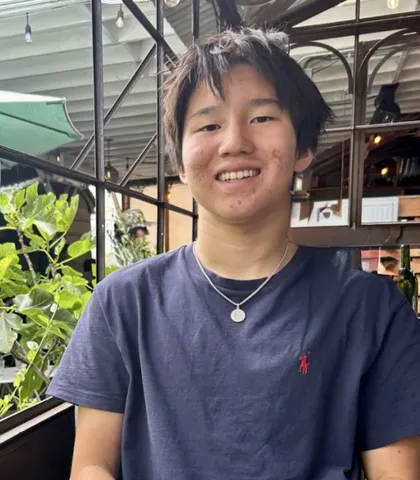
Collin Kim is a rising junior at Harvard-Westlake School in Los Angeles, California. When not immersed in his highly caffeinated school life, he is an avid surfer and violist, enjoys reading and editing submissions to the multiple literary magazines he is involved in, and of course, writing. He enjoyed responding to Scott Michels' reporting on Japan's atomic bomb survivors and the ongoing dangers of nuclear war while figuring out the enigma of writing his first contrapuntal style piece, in which the poem juxtaposes the testimonies of hibakusha (atomic bomb survivors) with the technical perspectives of nuclear weapons development.
Read more winning entries from the 2025 Fighting Words Poetry Contest.