Story
 September 26, 2026
WV Water Funding Low for Southern Coalfield Reliant on Expiring Federal Support
Country:

In West Virginia, water is a devastating stumbling block.
If you live in Southern West Virginia, you’re less likely to live as long as other West Virginians.
You’re also less likely to have been the beneficiary of a public water or sewer system investment from Gov. Patrick Morrisey’s administration.
The seven counties with the lowest life expectancies in West Virginia in 2025 were all in the southern coalfields, ranging from 65.5 to 68.9 years — well below the state average of 72.4, according to National Center for Health Statistics data. McDowell County had the 65.5-year statewide low, followed by Mingo, Logan, Lincoln, Boone, Wyoming and Mercer counties.

As a nonprofit journalism organization, we depend on your support to fund more than 170 reporting projects every year on critical global and local issues. Donate any amount today to become a Pulitzer Center Champion and receive exclusive benefits!
But that segment of West Virginia saw far less investment in state public water and wastewater system upgrades than the state at large in the first 18 months of Morrisey’s administration from January 2025 to July 2026, according to data the Gazette-Mail obtained from the Governor’s Office via a Freedom of Information Act request.
The state investment figures carry significant implications for the rest of West Virginia as well by revealing a heavy reliance on state funds that have relied on a pipeline of federal support that is about to run dry. And they point to a state water and wastewater investment baseline that falls well short of projected estimates of statewide water and sewer infrastructure improvement needs that loom over Morrisey’s pledge to strengthen that infrastructure.
Disproportionately low funding for southern coalfields
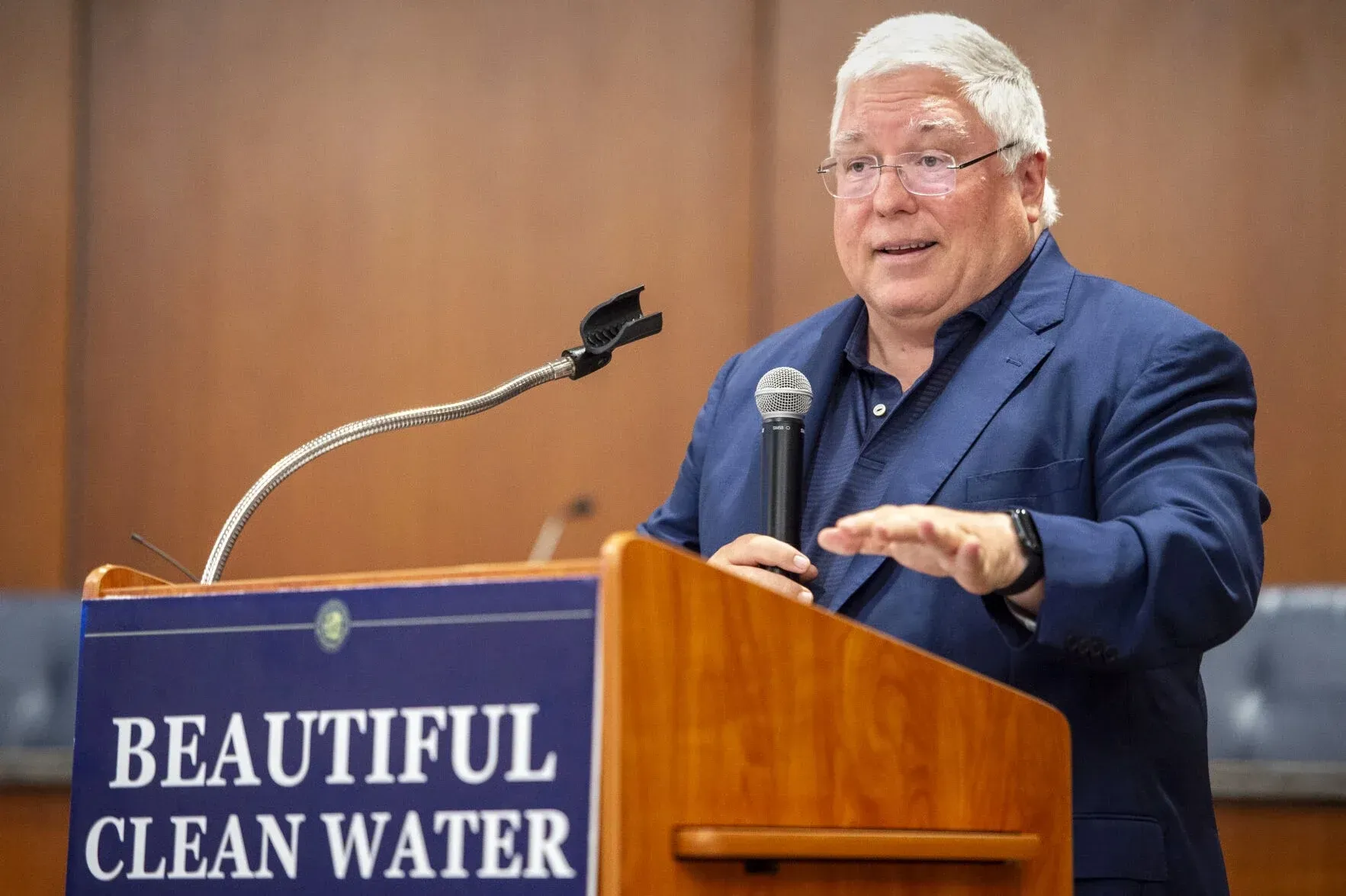
Morrisey made 10 stops across Cabell, Mingo, Mercer, Wayne, Wyoming and McDowell counties on Aug. 4 and 5 comprising what the governor billed as a two-day “water listening tour” to hear directly from local residents and officials about infrastructure and investment challenges that have poisoned residents’ trust in not only their water but their government.
But widespread skepticism among attendees of Morrisey’s listening tour stops was rooted in not just generations of underinvestment in their water infrastructure but Morrisey’s tour itself.
Morrisey talked for longer periods than he listened in Gary and at other tour stops, bristling at resident criticisms that progress or focus on water improvements hasn’t been sufficient since he took over as governor in January 2025 after 12 years as state attorney general.
Morrisey touted West Virginia providing more than $174 million in state grants and loans for water and wastewater infrastructure prior to his tour.
West Virginia provided roughly $174.6 million in total funding consisting of $110.2 million in grants or principal forgiveness and $64.4 million in loans from Jan. 13, 2025, to July 8, 2026, according to the Governor’s Office-provided data.
The six counties Morrisey visited on his water listening tour last month — Cabell, McDowell, Mercer, Mingo, Wayne and Wyoming — were awarded just over $11 million of that $174.6 million. That's just 6.3% of the total statewide funding amount despite those counties comprising 13.9% of West Virginia’s population.
The state’s recent investment footprint in Southern West Virginia gets even smaller when accounting for Boone, Lincoln, Logan and Raleigh counties, which were among the 16 of West Virginia’s 55 counties not listed as having been awarded any funding at all.
"The state's own project funding documentation substantiates what coalfield residents have said for years: the state doesn't care about you if you live south of I-64,” From Below: Rising Together for Coalfield Justice, a coalfield social justice initiative of the West Virginia Faith Collective that has advocated for significantly greater state and federal investment in West Virginia’s southern coalfield water infrastructure, said in a statement when it reviewed the data.
Morrisey has noted that some public service districts and other water and wastewater providers may lack the resources or knowledge to apply for funding from the state or any other source.
“I tell the story of when I became governor, I know people were talking about some of the water problems in one of the counties, and I said, ‘Well, why have we not heard about it through our Water Development Authority?’ And the quick answer to that was the local community hadn’t applied for it yet,” Morrisey said at an Aug. 5 news conference he held in Princeton to recap his listening tour.
The state Water Development Authority serves as a revenue bond bank to provide financing to local governmental agencies for water and wastewater facility construction.
But water and sewer infrastructure needs are great in the southern coalfields and across the state following some of the nation’s highest rates of drinking water violations. Boone, Cabell, Lincoln, Logan, McDowell, Mercer, Mingo, Raleigh, Wayne and Wyoming counties, combined, had 61 projects listed out of 222 statewide within the Fiscal Year 2027 Intended Use Plan for the state Department of Environmental Protection-administered Drinking Water Treatment Revolving Fund, which supports drinking water-focused projects in line with the Safe Drinking Water Act amendments of 1996.
In 2024, West Virginia had the nation’s highest percentage of public water systems with health-based Safe Drinking Water Act violations — 29.2%, according to a Gazette-Mail analysis of U.S. Environmental Protection Agency data.
West Virginia’s percentage of public water systems with any kind of violations has climbed sharply from 32.1% in 2015 to 79.1% in 2024.
West Virginia had the nation’s sixth-highest percentage of public water systems with acute health-based violations in 2024 — 2.1% (18 systems total) — over seven times more than the percentages in neighboring Maryland and Ohio and more than double that of neighbor Kentucky.
Health-based violations represent the exceedance of maximum contaminant or residual disinfectant levels. Acute health-based violations represent significant short-term health risks that can cause immediate illness.
West Virginia’s southern coalfield counties have been especially devastated by crumbling water infrastructure and decades of underinvestment, living with water quality failures and high levels of water loss that have left customers on the hook to pay for water too discolored and odorous for them to consider consuming — if it makes it to their taps at all.
The counties that received the most funding from the Morrisey administration in its first 18 months were:
- Kanawha County: roughly $32.8 million
- Harrison County: $23.1 million
- Mason County: $19.8 million
- Wood County: $13.9 million
Kanawha County’s total was driven by a Magazine Branch sewer improvement project.
From Below and other community and water quality advocates urged the West Virginia Legislature in the 2026 regular legislative session that ended in March to draw $250 million from the state’s $1.44 billion Rainy Day Fund for approved, shovel-ready water improvement projects in the southern coalfields, whose utilities have struggled to pay for upgrades to aging, outdated infrastructure amid dwindling customer bases.
But the Legislature never came close to doing so.
House Bill 5525 would have created a “Southern West Virginia Clean Water Fund” to be used in water emergencies or to upgrade infrastructure so residences can get clean water.
HB 5525’s appropriation of $10 million for water quality improvement programs in Boone, Fayette, Greenbrier, Lincoln, Logan, McDowell, Mercer, Mingo, Monroe, Raleigh, Summers, Wayne and Wyoming counties would have been only a tiny fraction of the hundreds of millions estimated to be required for needed water and sewer infrastructure upgrades in those counties largely devastated by coal industry decline.
The DEP’s Clean Water Needs Survey Dashboard shows total estimated project costs of more than $11.33 billion.
A December 2023 needs assessment published by the West Virginia Infrastructure and Jobs Development Council found that funding needs for water and sewer infrastructure based on applications filed with and approved by the council were roughly $1 billion for water projects and $1.3 billion for sewer projects.
Morrisey’s office did not respond to a request for comment this week when asked whether he supports creating a $250 million Southern West Virginia safe water fund.
Throughout his tour, Morrisey touted legislation in House Bill 5210 his office crafted and pushed during the 2026 regular legislative session that would have created a voluntary early intervention pilot program to give six to 10 public water and wastewater utilities an opportunity to address critical matters before the utilities end up on the state’s distressed and failing utilities watch list.
But although it would have prioritized issuance of loans to public utilities, it drew criticism from clean water advocates that it could direct resources away from needy public utilities by allowing private utilities to be eligible for low-interest loans through the Water Development Authority.
The Morrisey administration has estimated the $174.6 million awarded in his first 18 months helped advance more than $552 million in total projects.
Meanwhile, Morrisey’s office in March 2026 hailed $276 million to fully fund the Hope Scholarship program, the state’s nonpublic school vouchers program that provides families public money to have their children leave the public school system, in the Fiscal Year 2027 state budget he approved. Water quality advocates have accused Morrisey and the Republican-supermajority West Virginia Legislature of prioritizing the vouchers program over clean water investments.
Infrastructure law expiration threatening key funds
The water and sewer infrastructure investments comprising the $174.6 million via Morrisey’s administration in its first 18 months have come from four sources:
- Drinking Water Treatment Revolving Fund
- Clean Water State Revolving Fund
- Economic Enhancement Grant Fund
- Infrastructure and Jobs Development Council
The Clean Water State Revolving Fund is wastewater-focused and provides technical and financial assistance to local governmental entities to improve water quality and public health conditions.
The Economic Enhancement Grant Fund was created by the state Legislature in 2022 with $250 million in federal American Rescue Plan Act funding to support water and wastewater infrastructure upgrades as well as what the law calls “infrastructure projects to enhance economic development and/or tourism.”
The fund has drawn heavy criticism for supporting some non-water and non-sewer projects under U.S. Sen. Jim Justice, R-W.Va., when Justice was governor prior to the Morrisey administration, including $5 million to support Steubenville, Ohio-based College of St. Joseph the Worker, a Catholic school, $4.38 million for renovations at the Keith-Albee Performing Arts Center in Huntington and $3.8 million for a new Marshall University baseball stadium, Jack Cook Field.
The Infrastructure and Jobs Development Council has been a state clearinghouse for water and wastewater project funding. Morrisey chairs the council.
The state’s $174.6 million funding figure consisted of about $102.3 million for water projects and $72.3 million for sewer projects.
The two revolving state funds comprised the largest shares of funding for each category of projects.
Of the $102.3 million for water projects, $45.7 million came from the Drinking Water Treatment Revolving Fund, $39.5 million came from the Infrastructure and Jobs Development Council and $17 million came from the Economic Enhancement Grant Fund.
Of the $72.3 million for sewer projects, $39.7 million came from the Clean Water State Revolving Fund, $21.6 million came from the Economic Enhancement Grant Fund and $11.6 million came from the Infrastructure and Jobs Development Council.
DEP Secretary Harold Ward noted to the state Joint Technology and Infrastructure Committee at a Sept. 13 meeting that West Virginia is in its final year of support from the Infrastructure Investment and Jobs Act, landmark legislation signed into law in 2021 by then-President Joe Biden that provided $1.2 trillion for water, road, broadband, electric grid and other infrastructure.
Ward noted a “continual decline” in annual water state revolving fund support from the United States Environmental Protection Agency for West Virginia, which he attributed to congressionally directed spending grants being taken "off the top of” established, eligible state revolving fund monies. Congressionally directed spending is also known as earmarks, through which federal legislators request funds for projects within their home districts.
Ward reported a reduction in monies that can be set aside for administration of the programs resulting in a challenge for the state Bureau of Public Health to pay its workers who enforce compliance with and administer the Safe Drinking Water Act.
Infrastructure Investment and Jobs Act-tied funding comprises nearly all of the roughly $124.6 million in new funds available for West Virginia’s Drinking Water Treatment Revolving Fund for fiscal year 2027, according to DEP data.
In the Fiscal Year 2027 Intended Use Plan for its Drinking Water Treatment Revolving Fund, the DEP reported a Drinking Water Treatment Revolving Fund account cash balance of about $27.5 million as of March 31, with federal fund accounts payable of roughly $158.1 million boosting overall available funds to just shy of $185.7 million.
The DEP listed a federal Infrastructure Investment and Jobs Act grant of over $24.8 million and Infrastructure Investment and Jobs Act state match of over $4.9 million along with an EPA base grant of over $3.8 million and base state match of $768,400.
The Drinking Water Treatment Revolving Fund program provides lead service line replacement project loans at 0% interest for both disadvantaged and non-disadvantaged community water systems, per the EPA’s Intended Use Plan. Disadvantaged community water systems are also eligible for principal forgiveness loans to complete service line inventories. This year’s estimated Infrastructure Investment and Jobs Act funding allocation, along with the anticipated federal Fiscal Year 2026 allotment and reallotments for West Virginia, is approximately $68.3 million.
The Infrastructure Investment and Jobs Act requires 49% of the allotment be in the form of additional subsidy as a principal forgiveness loan.
Morrisey pledged $1.8M more monthly amid billions needed
The Morrisey administration has pledged $145 million in state funding for water and wastewater upgrades over the coming year, a commitment that would yield an increase of about $1.8 million more per month in state funding.
The Water Development Authority has committed under what Morrisey has called his “Clean, Clear Water Strategy” to check on projects every 60 to 90 days for greater accountability and to identify problems before they become costly delays.
The strategy includes a state partnership with Marshall and West Virginia universities to use the West Virginia Grant Resource Centers that they power to help provide technical aid to public water systems, including developing financial training to prepare entities to receive grants.
But southern coalfield advocates want a greater state funding pool available for their communities to draw from.
“Where you send your money tells us who you want to thrive," From Below said.