Story
 August 8, 2026
Morrisey’s Southern West Virginia Water Listening Tour Marred by Secrecy and Distrust
Country:

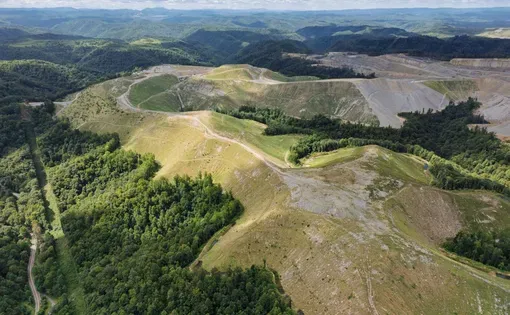
In West Virginia, water is a devastating stumbling block.
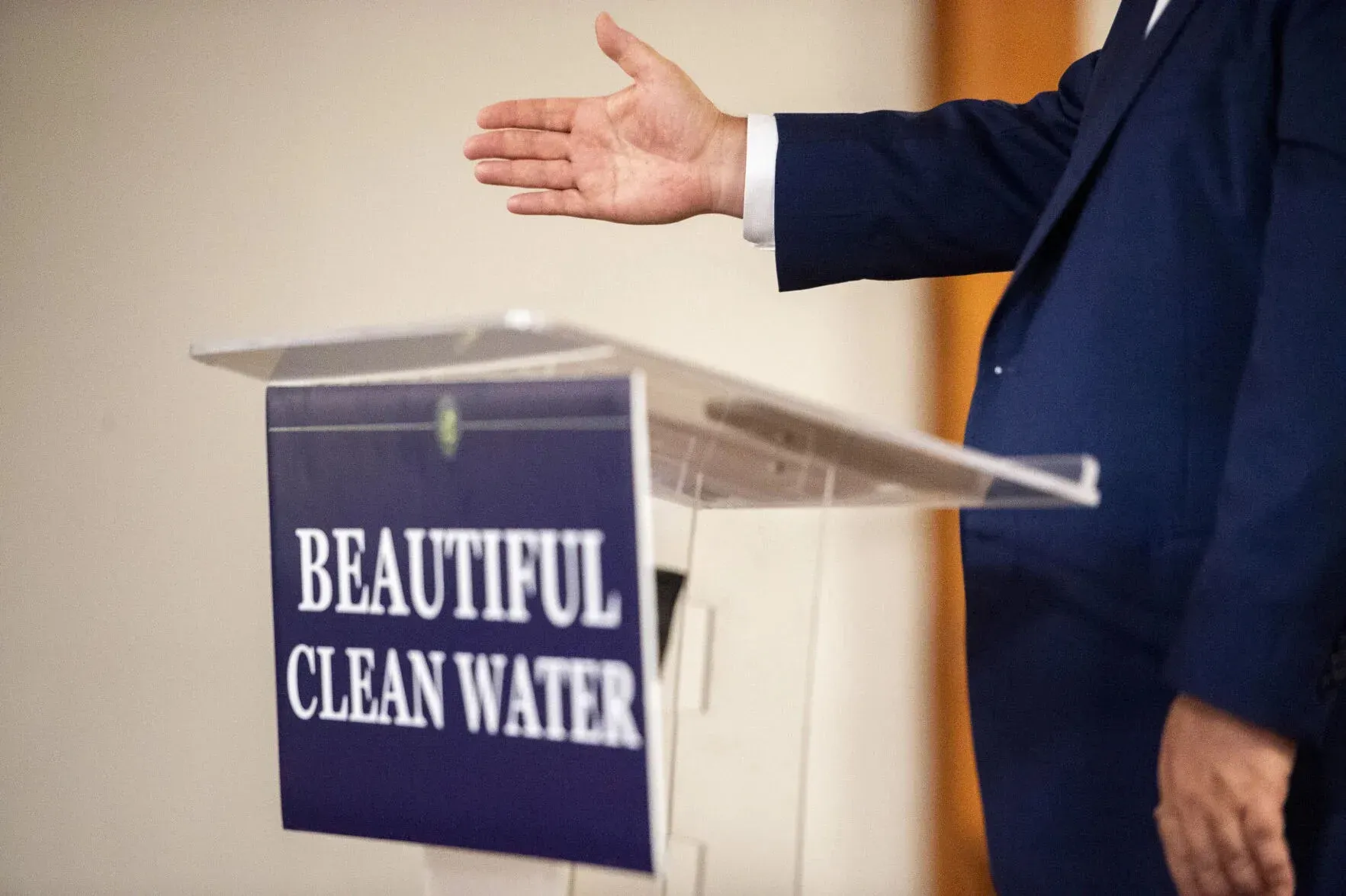
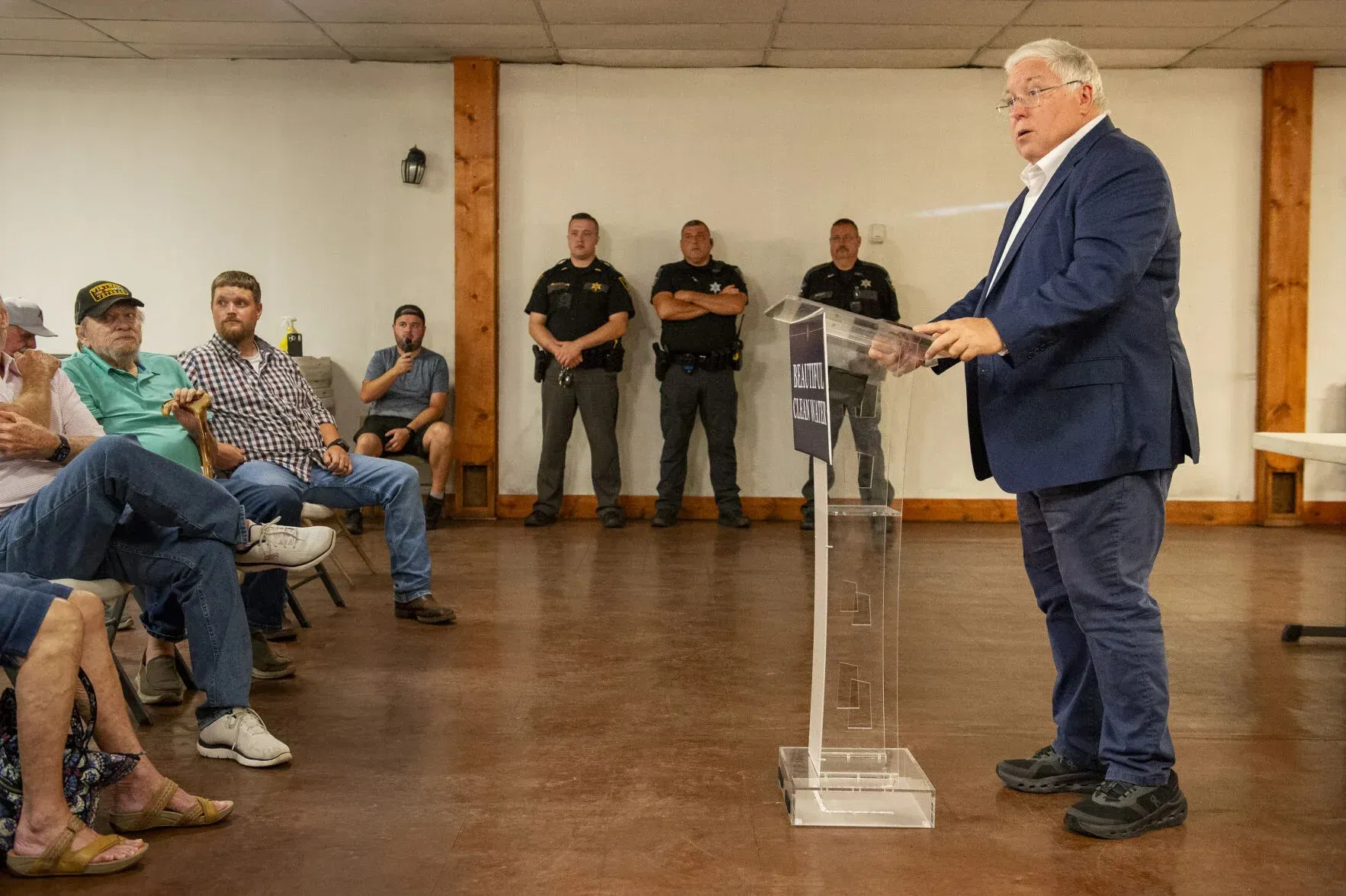
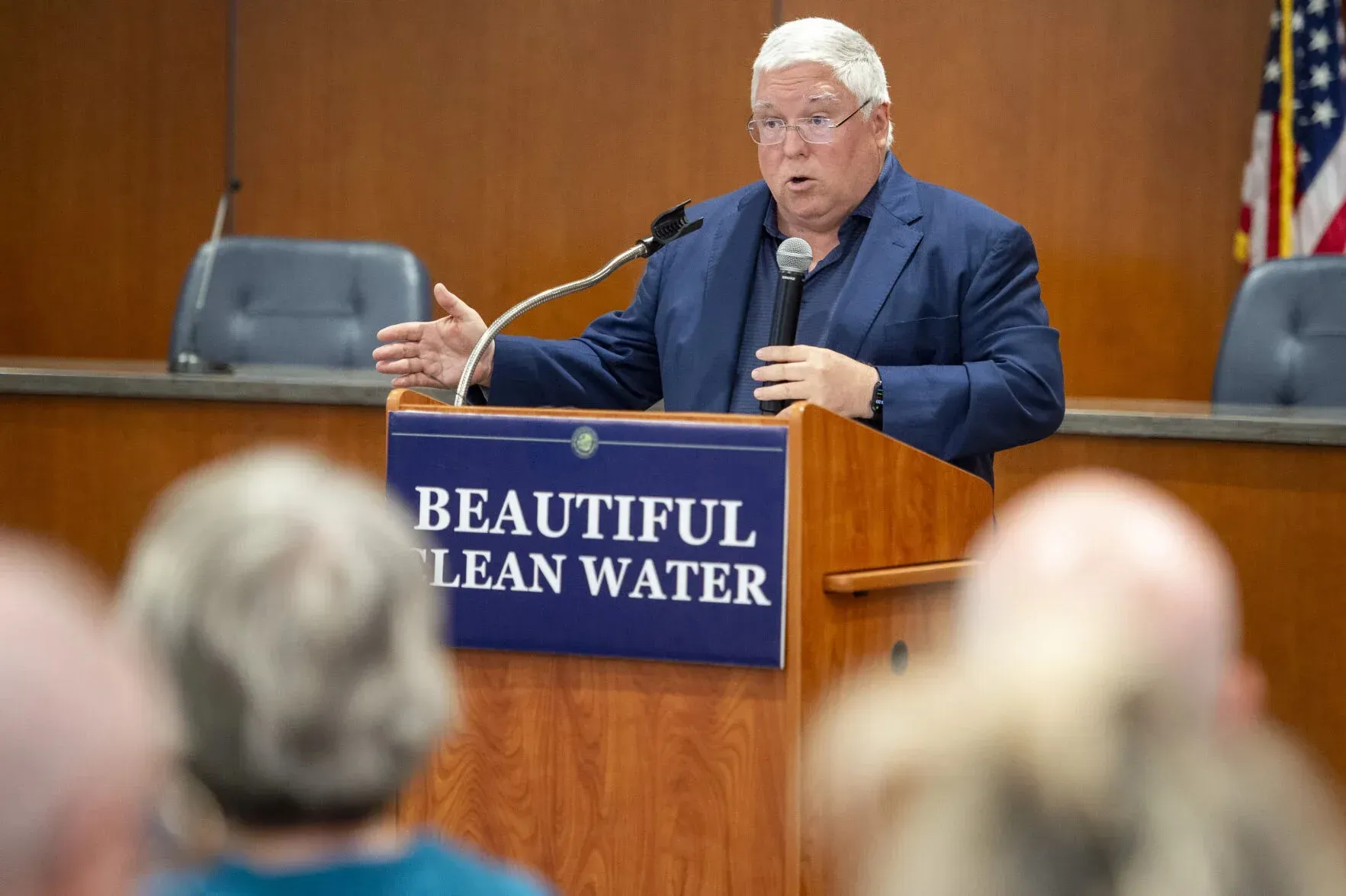
Gov. Patrick Morrisey stood behind a podium sign that read “BEAUTIFUL CLEAN WATER” in McDowell County.
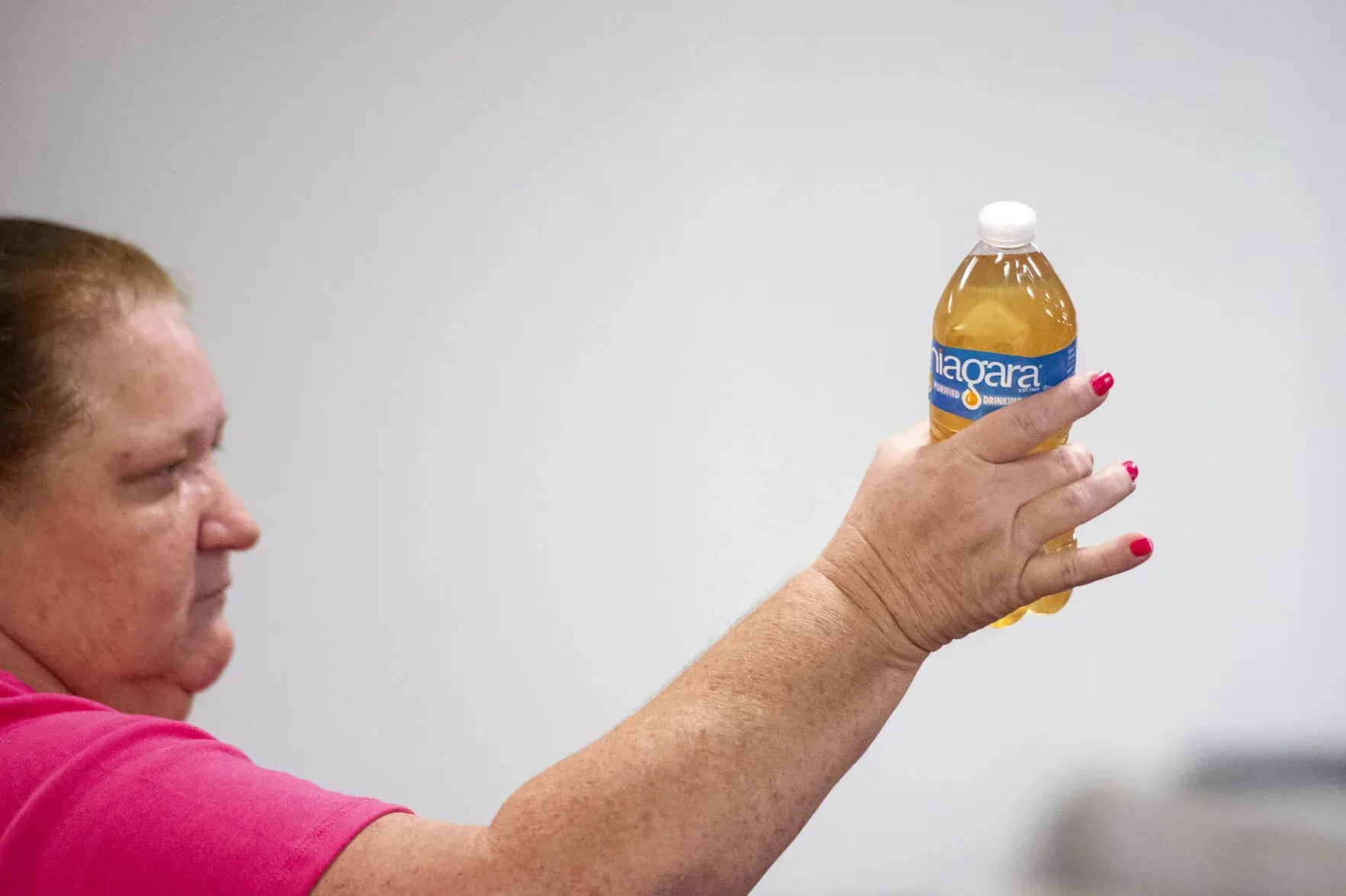
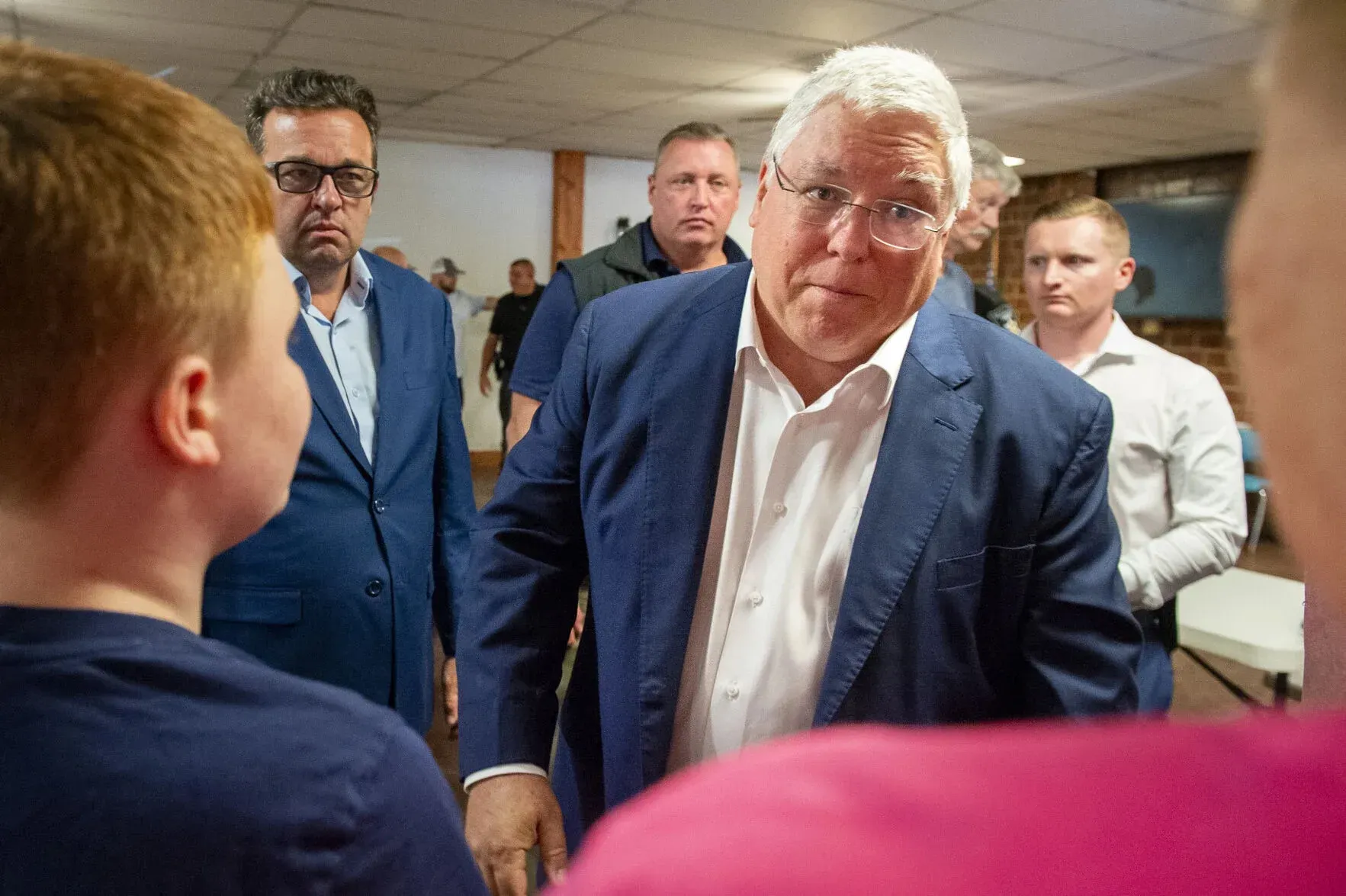
Drema Harmon stood up at Gary City Hall on Tuesday to show Morrisey a bottle of her city tap water that said something else entirely.
“This is our water,” Harmon, 55, of Gary, said, holding up a Niagara water bottle full of reddish-brown water that spoke volumes as she quietly asked Morrisey, “Would you want your family using this?”



As a nonprofit journalism organization, we depend on your support to fund more than 170 reporting projects every year on critical global and local issues. Donate any amount today to become a Pulitzer Center Champion and receive exclusive benefits!
“No. That’s not acceptable,” Morrisey replied before speculating that any mud and sediment buildup could be the culprit.
Harmon quickly rejected the suggestion, telling the governor her hot water tank was six months old.
Harmon asked Morrisey not to make empty promises.

“I don’t make empty promises,” Morrisey asserted, touting what he announced moments before was a $1.4 million award for water infrastructure improvements in Gary, which has long been plagued by water quality concerns and high levels of water loss that have left city customers on the hook to pay for water too discolored and odorous for them to consider consuming — if it makes it to their taps at all.
Morrisey and Harmon stood face to face at Gary City Hall in one of 10 stops across Cabell, Mingo, Wayne, Wyoming and McDowell counties Tuesday and Wednesday comprising what the governor billed as a “water listening tour” to hear directly from local residents and officials about infrastructure and investment challenges that have poisoned residents’ trust in not only their water but their government.
“These are not scripted events,” Morrisey said at a news conference to reflect on the tour at the City Municipal Complex in Princeton Tuesday. “But it’s important that we were able to listen so we can make the most effective decisions.”
But a day after Morrisey left Gary, Harmon, a coal mine security guard, didn’t trust that Morrisey or other state officials will have a positive effect on a water supply that she says has forced them to buy up to five cases of bottled water for drinking and cooking, leaving her with skin rashes and costing her and her retired husband David $30 a week to go to the laundromat.
“I didn’t see any benefit from it,” Harmon said of Morrisey’s roughly 40-minute interactive session before some three dozen people in Gary. “It’s been going on for years, the broken promises from Charleston. They promise all this stuff and it never comes through. This county is doomed as far as Charleston goes.”
Widespread skepticism among attendees of Morrisey’s listening tour stops is rooted in not just generations of underinvestment in their water infrastructure but Morrisey’s tour itself.
Morrisey talked for longer periods than he listened in Gary and at other tour stops, bristling at resident criticisms that progress or focus on water improvements hasn’t been sufficient since he took over as governor in January 2025 after 12 years as state attorney general.
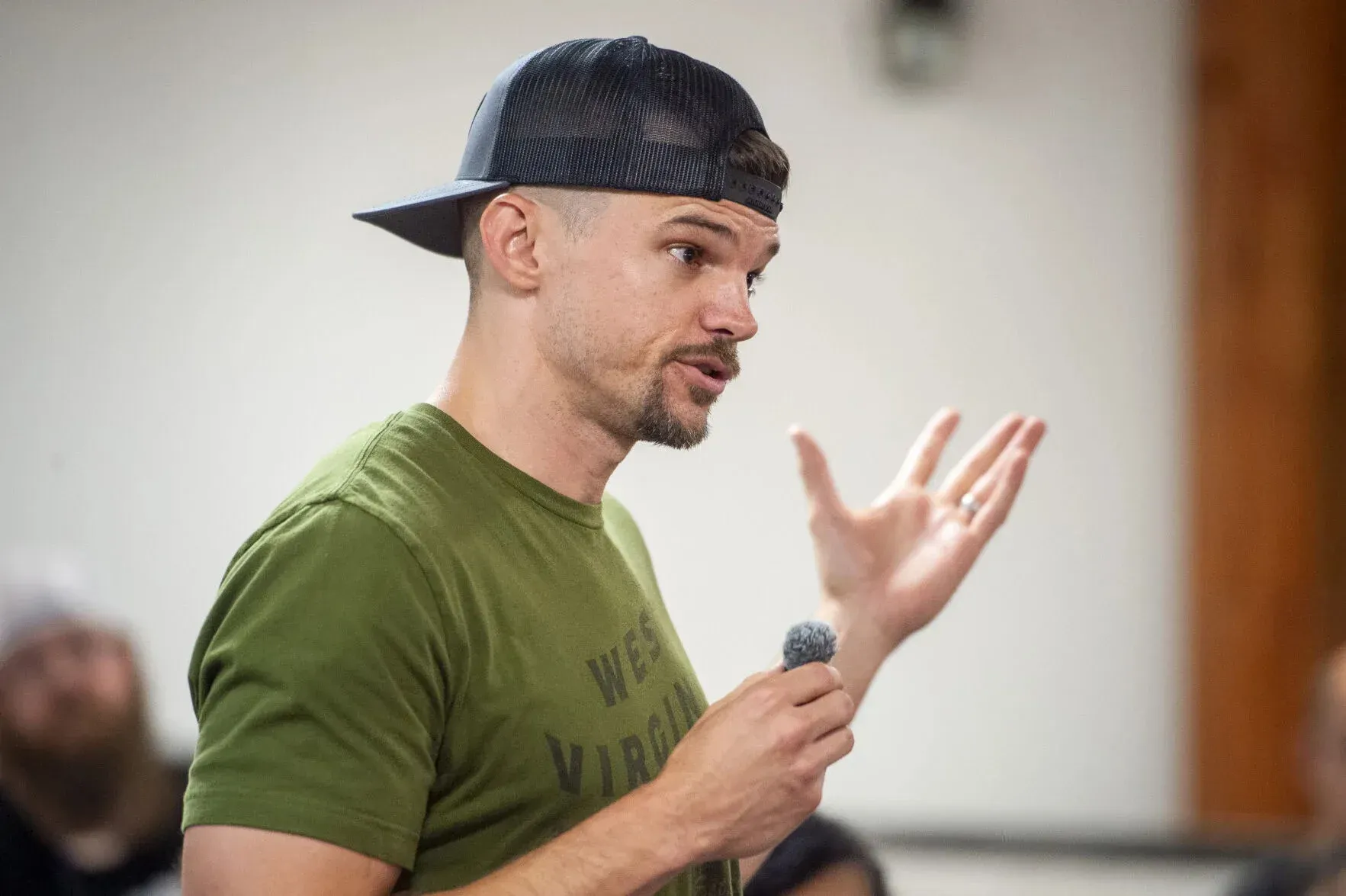
In Gary, Morrisey opened the floor up by limiting individual comment to 90 seconds and accusing the first public speaker J.D. Belcher — host of the storytelling-based, Appalachia-focused “Creepalachia” podcast — of being “not honest” about his administration’s spending on a portable Ferris wheel to be part of West Virginia’s Capital City Celebration of the 250th anniversary of the United States in Charleston.
West Virginia Auditor’s Office records show the Governor’s Civil Contingency Fund paid $349,999 to Florida-based Biggest Wheel LLC last month for the 229-foot-tall, 45-gondola wheel that Belcher and other critics say snared taxpayer support that should have gone toward water improvements.
Under state code, the Governor’s Civil Contingency Fund may cover expenses “incurred in the execution of any law for which there is no special appropriation, and any other sums which the Governor may deem necessary or proper.”
“First off, nobody in this county can barely afford to drive to Charleston to sit on the freaking Ferris wheel,” Belcher said. “So that's the reality these people are living in. They're living in struggle every day. They cannot feed their families, and when they see frivolous things like that spent for a party in Charleston that they can't afford to attend because they're trying to put food on their table, because they're trying to have water that doesn't turn brown, when they see that, yes, they call it stupid.”
Tour stops shrouded in secrecy
Southern West Virginia residents’ drive to see Morrisey Tuesday and Wednesday was a shorter distance away than the Ferris wheel was over America’s semiquincentennial holiday – but only for those who know when and where to find him.
The times and locations of Morrisey’s tour stops weren’t made public in advance.
The Governor’s Office declined multiple times to provide tour stop times and locations to the Gazette-Mail, and local residents and advocates were left scrambling to find out where and when they could attend — if they could make it during prime weekday work and school hours at all.
The McDowell County city of War confirmed Morrisey would stop there the day before his visit, after a planned location change, but added that it would be private due to security concerns it attributed to the Governor’s Office.
Officials at the McDowell County Commission and Gary City Hall offices said they lacked confirmation Morrisey would be in their areas as late as the day before his visits.
Governor’s Office spokesperson Lars Dalseide said in an email Morrisey’s schedule was “designed to maximize the number of communities he could visit and the amount of time he could spend meeting with local officials, water operators, and community stakeholders.”
Dalseide declined to say why the Governor’s Office didn’t make public the times or locations of the governor’s stops.
The Rev. Caitlin Ware, codirector of From Below: Rising Together for Coalfield Justice, a coalfield social justice initiative of the West Virginia Faith Collective that has advocated for significantly greater state and federal investment in West Virginia’s southern coalfield water infrastructure, told the Gazette-Mail that if Morrisey wanted to hear from “everyday people,” he wouldn't have come during work hours on a weekday “with no heads up.”
State senators and delegates and local municipal officials in Williamson, Mingo County, and Oceana, Wyoming County, thanked Morrisey for coming during his tour visits rather than making requests of or questioning his administration.
“Having it on a weekday afternoon without releasing the location publicly makes it nearly impossible for working-class residents and affected community members to show up and voice their concerns directly,” Tara “BabyT” Sexton of Williamson told the Gazette-Mail after Morrisey’s stop there Tuesday. “If leadership wants a true listening tour, these meetings need to be accessible to the public, announced in advance and held at times when working families can attend.”
In Williamson, Ashley Hedge of the tiny Mingo County community of Lenore told Morrisey her daughter’s 12-year-old best friend has to rely on rainwater to wash herself due to a lack of running water in her house.
“When you leave here, you’re going back to Charleston in a big, fancy car, back to a big, nice house, and all of these things are going to be provided for you with no issues,” Hedge told Morrisey.
State Sen. Mark Maynard, R-Wayne, who said at Morrisey’s Princeton news conference the following day he and Morrisey “align on everything,” interrupted Hedge at the Williamson event to call an end to Morrisey's formal listening session there.
In an exchange with Hedge, Morrisey defended himself by saying he had only been in office for a year and a half and that his administration has put in “economic systems” to “draw high-paying jobs in” to add resources to pay for water and sewer infrastructure.
Morrisey added that he had been “very patient” while Hedge addressed him.
“What needs to be asked about this tour is who was listening and who was talking?” Ware said. “It was clear by the rushed, rapidly changing schedule that everyday citizens were not who Morrisey came to speak to.”
Council grant disbursements on downturn
Policy consultant Brady Shrader, 29, of Charleston, said he was getting a new tire for his car with his father in Tazewell, Virginia, when he saw on social media that Morrisey’s War stop that ultimately would be relocated had been canceled, so they headed straight for Oceana, with Shrader figuring they’d have to do so to get to ask him any questions.
Shrader did get to ask Morrisey about the possibility of bringing in water-filled tanker trucks or replacing cisterns where people have poor water quality or equipment.
“And somehow it got switched around to increasing jobs and never really addressed the cisterns or the tanker trucks,” Shrader reflected afterward about Morrisey’s response. “Instead of being repetitive about, like trying to answer the questions in a repetitive way, circling it back to, we’ve got to increase jobs, we’ve got to bring in infrastructure and everything, I would have liked to know, how are you going to do this?”
Throughout the tour, Morrisey touted his office’s estimate that West Virginia had allocated $174 million in grants and loans that he said helped leverage $550 million-plus in overall water and wastewater project funding since he took over in January 2025.
“And we can provide the list to folks and the breakdown by counties,” Morrisey said Wednesday in Princeton. “I don’t have it all down in front of me, but you deserve to have that information.”
Morrisey’s office had not responded to a Gazette-Mail Freedom of Information Act request for records showing that information as of Friday afternoon.
Records of the state Water Development Authority, which serves as a revenue bond bank to provide financing to local governmental agencies for water and wastewater facility construction, list roughly $1.36 million in three Infrastructure and Jobs Development Council grants disbursed during Fiscal Year 2026 as of June 30 for projects in the counties on Morrisey’s tour, with none in McDowell or Wyoming counties.
The council has been a state clearinghouse for water and wastewater project funding. Morrisey chairs the council.
Authority records show 23 such grants overall disbursed during that span with more than $15.2 million awarded.
Entities in the Morrisey tour stop counties had been disbursed about $3.34 million across seven grants for Fiscal Year 2025 as of June 30, 2025, according to agency records, with $39.1 million awarded for 54 projects throughout the state.
By far the largest grant, a $5 million award made under then-Gov. Jim Justice’s administration, went to the Steubenville, Ohio-based College of St. Joseph the Worker, with an aim of creating a real estate development and construction company to be headquartered in Weirton that employs its students.
The award was made via the Economic Enhancement Grant Fund, which was created in 2022 via House Bill 4566 establishing the fund through $250 million in federal American Rescue Plan Act funding to support water and wastewater infrastructure upgrades, as well as what the law calls “infrastructure projects to enhance economic development and/or tourism.”
Morrisey has weakened water pollution protection
Morrisey’s office has announced just more than $102 million for water improvement projects in news releases since he became governor in January 2025 prior to his tour, with about $13.7 million going to the tour counties.
The first such Morrisey office announcement came in May 2025, four months into his administration and after his office issued a statement applauding a Trump administration plan to weaken a rule that governs what waters are protected under the Clean Water Act.
As attorney general, Morrisey fought against stronger federal environmental protections aimed at reducing water pollution, especially from coal-fired power plants. Morrisey took a swipe at what he called the “Green New Deal scam” and suggested further environmental regulation cuts could benefit the state during his tour wrap-up news conference in Princeton, where he echoed his own comments from his tour kick-off news conference at Marshall University the day before in favor of consolidating water project oversight among state-level agencies.
This year, Morrisey signed Senate Bill 256, weakening a standard for how much selenium — an element with toxic effects for West Virginia’s aquatic and potentially human life — is allowed in fish tissue.
He also signed SB 641, gas and oil industry-backed legislation which loosened regulations for some aboveground storage tanks containing potentially environmentally dangerous brine water produced in connection with hydrocarbon storage or production activities nearest to public water intakes.
Throughout the tour, Morrisey touted legislation in House Bill 5210 his office crafted and pushed during the 2026 regular legislative session that would have created a voluntary early intervention pilot program to give six to 10 public water and wastewater utilities an opportunity to address critical matters before the utilities end up on the state’s distressed and failing utilities watch list.
But although it would have prioritized issuance of loans to public utilities, it drew criticism from clean water advocates that it could direct resources away from needy public utilities by allowing private utilities to be eligible for low-interest loans through the Water Development Authority.
A report prepared for the Appalachian Regional Commission and published last year estimated West Virginia’s drinking water needs would cost roughly $1.73 billion when accounting for the state’s 414 community water systems — some 10 times the $174 million Morrisey said the state has made in grants and loans for water and wastewater during his administration.
The $1.73 billion estimate doesn't account for the thousands of West Virginians still relying on undocumented private wells or roadside springs thought to harbor greater health dangers because they don’t trust their own water supply throughout the state.
“You’re not answering. You’re just fooling around. Do you understand that us citizens’ patience [is] worn out?" Hedge told Morrisey, adding that the people were getting "a minute and 30 seconds to tell you our problems, and then you go back to Charleston and everything’s fine. You have sat down and explained to everybody here what you’re putting in place and what you’re doing, but nothing’s being done.”
Colors of rust and distrust
Harmon said the day after Morrisey’s Gary visit that she’d like to see the state do more to clean up abandoned underground mines. She attributes what she says has been a decline in her water quality in recent years to contamination from those mines as more of them become abandoned.
The West Virginia Department of Environmental Protection has said data collected by the agency hasn’t indicated any public health or safety issues related to mine water discharges in McDowell or Wyoming counties exist. The agency has said results show parameters associated with coal mining activity are meeting state water quality standard criteria for both aquatic life and human health.
But area residents have little faith in what they say has been an unresponsive DEP.
Testing results throughout the southern coalfields have shown results at or above secondary drinking water standards set by the U.S. Environmental Protection Agency for iron, manganese and aluminum. The secondary maximum contaminant levels are set as guidelines to help public water systems manage drinking water for aesthetic considerations, like taste, color and odor.
Contaminants aren’t considered to pose a human health risk at the secondary maximum contaminant level, according to the EPA.
But noticeable effects of secondary maximum contaminant level exceedance for iron include a rusty color, metallic taste and reddish or orange staining, according to the EPA. Manganese exceedance yields a black to brown color, black staining and a bitter metallic taste.
Harmon’s water has stained her life. She says she hasn’t had her water tested and may not even trust independent lab test results. Her trust is gone.
“I don't know if I would or not,” Harmon said, "because the government's got their hand in everything that's done.”