

The Nuba Mountains became a refuge. That safety is now unravelling.
Sophie Neiman and Guy Peterson report on how starvation is being used as a weapon in Sudan’s war.
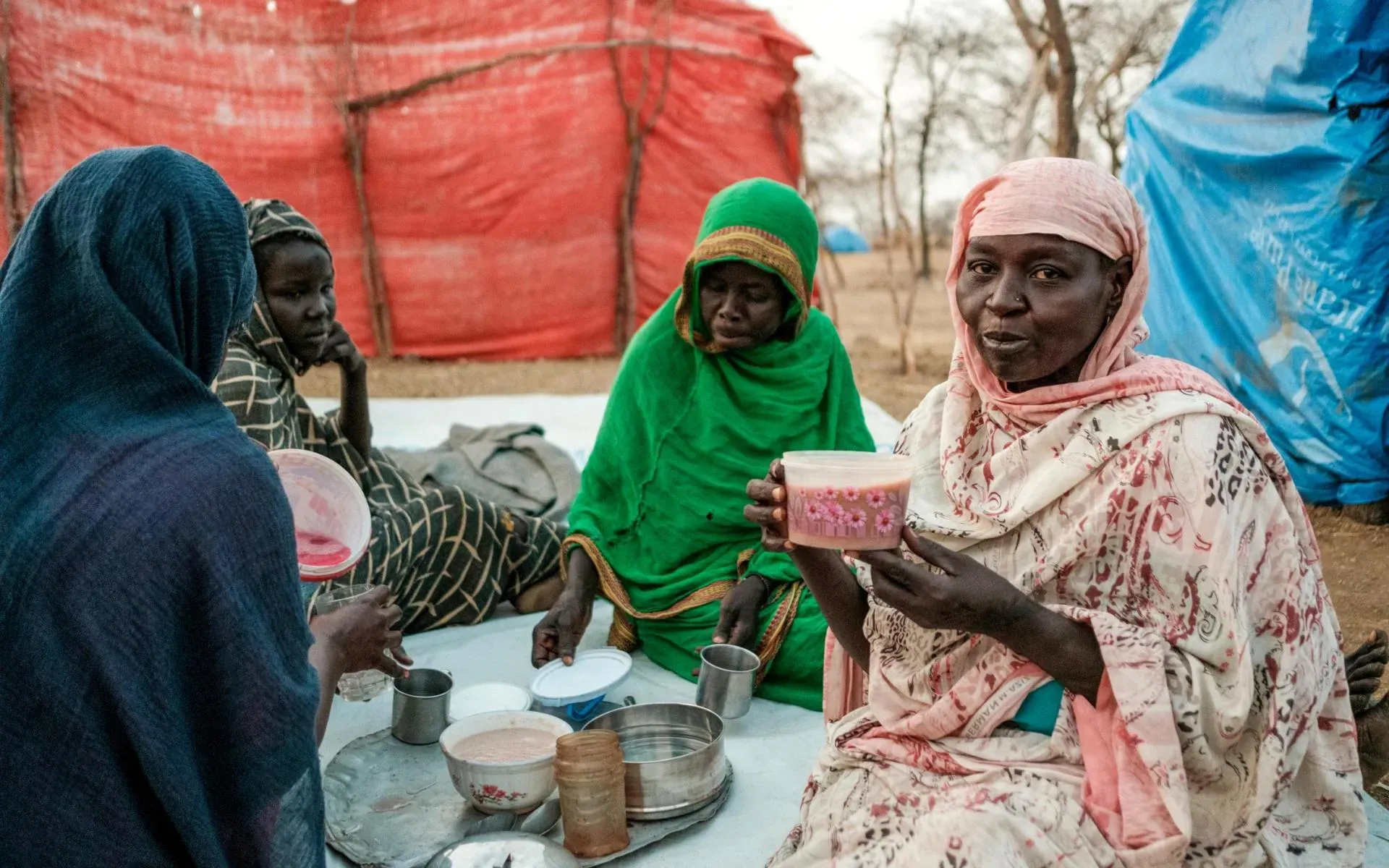
Halima Sulieman Jibreel prepares to break her Ramadan fast at a displacement camp in the Nuba Mountains. She spreads out what little food she can find on a white tarpaulin.
There is pink juice mixed in a detergent container, cool water served with porridge and a pot of beans cooked over an open flame. It is a fraction of what the family would normally eat, but it is all they can manage after fleeing the besieged Sudanese city of Kadugli.
Friends, all uprooted by conflict, gather to share the meal. While Jibreel and the other women cook, men kneel down to mumble a prayer as the sun sinks behind rugged mountains.

As a nonprofit journalism organization, we depend on your support to fund more than 170 reporting projects every year on critical global and local issues. Donate any amount today to become a Pulitzer Center Champion and receive exclusive benefits!
War erupted in Sudan three years ago, when two generals came to blows in the aftermath of the country’s pro-democracy protests. In April 2023 soldiers from the Rapid Support Forces (RSF), a paramilitary force previously aligned with the government, attacked the Sudanese Armed Forces (SAF). The ensuing conflict tore the country apart, creating what the United Nations has called the world’s worst humanitarian crisis. According to the World Health Organization, some 21 million people are now desperately in need of food.
Starvation has become a weapon in Sudan, with flashpoint cities intentionally cut off from supplies and aid. Famine has been declared three times since the war began. For example, in Darfur, the RSF blocked the western city of El Fasher from aid for more than 500 days before finally capturing it in October. By then, more than 70 per cent of children under five escaping the city were acutely malnourished.
In South Kordofan State, during the years-long siege of Kadugli, the RSF and its allies blocked supply routes, unleashed a volley of drone attacks and clashed violently with the SAF. Meanwhile the city, once home to some 200,000 people, slid into famine. Now, after the siege of Kadugli was broken in February, it provides a startling window into how starvation is creating wounds that will last a generation.
Nothing to eat
Jibreel arrived in Kadugli in June 2025. She comes from Demik, which sits on the border between RSF and SAF territory. That summer, she recalls, the family had gathered there for the funeral of her grandmother. Suddenly, men with guns arrived and opened fire on the gathering.
"It is something I will never forget," says Jibreel. "It all happened so quickly. One minute we were mourning my grandmother, the next people were dying around us." Forty of her relatives and neighbours were killed, she says.
Jibreel ran into the surrounding mountains and then fled with her family to Kadugli. The city was by no means safe, but it was the nearest place she could think of to go.
In the borderlands between SAF and RSF territory, where Jibreel lived, anyone could have been responsible for such an assault. Fighters from both sides have been accused of targeting civilian gatherings, with the RSF using drones to strike a funeral in North Kordofan, not far from Jibreel’s village, in November.
Once they arrived in Kadugli, Jibreel, her husband and their seven young children lived with other displaced families in a former football stadium. Finding food was a constant problem because of the siege. Jibreel sometimes saw supplies in the market but could not afford to buy them. They were already living in poverty and prices had skyrocketed, with food becoming exponentially more expensive than it was in peacetime. The family survived on grass.
Jibreel’s children grew weak and thin. "A mother cannot accept seeing her children fall down from hunger," she says, weeping and wiping away tears with the corner of her pink hijab. "That pain stays in my heart."
Late last year, Jibreel and her family decided to leave the city and try their luck elsewhere.
Mathilde Vu, Sudan advocacy manager at the Norwegian Refugee Council, describes Kadugli’s famine as "man-made": "It’s not a mere byproduct of the war. It’s really the result of a blatant violation of international humanitarian law."
The Geneva Conventions forbid warring parties from cutting civilians off from essential aid and supplies, as occurred in Kadugli.
Escape
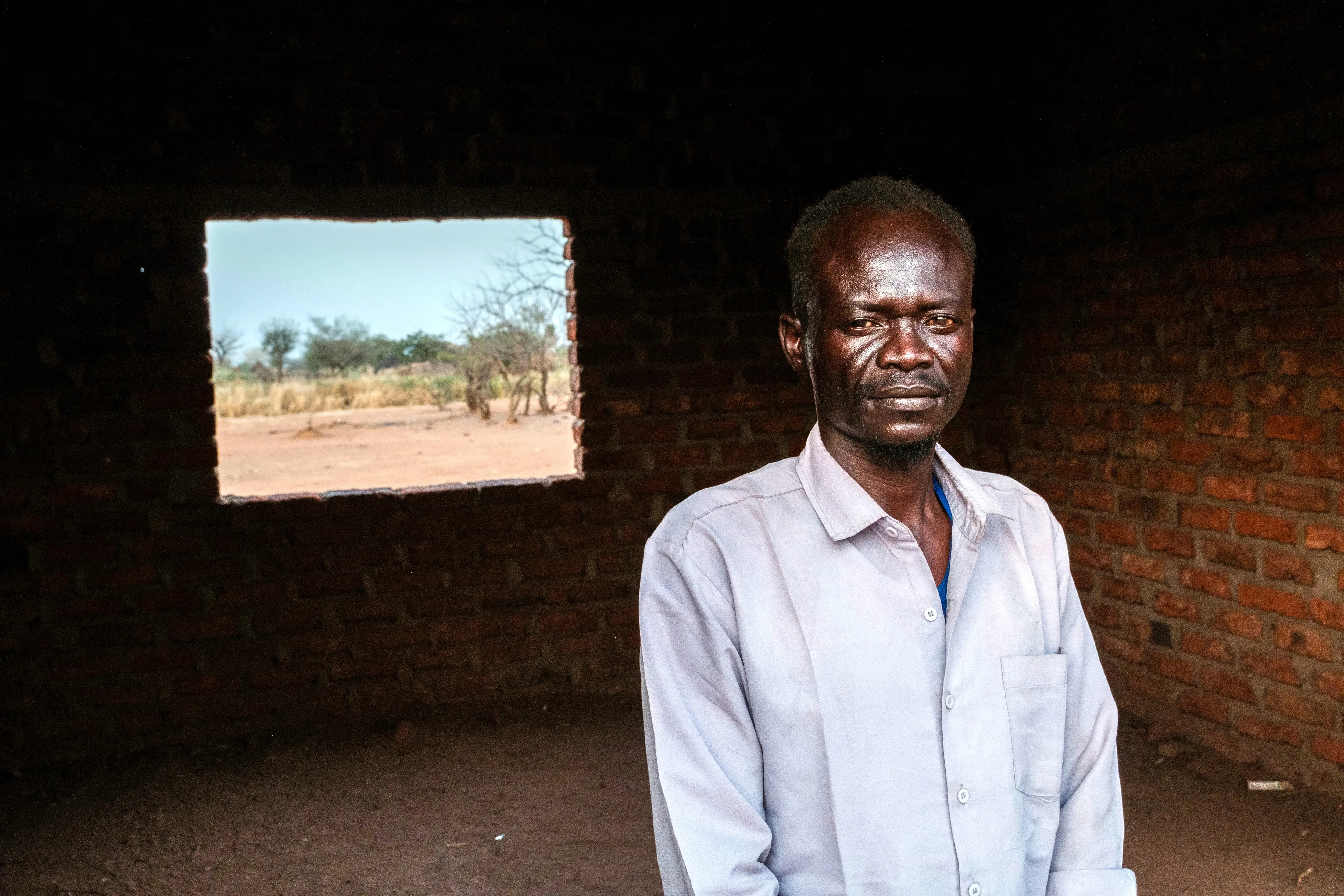
Mohamed Mahdi was born in Kadugli. Before the war he enjoyed playing football in the stadium where Jibreel would later shelter with her children.
The war changed everything and all Mahdi could think of was how to feed his family. Whenever he could, he slipped out of the city to the farms on its edge, searching for something for his four kids to eat. It was a dangerous task. Armed groups and bandits killed anyone who crossed their paths. "Even though I was afraid, it was better to risk death than to see my children go hungry," Mahdi says.
Sometimes he succeeded in finding food. Sometimes he did not.
Meanwhile, RSF drones filled the sky. Mahdi dug a small foxhole in the shade of a tree and hid the children inside whenever he heard the mechanical whir of drones overhead, hoping the shadow cast by branches and leaves would disguise them.
The children survived but other family members were not so lucky. Eight months ago a drone strike killed his niece, nephew and older brother. Mahdi tells me that he was close with his brother, but he can’t bring himself to say much more.
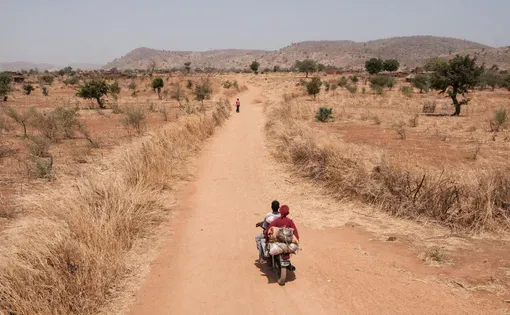
In November he and his wife and their children walked out of Kadugli. When the children grew tired, Mahdi told them there was only a little further to go, even if that was not true. Eventually, he picked them up and carried them.
At last, the family arrived in Enbal Displacement Camp, one of the many informal settlements scattered across the Nuba Mountains. Other homeless people, including Jibreel’s family, had strung up dusty tarps there or made traditional huts of dry yellow grass, using any materials they could gather to keep the scorching sun off their backs.
Little has changed in Kadugli since the SAF broke the siege earlier this year. Food is still hard to come by and drone strikes are unrelenting. The few aid trucks that have reached the city are not enough to alleviate months of starvation, humanitarians say.
Meanwhile, displaced people are still hesitant to go home and unable to find food in hastily assembled camps.
Searching for help
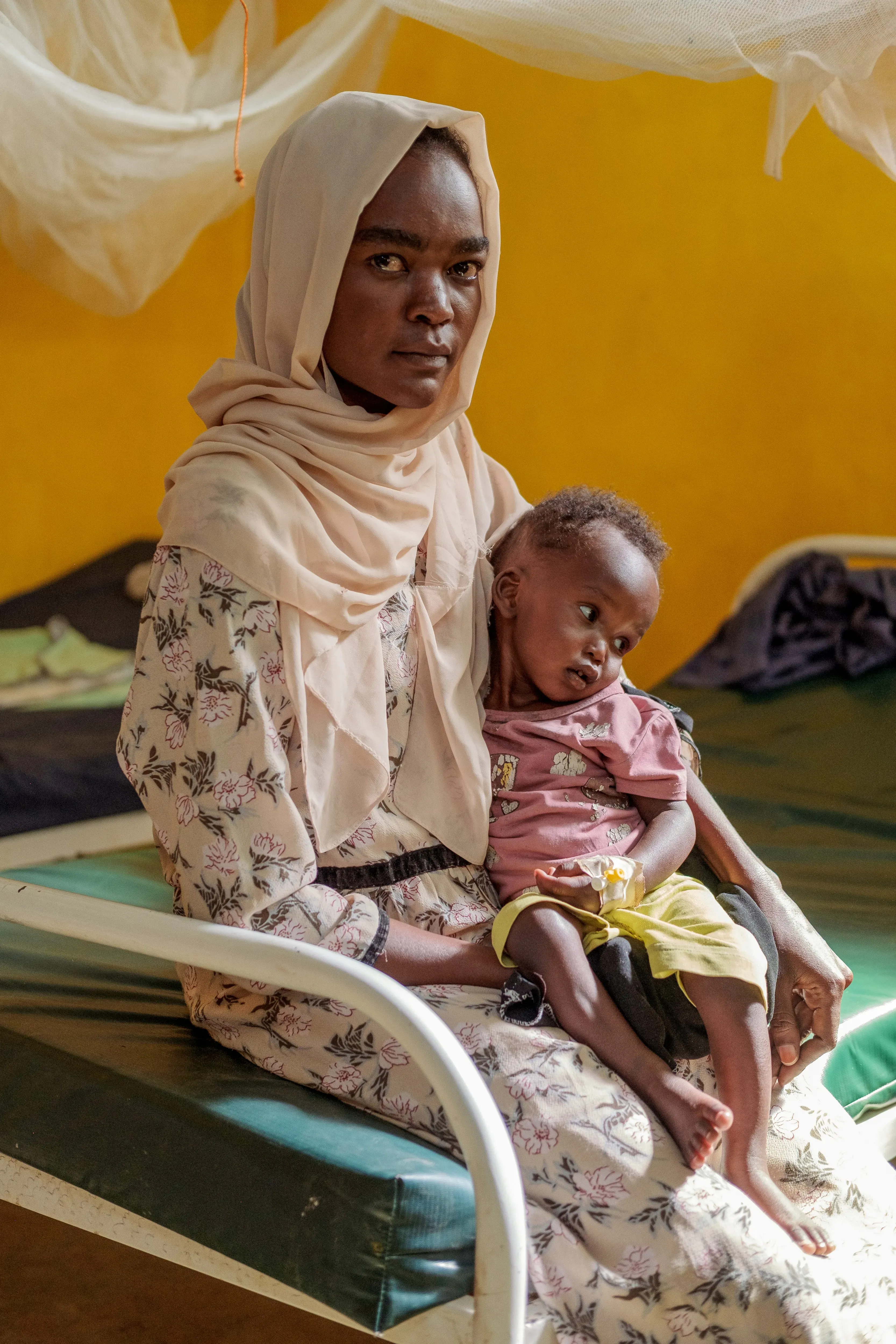
Perched on the edge of a hospital bed, Bara Abdel Rahman holds tight to her eight-month-old son, also named Mohamed. The boy is small for his age and hardly cries. He’s been sickly, his mother says, ever since he was born amidst the siege of Kadugli.
There, Rahman ate once a day or not at all. She felt hunger pangs in her stomach and could not produce enough milk to feed Mohamed, so watched the boy with worry. "He became thinner and did not grow well," Rahman says quietly.
The young mother had little help. Her husband had stayed in the city of El Obeid, where the RSF and SAF also fought fiercely for control. He hoped his family would be safer in Kadugli, while he saved money he earned from driving a taxi. Neither Rahman, who was pregnant with Mohamed at the time, nor her husband knew the danger that would befall them when they said goodbye.
"I was often hungry and worried about what we would eat the next day," she says. "It is very difficult for someone to leave their home like that, especially for the children."
In November, she left Kadugli with baby Mohamed and her toddler daughter. The boy remained small and feeble. When they reached the hospital, administered by the German humanitarian organization Cap Anamur, doctors said he was one of the sickest babies on the ward.
Cap Anamur is located in the town of Kauda, some 127 kilometers from Kadugli. As Rahman clutches tight to her son, other parents with sick babies sit on nearby beds in the hot ward and on a concrete ledge outside.
Childhood malnutrition has lifelong impacts, including weak immunity, increased mortality and impaired cognitive and physical development, according to the British Medical Journal.
Rahman leans emotionally on her own mother, who cares for her while she cares for baby Mohamed. "We went through everything together," Rahman says. "We are only here with each other. Women are strong."
Rahman has not seen her husband since late 2024. They communicated by Facebook Messenger for as long as they could, but now she does not know if he is dead or alive.
Rahman looks down at her son. "My hope is that Mohamed will have good health," she says.
'Famine is not a mere byproduct of the war. It’s really the result of a blatant violation of international humanitarian law.'
The next generation
Back at the displacement camp, where Jibreel and Mahdi live, the sun is setting on the first night of Ramadan. Families come together to share what little food they have, quiet and reflective.
Sharing has long been central to Sudanese culture. Eating a specific dish is less important than having someone to eat it with. "During the course of this conflict... hospitality became a survival tool," says Omer Eltigani, a member of the Sudanese diaspora, and author of the first comprehensive Sudanese cookbook in English.
These social lifelines are essential because little international aid has reached the scattered camps around the Nuba Mountains. The territory is controlled by the rebel Sudanese People’s Liberation Movement-North, who have set up a de facto government. Last year, they announced an alliance with the RSF. The little aid that does make it here comes over an unofficial border post with South Sudan. Humanitarians keep quiet, for fear of losing access to the SAF-controlled parts of the country.
Jibreel’s primary-school-age children sometimes walk to the market to look for odd jobs. The family depends on support from neighbours and is waiting until it is safe to return home to Demik. "The conflict is happening because all these parties are fighting for power and greed. I wish peace and stability for Sudan," she says.
One million people have been displaced to the Nuba Mountains since the start of the war, all facing similar difficulties. But more challenges are yet to come. In May, the rainy season will seal the Nuba Mountains off from the trickle of aid, as the roads turn waterlogged and impassable. Displaced families will likely have even less to eat.
Mahdi’s two youngest children now attend school in the camp, but the older two have had to stop their lessons due to lack of money. "I just want peace and security for myself and my family. I want my kids to live a happy and healthy life," he says quietly.
In that sense, Jibreel, Mahdi and Rahman are united by a simple desire: something better for their children, whose lives have been forever impacted by hunger and war.