Story
 April 3, 2026
Analysis: The First Amendment Under Pressure in Immigration Coverage
Country:

Project
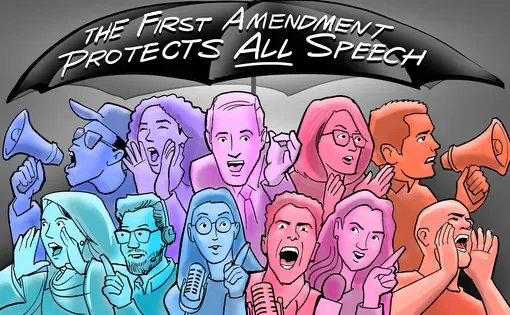
The Free Speech Files
In this project, student reporters and young journalists explore First Amendment disputes in...

In communities across the United States, the work of documenting immigration enforcement is becoming harder and riskier. Reporters face restricted access to federal agents, frightened sources who hesitate to speak, and government data that is incomplete, delayed, or hidden behind litigation.
The Spring 2026 issue of the Gateway Journalism Review (seen in the PDF below) examines what those conditions mean for the First Amendment to the United States Constitution and for journalists trying to report on the activities of the Department of Homeland Security at a moment of heightened enforcement and secrecy.
Our cover story looks at the rise of data journalism as a tool for accountability. Reporters at the Chicago Sun-Times, Chicago Tribune, and ProPublica are using court records, public datasets, and litigation under the Freedom of Information Act to reconstruct what the government does not readily disclose. Their work illustrates how rigorous, methodical reporting can challenge official narratives and create a public record.

As a nonprofit journalism organization, we depend on your support to fund more than 170 reporting projects every year on critical global and local issues. Donate any amount today to become a Pulitzer Center Champion and receive exclusive benefits!
Other stories in the Gateway Journalism Review issue examine the impact on journalists themselves. One feature follows international journalism students navigating new risks in the United States. Another story explores the evolving realities for reporters documenting raids, protests, and community response as U.S. Immigration and Customs Enforcement tightens controls on access and communication. Those restrictions raise fundamental questions about press freedom in public spaces and the chilling effect of enforcement activity on both reporters and the people they cover.
The issue argues that immigration coverage is no longer just another beat. It has become a stress test for the First Amendment.
Journalists are confronting restricted access and surveillance that complicate routine newsgathering. Sources, particularly within undocumented communities, face heightened vulnerability. Latino journalists covering immigration enforcement can face particular risks when racial profiling targets them and their communities. At the same time, public-records laws and press protections are being tested in real time.
For the Midwest, these questions carry particular urgency. Immigration debates often unfold outside the intense media scrutiny that accompanies coverage on the coasts. Local newsrooms are frequently the first to witness enforcement actions, yet they are often the least resourced to fight access battles or litigate denials.
At its core, this Gateway Journalism Review issue is about transparency and the role of journalism when the public record is contested, and when government actions become harder to see, our responsibility as journalists to document them becomes critical.
Contributors
GJR founder: Charles Klotzer
Publisher: William H. Freivogel
Editor: Jackie Spinner
Publication designer: Peyton Cook
Newsletter editor: Katerina Sirinyok-Dolgaryova
Illustrator: Steve Edwards
Copy editor: Ruth Johnson
Anjana Tomy: ex-Marine and current biomedical science student hoping to pursue a career in pathology
Hannah Pajtis: Philadelphia-based freelance journalist and editor-in-chief for The Hawk, the independent student-run news organization of Saint Joseph’s University
Araceli Ramirez: Chicago-based freelance journalist who reports on art, activism, and neighborhood life
Sky Chadde: senior investigative reporter for Investigate Midwest
Kenn Cook Jr.: award-winning Chicago-based freelancer and visual artist
Kiley Huang: senior at Kirkwood High School in Missouri and co-editor-in-chief of the school’s student newspaper, The Kirkwood Call
Josie Mottl: senior and one of the co-editors-in-chief for The Kirkwood Call
Kate Jensen: senior at Kirkwood High and editor of the Pioneer yearbook
Brian S. Brooks: former associate dean and longtime faculty member at the University of Missouri School of Journalism
Jack Grone: editor of McPherson, an independent journalism startup based in St. Louis
Virginia Young: covered Missouri state government for the St. Louis Post-Dispatch
Phil Didomenico: completing his degree in adult education. He served in the Marine Corps as a dragon gunner
Sofía Oyarzún: award-winning Chicago-based freelancer and editor at The Columbia Chronicle
Michael Cortez: award-winning Chicago-based videographer and photojournalist at The Columbia Chronicle
Carly Gist: award-winning Carbondale, Illinois-based reporter and editor-in-chief of The Daily Egyptian
Riley Sember and Olivia Luesing: student photojournalists for The Daily Egyptian