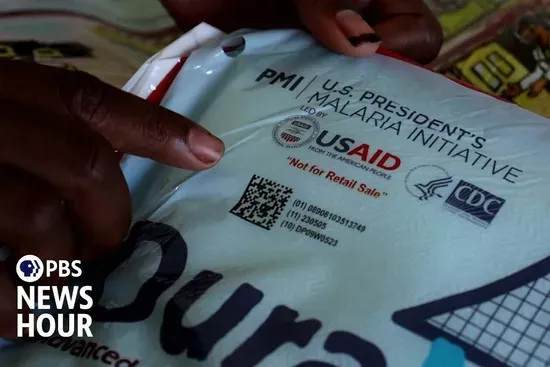
This letter features reporting from “Cuts and Consequences: The End of USAID” by Molly Knight Raskin and William Brangham
Dear Congresswoman Rosa DeLauro,
Food is the most basic human necessity, a fundamental human right, and the foundation on which human civilization is built. Yet, in the nation that prides itself on human achievements, millions are left starving as the right to food is the first to be threatened when politics fall apart. On November 7th, 2025, thirty-seven days into the government shutdown, the USDA announced that only $4.6 billion remains in the SNAP emergency fund, barely half of the $8 billion needed to feed America’s 41.7 million SNAP recipients each month.
This isn’t the first time political decisions have suddenly put humanitarian programs at risk. In the Pulitzer Center-supported documentary “Cuts and Consequences: The End of USAID,” journalists Molly Knight Raskin and William Brangham reveal how political funding cuts can dismantle lifesaving humanitarian programs. In both Kenya and Ghana, communities depended on USAID projects for access to clean water, medical assistance, and crop cultivation. These projects provided job opportunities for locals, helping communities adopt new technologies in agriculture and healthcare for long-term benefits. The sudden USAID cut in January 2025 left many communities unprepared for self-reliance, leaving them highly vulnerable. This abrupt loss of aid led to worsened conflicts for medical and food resources, deepening the inequality between regions. This withdrawal of USAID abroad mirrors what is happening domestically right now, where essential programs are easily manipulated or cut short without a transitional plan in the face of sudden political upheavals.
According to a 2024 USDA report, Connecticut alone has approximately 391,200 residents who rely on SNAP to afford basic groceries, with 50% of these recipients being either under the age of 18 or over the age of 60. This is especially evident in my hometown of New Haven, where 22% of the residents struggle to access sufficient nutritious food. Despite New Haven’s abundance of food pantries and community gardens, a week of SNAP delay tips the fragile point between supply and demand at these pantries.
On Wednesday mornings at Sunrise Cafe, where I volunteer by serving free breakfast to anyone who walks through the doors, I’m accustomed to a steady crowd and familiar faces. However, by the first hour of opening this Wednesday after the SNAP delay, the line was already wrapped around the block. There were children barely five years old, disabled guests who were getting pushed to the back, and students with backpacks just like mine. I moved between the tables, knowing all too well that the fridge in the kitchen was nearly empty. In that moment, the 30,000 New Haven residents impacted by the delay of SNAP benefits stopped being a number in the headlines to me. They were the faces in front of me, the people waiting for something no one should have to question: the next meal.
The issue here is not a lack of resources but the lack of protection. Allowing programs to be decimated by a single political shift or shutdown exposes the fragility of a system without a backup plan. This systemic issue will enable programs to be manipulated in political negotiations rather than being treated as a guaranteed right. On November 8, 2025, the USDA refused to use the contingency fund for SNAP and announced to all state SNAP agencies, instructing them to reverse any steps taken to issue full benefits for November. The USDA also warned that states would face financial penalties if they refused to comply. For lawmakers on both sides, using basic human needs as leverage in a budget dispute is an act of extreme cruelty, one that diminishes rights into a form of political currency.
Congresswoman DeLauro, you are one of Congress’s strongest voices for vulnerable communities, with a long-standing history of protecting the integrity of humanitarian programs, especially your recent defense of SNAP and WIC during the shutdown. I urge you to continue pushing for humanitarian policies that ensure the continuity of funding during these transitional times. When the United States withdrew USAID support in Kenya and Ghana, it did so without a transitional funding plan or a plan to stabilize the communities left behind. These foreign programs were cut under the justification of serving more critical domestic priorities. Yet, if food isn’t even considered a priority domestically, then we seem to have forgotten whom those priorities are meant to serve.
Sincerely,
Rebecca Li

Rebecca Li is a student at The Hopkins School in Connecticut with a strong interest in community service and humanitarian issues. She serves on her school’s community service board and is particularly interested in issues of food security and equity. In her letter for change, she examines how disruptions to SNAP benefits during government shutdowns reveal the fragility of systems meant to ensure food security.
Read more winning entries from the 2025 Local Letters for Global Change contest!
Student letters reflect the authors’ views. Students choose their own topics and act independently if they decide to share their letters outside the classroom. The Pulitzer Center is a nonpartisan 501(c)(3) organization that does not endorse candidates, parties, or specific legislation. Our publication of student work is for educational purposes.