Story
 December 23, 2025
Analysis: Free Speech Is Under Assault As the U.S. Turns 250
Country:

Project
The Free Speech Files
In this project, student reporters and young journalists explore First Amendment disputes in...
The United States will soon cross the doorstep to the 250th anniversary of its founding—a founding built on America’s embrace of Enlightenment values: freedom, equality, and a government of the people. No other nation in history had entrusted power to “We the people” by making the people sovereign, instead of a king or potentate. The task was laid out plainly: to create a “more perfect Union” and “secure the Blessings of Liberty.”
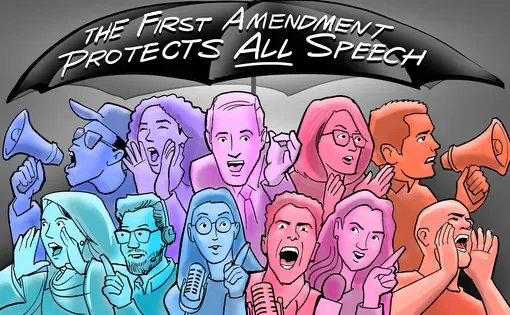
The First Amendment became a part of this founding idea of liberty, alongside the Declaration of Independence. It protects everyone’s speech, including the speech we hate.
This Gateway Journalism Review project is funded by the Pulitzer Center and contains the work of young and veteran journalists and lawyers in Missouri, Illinois, and other parts of the Midwest. St. Louis artist Steve Edwards illustrated the project.
It begins with an overview written by William H. Freivogel, the publisher of GJR who covered the Supreme Court for the St. Louis Post-Dispatch.
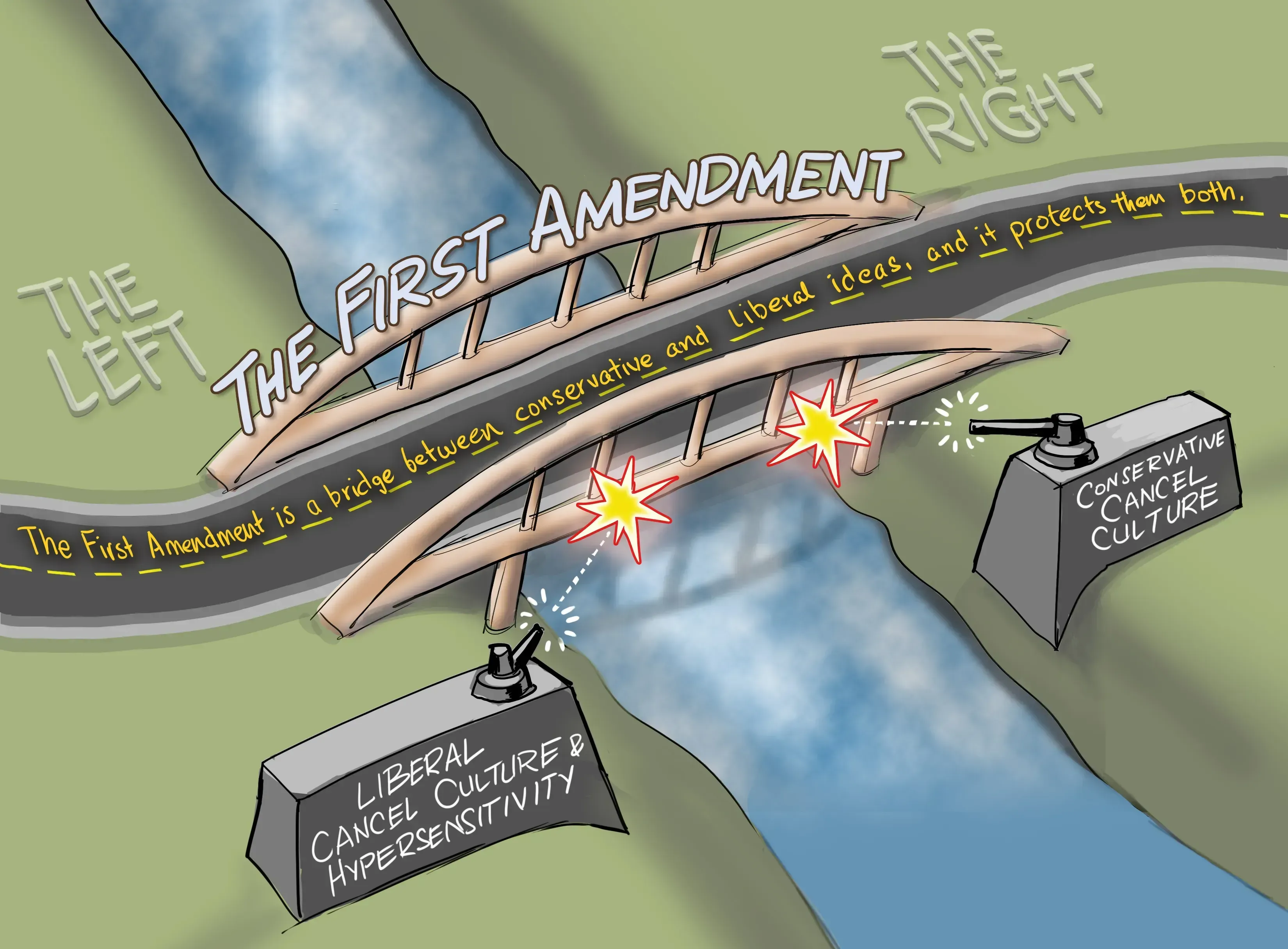
The introductory analysis recounts how President Trump emphasized the importance of the First Amendment during his campaign for a second term in 2024, criticizing “woke, cancel culture” for infringing speech. But Trump quickly pivoted after the election, issuing executive orders against big law firms, media companies, and universities—in violation of the First Amendment because they targeted critics and ideas.
Many of those institutions chose to surrender First Amendment rights and to make deals with the Trump administration worth hundreds of millions of dollars. The 2025 assassination of conservative activist Charlie Kirk, an advocate of free speech on college campuses, led to Trump administration threats against liberal nonprofits and a period of "cancel culture" from the right that temporarily removed TV late-night host Jimmy Kimmel from the air and resulted in threats by Trump’s FCC chair to review broadcast licenses. A civil liberties group documented a spike of 80 campaigns to punish individuals at universities for negative remarks about Kirk.
The recent turmoil over free speech shows that the winding road toward that more perfect union envisioned 250 years ago—where everyone enjoys the blessings of liberty—stretches far ahead.
(This report continues below.)
The bulk of this project focuses on individual First Amendment disputes, especially in the Midwest:
Contributors
- Journalist Alan Greenblatt retells the story of how he quit as editor of Governing magazine after his boss killed a story for fear of upsetting the Trump White House. The story was about the First Amendment.
- Paul Wagman, a former Post-Dispatch reporter, builds on years of reporting about the inaccuracies of the Gateway Pundit, a conspiracy-minded website. In his story, he follows the Pundit to the Pentagon press room, where new rules have disempowered the press.
- Carly Gist, a student editor at Southern Illinois University (SIU), reports on the Indiana University newspaper censorship story that resulted in the firing of the paper’s longtime adviser. Gist joins me in a podcast about the long-term negative impact of Hazelwood v. Kuhlmeier, the St. Louis Supreme Court case that denied editorial independence to student journalists.
- Molly Parker, an SIU colleague and reporter for Capitol News Illinois, joins me for a podcast on the community reaction in Breese, Illinois, to a controversial Proud Boys billboard.
- Felicity Barringer, a former New York Times correspondent, writes about the police search of the Marion Record in rural Kansas in 2023 and her memories of the 1971 police raid of The Stanford Daily, an event that led to a law barring newsroom searches.
- Reporter Kallie Cox describes the First Amendment playing out at a tense constituent meeting called by U.S. Rep. Wesley Bell, where pro-Palestinian protesters criticized his acceptance of pro-Israeli money permitted by the Citizens United Supreme Court decision.
- Glennis Woosley, editor of a high school news magazine in Nixa, Missouri, tells of pushing back against efforts to ban books in the library. The right of students to read remains in peril.
- Pulitzer Center Founder Jon Sawyer writes about the rewards of teaching The 1619 Project in schools that once taught egregious misrepresentations of slavery and the Civil War.
- GJR editor Jackie Spinner reports on ICE agents targeting people of color and journalists in Chicago immigration raids.
- Caroline Steidley, a Missouri University journalism student, interviews critics who say Washington University Chancellor Andrew Martin talks a big game on free speech, but doesn’t live up to it.
- Mark Sableman, a top St. Louis media lawyer, offers twin columns explaining how government actions that chill free speech or retaliate against unfavored speakers can violate the First Amendment.
- Journalist Marty Baron says in a St. Louis talk on the First Amendment hosted by GJR that he no longer takes for granted that the “rule of law will prevail.” But he remains optimistic because “there are promising signs of some rebellion against encroachments on free expression.”