Journalist Resource
 October 3, 2025
How We Exposed Texas’ Systemic Failures in Protecting Children
Country:


In an age where information is everywhere but often eludes the communities that need it most...

An investigation into the policy failures that left Texas children in dangerous homes as part of the StoryReach U.S. Fellowship resulted in reporting, events, and a searchable database highlighting stories of the 1200 children who died over six years after abuse in their homes had been reported to the state’s Department of Family and Protective Services (DFPS). Highlights include:
- Exposed systemic failures in Texas child protective services: The stories of the 1,200 child deaths linked to abuse/neglect, many after prior reports, were documented in a free, searchable database.
- Highlighted DFPS practices: Uncovered high case closure rates (up to 70%) without follow-up, showing gaps in oversight.
- Legislative outreach led to increased awareness among lawmakers about local child deaths and DFPS shortcomings.
- Sparked discussions among child welfare executives, social workers, and the public on the effectiveness of family preservation policies through a call-in radio show and in-person events hosted by Texas Public Radio and the American Enterprise Institute.
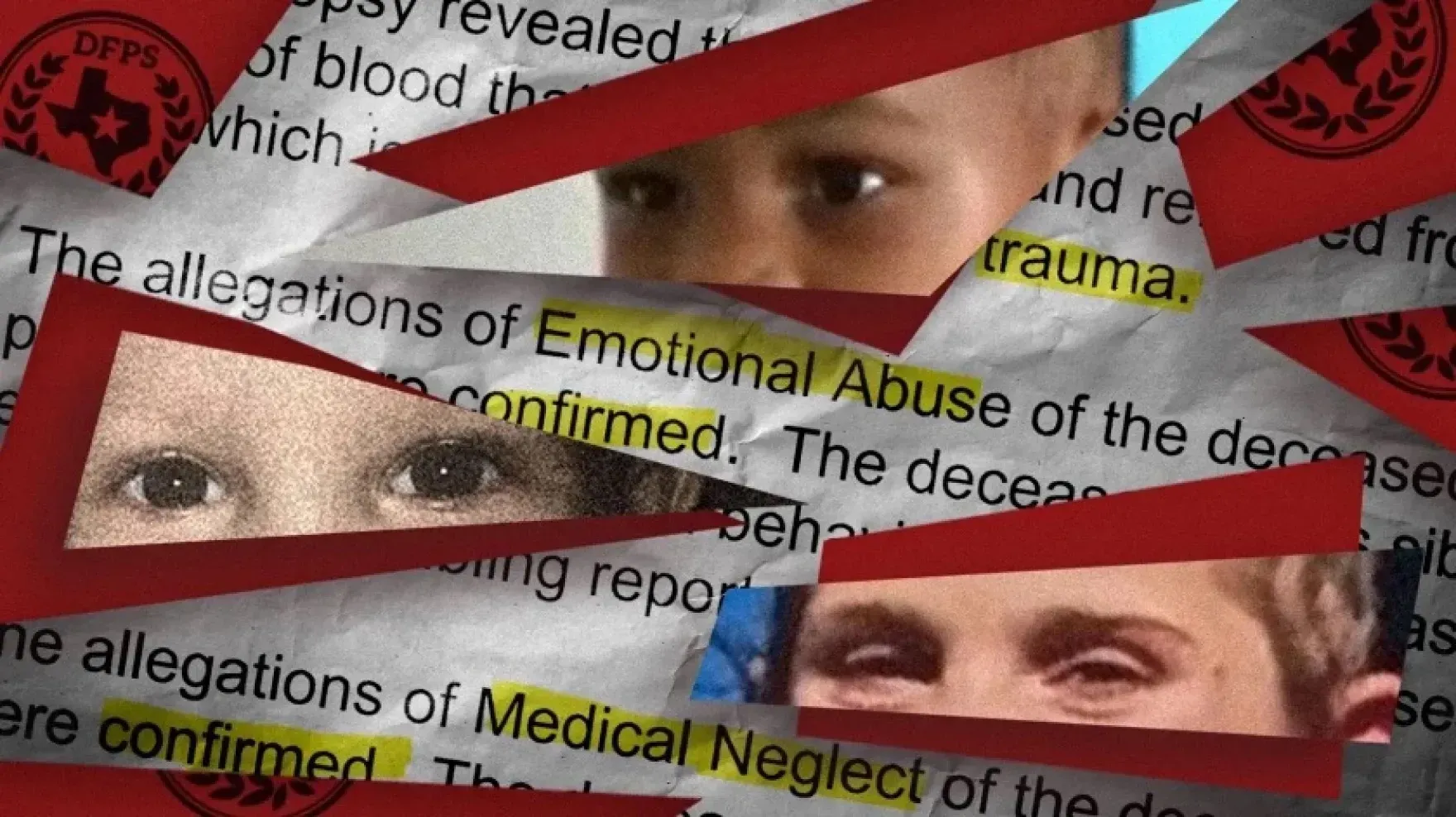
When Home Is the Danger is an investigative series and interactive website on child abuse and neglect deaths in Texas and how policies and law changes have in many cases made children less safe—leaving them in dangerous homes while obfuscating data on child fatalities.
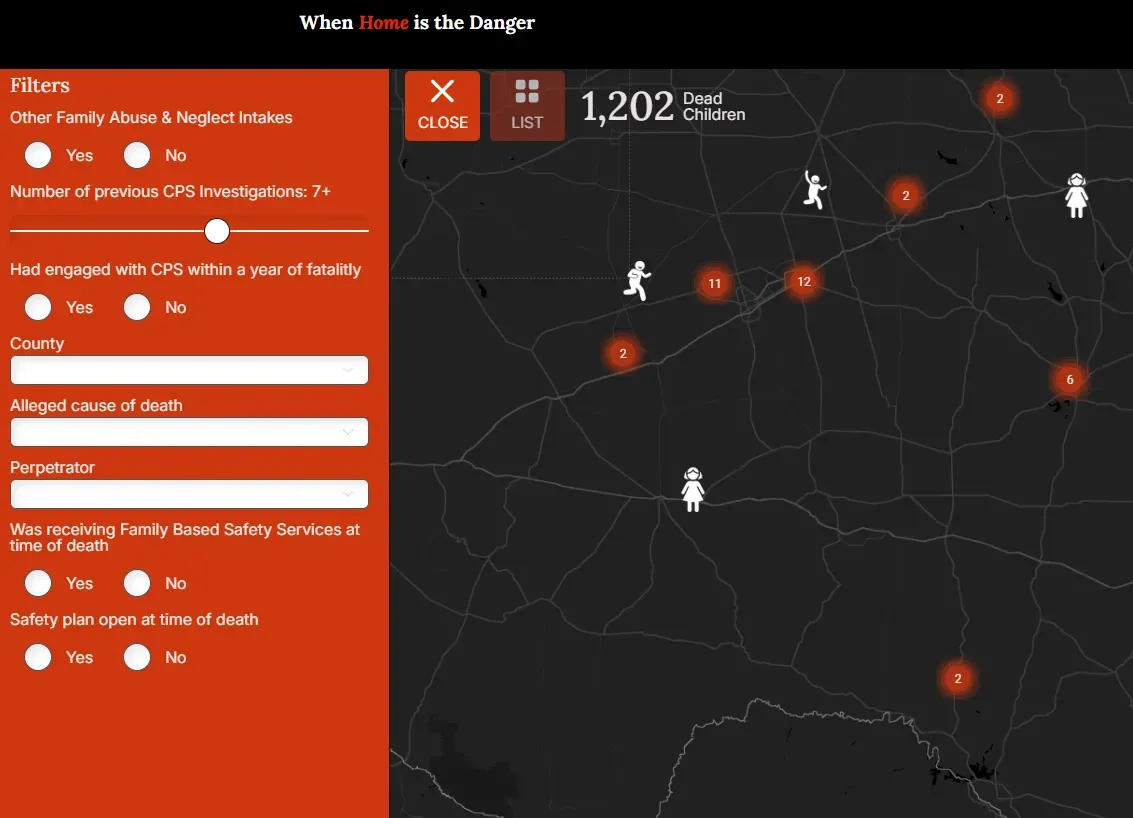
With WhenHomeIsTheDanger.org, I wanted to give a name to each of the more than 1,200 children who died from abuse and neglect between 2018 and 2023 in Texas. So often the names are obscured, and aggregated. The state’s role in individual cases goes unexamined. The website is additionally a home for the video, audio, and print stories, as well as a trove of data and narratives around children who died, gleaned from state reports obtained by Texas Public Radio. On the website, visitors can see a map of fatalities broken down by county to get a sense of how massive the number 1,200 is, even in a big state like Texas. The searchable database can be filtered by things like county, manner of death, number of previous state investigations into families and caregivers, as well as services provided.

As a nonprofit journalism organization, we depend on your support to fund more than 170 reporting projects every year on critical global and local issues. Donate any amount today to become a Pulitzer Center Champion and receive exclusive benefits!

Pre-reporting
I am a station-based reporter and editor at Texas Public Radio. Since this was just one project among many, I worked on it for far longer than the yearlong Pulitzer Center StoryReach Fellowship. Most of that time was spent building the database, refining/analyzing the data, and finding sources who could provide context.
A child welfare advocate reached out to me shortly after I published a series on how the state doesn’t support child sexual abuse and trafficking victims. They told me about the issues with a 2021 law change making it more difficult to remove children from dangerous homes.
The source said his organization was hearing horror stories from families and Child Protective Investigations workers about how the state was not acting in many cases. Representing that in data was very difficult. That person had public data from the state showing that the number of abuse and neglect cases being confirmed had dropped a little but that the number of removals had dropped immensely, but the aggregate and nameless data was far from conclusive.
The first thing I did was scan other media, finding a few organizations speaking up with concern about the law change. All the concerns were broad based and without data though.
At this point the story was exploring the impact of the lack of power to remove children by the state.
First I requested five years' worth of fatality reports from the Texas Department of Family and Protective Services (DFPS). These are statute-mandated reports of a child’s death with name, county of residence, gender, some details about previous interactions with state, and the narrative of the death. This would become the backbone of the reporting.
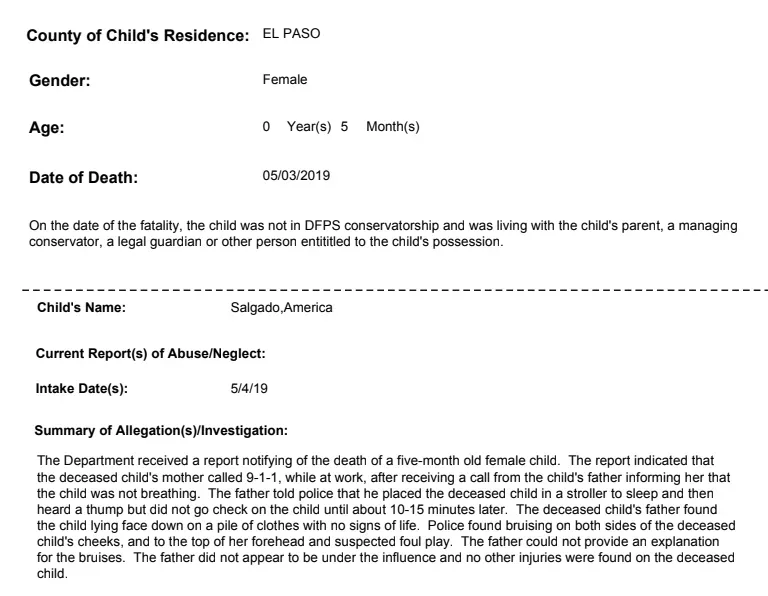
Obtaining these documents would ultimately take six months and threats from our lawyers. There were more than 1,000 reports for the 2018-2022 time frame I requested. By the time they were released, I had to submit one for the following fiscal year as well. Those records were produced more quickly.
At this time I also requested data around Family-Based Safety Services or Family Preservation Services. These are services for caregivers who have been found to have abused or neglected their children. The services can include drug testing, treatment, domestic violence prevention, protective day care, and ongoing monitoring by a social worker. One of the former DFPS workers I contacted suggested that the services became more difficult to get around 2020. I requested the number of families who were rejected or dropped out within 21 days. The numbers of rejected families would shoot up 700 percent in a single year. It took several months to obtain these as well.
I wrote about some of my problems obtaining data from the department in this report.
Throughout this time period, I was reporting regularly on other items related to foster care and Texas prisons. This project was an unfunded backburner.
I began coming in early and on weekends to build the database. The big problem was how narrative-based the documents were. It was great as far as reporting, but terrible in terms of aggregating data through an automated system like Google Pinpoint. Pinpoint allows users to build a template of what data points to collect from masses of repeated forms. The problem was these fatality reports vary in length and detail dramatically, some two pages, some 10 or more.
Ultimately I was only able to collect about five columns worth of data in an automated way (name, county of residence, gender, date of death, date of intake, and whether or not they were in DFPS custody at the time). The other 37 or so columns would ultimately be populated by reading each individual fatality narrative and extracting details—like who the alleged perpetrator was, whether drugs or alcohol were involved, and many other small details—and entering them into the database manually.
The first version of the database was completed in early 2024. It looked like this, but longer.
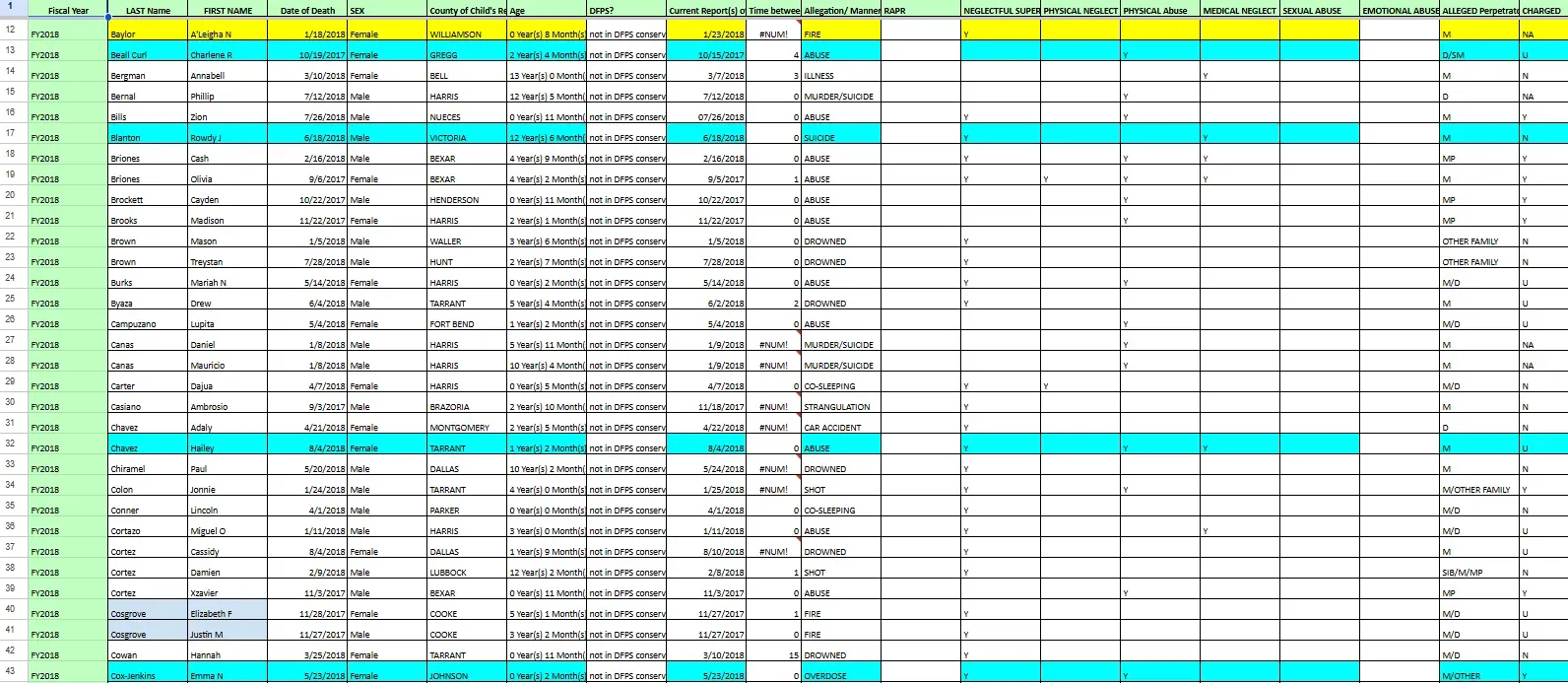
I would probably review this data two dozen times, refining, and re-reading the 1,200 fatality reports for accuracy. Each data item included in the story would receive special attention to ensure we got it right. We then handed off a version of this data to our web developers. They would spend a couple of months building WhenHomeIsTheDanger.org. This was one of the major items for which we needed funding from the Pulitzer Center.

Sources
Finding real sources from inside DFPS was always going to be a challenge. The department has been in a period of an “us versus them” bunker mentality for many years. It has been fighting federal court oversight since 2011. But people who could breathe life and context into the sanitized fatality reports were vital.
At one point I tried an ill-fated data scrape of Linkedin for former investigators. Out of more than 500 profiles I viewed (which is when LinkedIn stopped me from being able to search, worried I was a bot), I probably got responses from six-10 people. Two to three of those actually had interesting insights and one had real suggestions for data to request.
I began searching documents I had from the longstanding federal lawsuit against the state over its foster care system, searching for sources who spoke out. I found Sharon Fonvielle-Baughman’s resignation letter from 2023. She had been a director of Special Investigations within DFPS and was well respected. In the letter she lamented the state’s dire backlog in investigations.
At this point I had the good fortune of being given the Pulitzer Center’s StoryReach Fellowship. The money for this made everything that came next possible.
I booked a flight to Dallas to speak with Fonvielle-Baughman and pet her many cats.
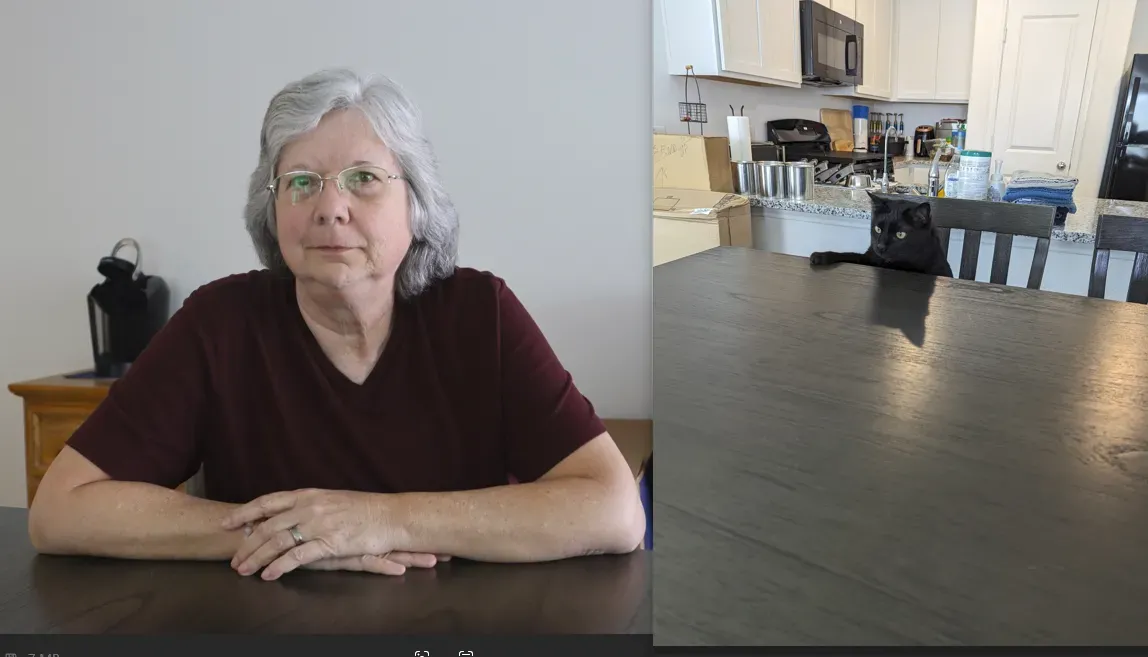
Fonvielle-Baughman proved extremely helpful. She looked at several of the documents I had and offered insights on how to connect with other former and current DFPS employees. Throughout the project I would connect with a couple dozen current and former DFPS investigators and executives, speaking with two former commissioners.
She also provided good context for her concerns around the staff turnover and the massive backlogs in investigations. I used her details to request additional data from DFPS regarding communications and backlogs.
More open records requests followed. Just in 2024 there were dozens of open records requests for various items. Many had to do with gaining autopsies from various medical examiners and incident reports from various police departments. This was how I learned about large carve-out exemptions in the state’s open records laws. I wrote about this in one of the stories, but Texas allows law enforcement declining releasing any reports dealing with child abuse investigations even if a child dies, except for limited reports from DFPS.
After going through the data, and determining several key trends, I limited my efforts to about two dozen children and started doing a deep dive on them, attempting to gain records through courts and elsewhere. I crisscrossed the state a few times, spent days observing trials for at least three deaths, and interviewed family members from multiple families. All of this traveling and time was funded by the Pulitzer Center.
We published stories on around seven children and others have been in the works.
Locating families proved difficult for many reasons. One was that state records did not list parents or anyone but the deceased child, who often did not share a last name with one or both caregivers at the time of death. Through a variety of shoe-leather and internet search databases I tracked down many of them, but there were challenges.
Many families we reached out to did not want to speak with us. In some cases the guilt and shame that run through surviving loved ones in child abuse and neglect tragedies are powerful and debilitating. In other instances, all the family left that existed were the perpetrators.
Thankfully, there were several families who gave us their time, had questions about what happened, or who wanted to speak out.
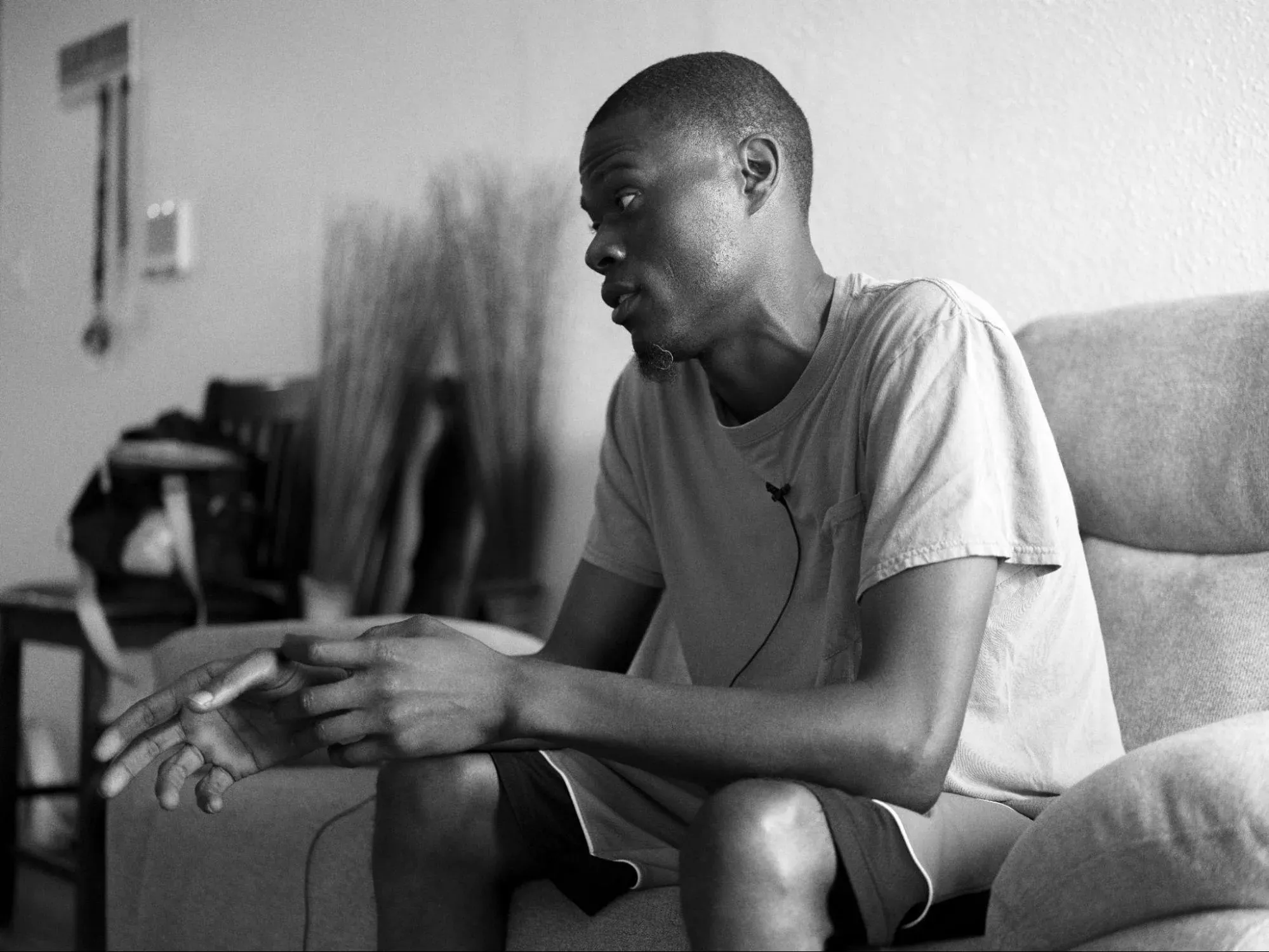
Eddie Williams was one of the relatives who had been left in the dark by DFPS.
His daughter, A’Lona, was killed after abuse and neglect by her mother (his ex-wife) and her mother’s boyfriend. Williams described how the first time he found out there had been an abuse investigation into his ex-wife and her boyfriend was after his child’s death. DFPS had excluded him from the process, not telling him that his daughter had been taken to the hospital multiple times and that multiple times hospital staff called DFPS, warning of potential abuse.
Instead of removing A’Lona and placing the girl with him, they gave his ex-wife and her boyfriend a Safety Plan, a plan mutually agreed on by a caseworker and family to keep a child safe. We wrote about how often these plans fail like A’lona's.

“The StoryReach Fellowship shifted how I thought about the audience and has influenced how Texas Public Radio will report big stories in the future.”

Audiences
The StoryReach Fellowship shifted how I thought about the audience and has influenced how Texas Public Radio will report big stories in the future. By using the engagement framework, we were able to identify numerous groups we believed would have an interest. The simple act of talking among our team about possible audiences really inspired a lot of work to be done reaching out to them.
The first group we identified included those who were specifically tasked with child protection and foster care.
Many of these groups were happy to be asked to share the work. We spoke with Court Appointed Special Advocates (CASA), which works directly with foster care youth, about adding us to its newsletter and were able to secure thousands of extra sets of eyes on the work. CASA San Antonio has a newsletter that reaches 5,000. Dallas CASA also added us to its newsletter.
We heard from some groups that were involved in child placement, as well as service providers, that they felt pressured to not share the series out of concern over state reaction, and potential threats to their funding.
Our second audience was the general public. We produced four stories locally that were later rebroadcast across Texas on The Texas Standard, a statewide news show that airs each day on every station in the state.
The show had me do an interview segment to promote the series. I am currently producing one last story that will likely also run on The Texas Standard.
At Texas Public Radio in San Antonio we hosted an hourlong call-in show that included a local state senator, a woman who had lost a great-granddaughter to abuse, an advocate, and myself. In addition, I turned our multiple stories into a 30-minute documentary that aired on a show we pushed to several stations across the state.
Both shows run at the same time and reach more than 6,000 people live each day on average and around 3,800 in a second run at 7 p.m. Central. We also received support from other public radio stations in Texas.
The website itself is aimed at the general public, and we have seen people use it to locate information about their loved ones.
The next audience was the legislature. The series came out during the legislative session.
We decided to do an email campaign in which we singled out children in their region (where we could) who died from abuse and neglect despite multiple interactions with DFPS.
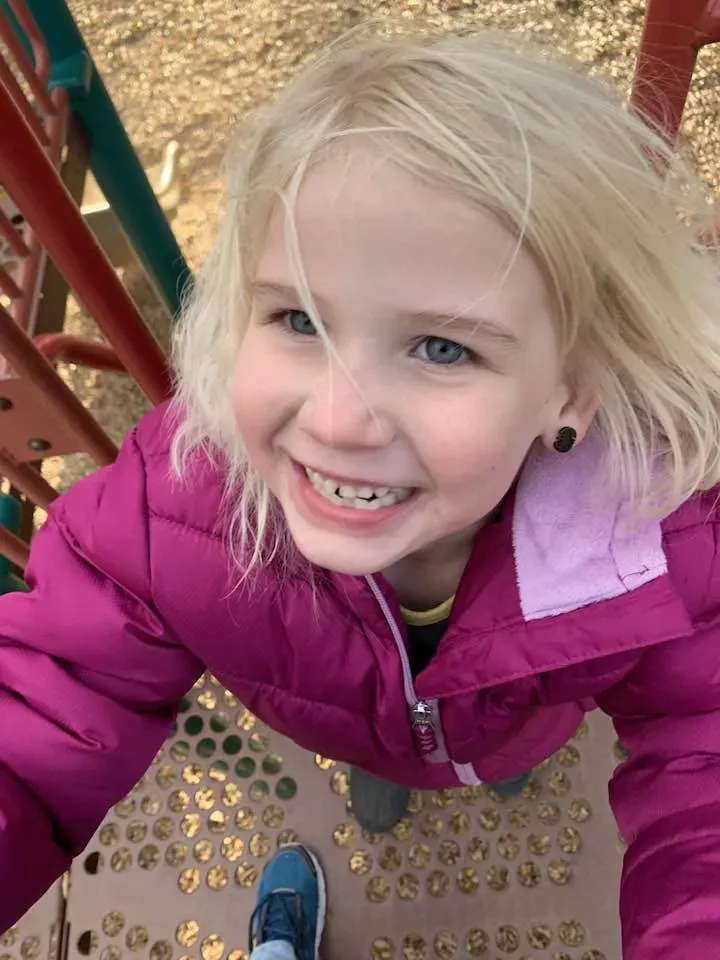
I wrote around 16 different email variations. HardiQuinn Hill's was one story we told in the mass email to legislative staff.
After the main stories were published, we sent these designed emails to 480 legislative staffers. The open rates varied, but many exceeded 30%.
Afterward, a state senator from Austin shared our series with thousands of constituents in her newsletter.
Our attempt to get follow-on coverage was less successful, though. We had hoped by sending a press release to local and statewide news stations that we might get more attention through other media. We failed.
However, since the publication of the series we have also heard from organizations working on similar projects, like the Lives Cut Short initiative from the American Enterprise Institute (AEI).
AEI hosted a panel discussion with me and three others talking about how Texas cares for children. The event was held during a gathering of conservative state child welfare executives, and around 40 of them showed up to the event. A few dozen more watched online. It was extremely interesting to have them discuss during the Q&A section how family preservation works and doesn’t work in their states. One leader, clearly wanting to believe in the strategy, said she was not seeing it work in data.
“…Taking the opportunity to talk with your team or even just ruminate yourself about who is going to be interested in your work will pay dividends. For most projects it will likely lead to more sources for the journalism you hope to do.”

Conclusions
In conclusion, this reporting project would have been impossible without the support of the StoryReach Fellowship, and it gave TPR a number of new tools and processes to approach pushing our stories to audiences.
We intend to refine, develop, and continue to use mass emails to promote our work to targeted audiences. Similarly, we are exploring how to incorporate the engagement framework into our normal project workflow. Also, the process of promoting the project pushed our staff to develop more robust calendars for promotion, which increased the planning around multiple platforms. This calendar has become the norm for our project promotion.
I would encourage other journalists to use the engagement framework going forward. While I know that journalists are busy and the idea of what constitutes office work can be a nonstarter, taking the opportunity to talk with your team or even just ruminate yourself about who is going to be interested in your work will pay dividends. For most projects it will likely lead to more sources for the journalism you hope to do.