
Project
Forest for Tycoons
More than 150 companies apply for permits to control millions of hectares of forest areas.
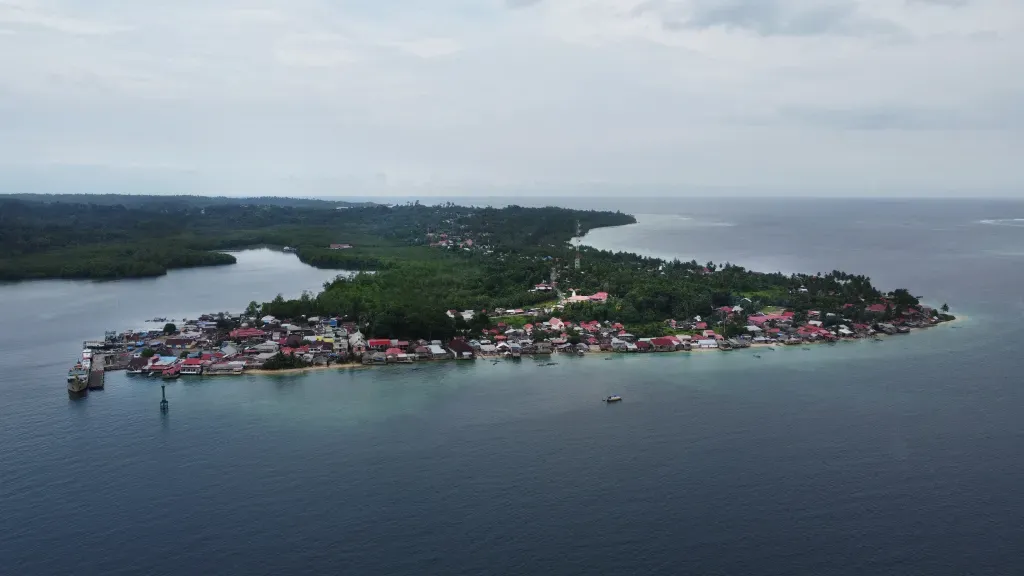
Sumber Permata Sipora is setting its sights on the last remaining natural forests on Sipora Island. And some corporate giants are emerging behind the scenes.
Bacalah ini dalam bahasa Indonesia.
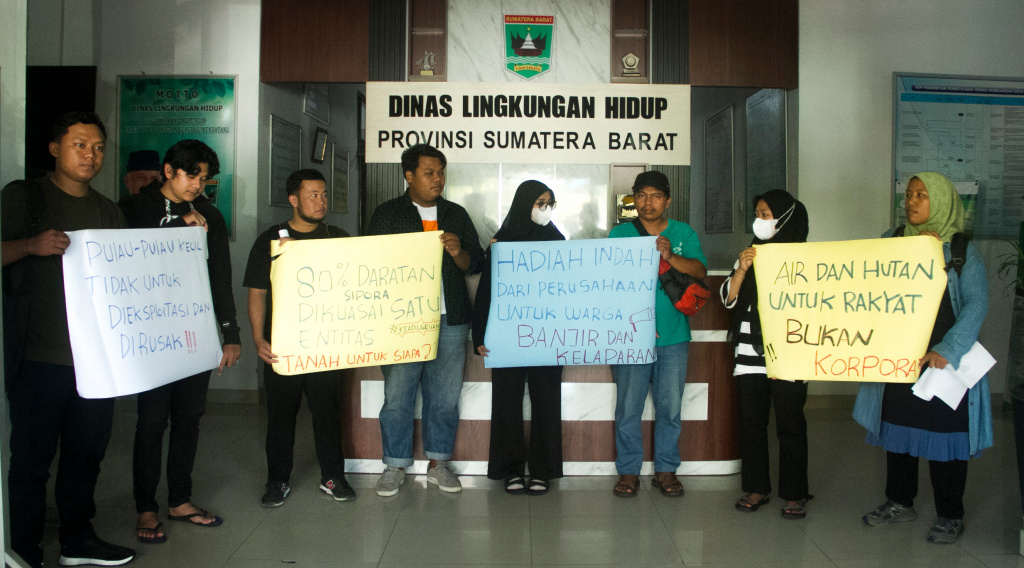
RIFAI Lubis harbored deep doubts about the environmental impact analysis (ANDAL) submitted by Sumber Permata Sipora (SPS) for its planned operations on Sipora Island in Mentawai Islands Regency, West Sumatra. “These people are linked to the company next door,” said Rifai, a representative of the Qbar Madani Indonesia Regional Association, during a meeting of the Environmental Feasibility Test Commission at the West Sumatra Environmental Office on Thursday, May 22, 2025.
By ‘company next door,’ Rifai was referring to the Forest Concession Right (HPH) holder operating on nearby Pagai Island, one of the smaller islands off the coast of Padang. Though he did not name the company outright, everyone in the room understood he meant Minas Pagai Lumber, which has controlled 78,231 hectares—out of the 122,200-hectare island—since 1972.

As a nonprofit journalism organization, we depend on your support to fund more than 170 reporting projects every year on critical global and local issues. Donate any amount today to become a Pulitzer Center Champion and receive exclusive benefits!
A coalition of civil society groups in Padang once reported the concession holder to the Ministry of Forestry over allegations of logging beyond its permitted area in 2016. But the case evaporated without legal consequence. According to the Ministry of Law’s General Legal Administration website, the company is led by Haji Bakhrial, a well-known timber, oil palm plantation, and coal mining magnate in West Sumatra.
For the past two years, rumors have circulated that Bakhrial intended to expand his operations into Sipora Island. The buzz grew louder when SPS secured an Identification Number for Risk-Based Business Licensing from the Ministry of Investment on January 12, 2023. This was followed by a public outreach session on July 1, 2023, at the South Sipora subdistrict office to discuss a proposed 20,706-hectare timber concession.
SPS only publicly introduced itself during the official ANDAL and Environment Management Plan-Environment Monitoring Plan (RKL-RPL) presentation on May 22, 2025. Representing the company was its director’s proxy, Daud Sababalat, along with consultant Dasa Iskandar Ogo. A group of academics served as reviewers, accompanied by West Sumatra Environmental Office Chief Tasliatul Fuaddi.
The company’s explanations failed to reassure Rifai. Instead, his concerns deepened when the meeting concluded with approval of the ANDAL and RKL-RPL through an official Environmental Feasibility Test Commission report signed by all attendees. “We, a coalition of 19 civil society organizations in West Sumatra, suspect the company can proceed because of the powerful names behind it,” said coalition spokesman Buyung Askurnis.
Tasliatul Fuaddi insisted the government remains open to public criticism. He even allowed civil society representatives opposing SPS to read their demands during the commission meeting. “Our ANDAL recommendation is not an approval or rejection,” he said, “but rather a study and input to be forwarded to the Forestry Minister.”
•••
ACCORDING to the deed filed with the Ministry of Law’s General Legal Administration (AHU), Sumber Permata Sipora is registered at The City Tower, 12th Floor, Unit 1-S, in Central Jakarta. Its shareholders are Sumber Potensi Semesta and Sumber Potensi Sejahtera. Haji Bakhrial is listed as a director, Sugianto Gunawan as a commissioner, and Acmad Syam Basigar as chief executive officer (CEO).
Ownership records show that Sumber Potensi Semesta is ultimately controlled by Bakhrial, who also serves as its majority shareholder. Meanwhile, Sumber Potensi Sejahtera is owned by Cynthia Gunawan and Sugianto Gunawan.
SPS is also listed on the website of Padang Mulia Group as a subsidiary operating in the forestry sector. It is one of the business units under the group’s umbrella. According to the AHU website, Garibaldi Thohir is registered as the ultimate beneficial owner of Padang Mulia’s shares.
Padang Mulia itself is a coal mining company with a 2,434-hectare concession in East Barito Regency, Central Kalimantan. The company’s official deed also lists former Home Affairs Minister in 2009-2014, Gamawan Fauzi, as its president commissioner, along with Andi Masmiyat as CEO and Carolus Niode Sahetapy as director. Shareholders include Bakhrial and Makmur Permata Sejahtera.
Tempo sought clarification from Garibaldi Thohir regarding his alleged ties to Padang Mulia. Febriati Nadira, Head of Corporate Communication Division at Alamtri Resources Indonesia (ADRO), denied any link. “Garibaldi Thohir does not own shares in the company in question, so the information is inaccurate,” she said on Wednesday, May 28, 2025.
Gamawan Fauzi offered a different explanation. He said the Padang Mulia Group website was created when the company was still owned by Garibaldi. The firm was later sold to Bakhrial. “Padang Mulia was sold to Haji Bakhrial around 2023,” Gamawan told Tempo on May 28. He added that he currently serves as commissioner at Padang Mulia at Bakhrial’s invitation and stressed he has no ties to SPS.
A letter requesting comment from Bakhrial was delivered through SPS director’s proxy Daud Sababalat. As of publication, Daud had not responded to an attached list of questions.
•••
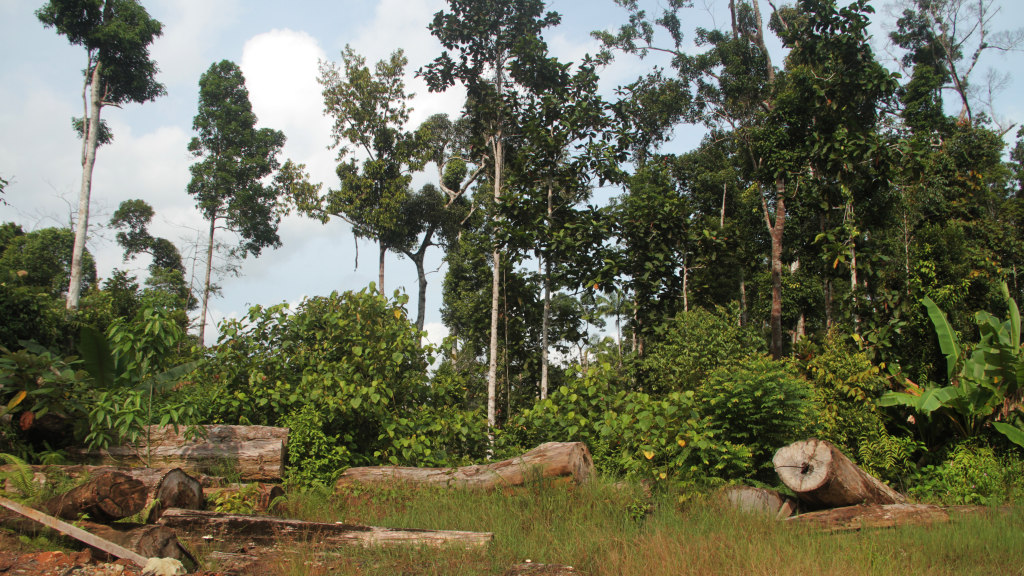
LONG before Sumber Permata Sipora arrived, Sipora Island had already been under threat from deforestation. Logging has repeatedly triggered flash floods on the island. “If it rains heavily for just half a day, flooding is inevitable,” said Alpian, 42, Secretary of Saureinu village in South Sipora subdistrict, in September 2024.
Motivated by the flooding, Alpian and other villagers began protecting their customary forest. They started in 2018 by registering 7,937 hectares of customary land with the Customary Area Registration Agency (BRWA). A year later, the regency government and the Ministry of Forestry recognized 5,739 hectares of that land as the Uma Saureinu Customary Forest, shared by 13 indigenous groups.
But official recognition was not enough to save the forest or prevent worsening floods. The upstream area of the Saureinu River had already been stripped bare. “We have been traumatized by previous firms,” said Nathan Siritoitet, Head of the Saureinu Customary Law Community. “Companies came asking for permission, destroyed the forest, the floods came, and they just left.”
Nathan’s concerns are shared by residents of eight villages within SPS’s concession area. They fear the company’s logging plans will destroy at least 18 watersheds on Sipora Island.
The people of Saureinu depend on the river for their livelihoods. For generations, they have lived along the banks of the Saureinu River, which empties into the Mentawai Strait. In the past five years, floods have forced villagers to relocate to higher ground, about 500 meters from the river.
Norvi, 45, has felt the impact most acutely. A cultivator of toek—a local name for woodworms—he has seen his income plummet. The decaying logs that serve as breeding grounds for the worms are often washed away by floods. “Now I tie the logs to trees,” Norvi said, when met along the Saureinu River in September 2024.
Some 457 families in Saureinu depend on forest products, including the toek cultivation. The method is simple: Logs are soaked in the river for three months until they rot and become infested with worms. The logs are then split open for harvest. According to Norvi, a single log yields worms worth Rp20,000 to 50,000 (around US $1.23-$3.00).