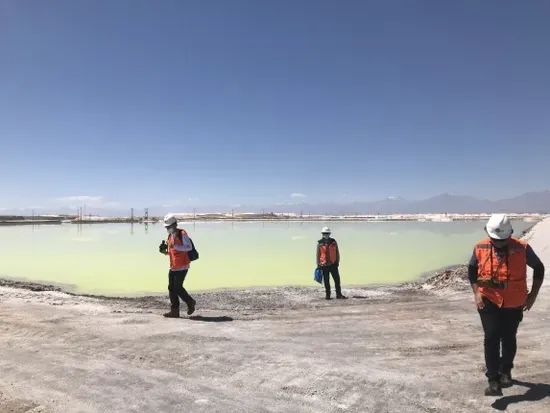
This letter features reporting from “Chile’s Conundrum: Will Saving a Desert Hinder Global Energy Transition?” by Vince Beiser
Dear Senator Alex Padilla,
Just like a body cannot survive without a heartbeat, green energy cannot survive without lithium. As I write this letter from my home in the Bay Area, roofed with solar panels, with an electric car in my garage and every neighbor on the block driving an EV, it’s fair to say that I am surrounded by green energy. At the core of this transition, however, are lithium-ion batteries.
In his Pulitzer Center-supported story, “Chile’s Conundrum: Will Saving a Desert Hinder Global Energy Transition?”, Vince Beiser explores the human and environmental impact of the Atacama lithium boom. Lithium is incredibly effective in batteries because it is the lightest metal and still preserves a high energy storage capacity. Beiser’s article explains that the process of mining lithium involves sucking up and pumping brine water from underground, and then allowing the salty water to dehydrate in the sun. After the water evaporates, what’s left is a lithium-rich deposit. While the process is more environmentally sustainable than traditional mining methods, it's still highly water-intensive. Local communities suffer from its effects on drying up the desert and depleting biodiversity. Even though the article reports on Chile, the warnings about water depletion, Indigenous harm, and unregulated brine extraction are directly relevant to California’s Lithium Valley project. California’s own Environmental Impact Report for Lithium Valley acknowledges similar concerns as the Atacama Desert. However, it does not close the gap or propose solutions to address these critical issues.
Senator Padilla, from your support for the emerging Lithium Valley to investments in zero-emission vehicle charging and fueling infrastructure, it is clear that you care deeply about the ongoing issue of sustainable energy. If we don’t create environmental safeguards and transparency, we risk seeing devastating environmental and social impacts like those in the Atacama Desert. The reality is unavoidable. Beiser’s article estimates that lithium production must increase fortyfold by 2040 to make a meaningful impact on global warming. If the clean energy transition is meant to be truly “clean,” then mining practices should be sustainable, ethical, and transparent. My suggestion is for California to mandate reporting on lithium sourcing, water usage, mining practices, and land-restoration plans. We can build on existing reports by collaborating with environmental activists and nonprofits in order to add new suggestions and continue developing more sustainable methods. Second, California could reform its tax strategy to encourage companies to be more environmentally conscious. Bills like AB 208 involve redistributing taxes to the counties from which lithium is mined, already showing priority for local communities. However, the taxes are charged on the volume of lithium produced, which conditions companies to minimally comply instead of finding the most sustainable practices. By restructuring our tax policy, we can encourage companies to be more environmentally conscious. Lastly, we can invoke local change within California by empowering consumers to choose environmentally friendly products by labeling lithium products as Free, Prior, and Informed Consent (FPIC), giving recognition to products sourced responsibly.
Senator, lithium is truly the beating heart of clean energy; overworking it will only poison sustainability efforts. The world's supply of lithium is a global issue, and California has a unique opportunity to set the standard for regulation everywhere as both a consumer of lithium and a producer. With your help, we can strengthen the beating heart of this transition to make it truly sustainable and equitable.
Sincerely,
Krisha Umashankar

Krisha Umashankar is a junior at California High School whose passion sits at the intersection of gender equity, justice, and community impact. As an advocate with Girl Up, a United Nations founded movement for gender equality, she has led campaigns to prevent gender‑based violence, expand menstrual health access, and empower young women to speak up for their rights.
Her curiosity about environmental justice and Indigenous sovereignty inspired her research on the Atacama Desert, where she examined gaps in legislation meant to protect both the land and the communities who depend on it.
Krisha also brings her passion for justice into the courtroom through Mock Trial and enjoys learning about international legislation through Model UN. Outside her advocacy and academic work, she plays a sport called curling that keeps her grounded, focused, and always learning.
Read more winning entries from the 2025 Local Letters for Global Change contest!
Student letters reflect the authors’ views. Students choose their own topics and act independently if they decide to share their letters outside the classroom. The Pulitzer Center is a nonpartisan 501(c)(3) organization that does not endorse candidates, parties, or specific legislation. Our publication of student work is for educational purposes.