Journalist Resource
 September 30, 2025
How To Track Ships Like a Pro Using OSINT (Part I)

Knowing how to track ships helps journalists uncover hidden stories and hold wrongdoers accountable. From drug trafficking and illegal fishing to the smuggling of goods and weapons, maritime monitoring can reveal hidden activities and uncover patterns. Whether your focus is on ocean issues or broader geopolitical dynamics, this toolkit will help you interrogate vessels and report on them with greater depth.
In the first part of this toolkit we will talk about a vessel’s identifiers, corporate structure, crew information, and open source intelligence (OSINT) formulas that can help you find leads. In the second part of this toolkit, we cover tracking tools, historical AIS (Automatic Identification System) data, satellite imagery, port records, and ship registries to find a vessel’s whereabouts and activities. We’ll also provide a list of important platforms (free and paid), investigative use cases, and step-by-step examples that will help you expand your maritime OSINT capabilities.
The protagonist of “Part I” is a ship called Gelendzhik. It appeared in my research when I was looking into deep-sea mining, and something about its “rusty keel” sparked my interest. I also thought it would be a fun exercise to conduct OSINT research in a language I can’t understand, to show what is within reach when journalists are conducting a similar analysis.

As a nonprofit journalism organization, we depend on your support to fund more than 170 reporting projects every year on critical global and local issues. Donate any amount today to become a Pulitzer Center Champion and receive exclusive benefits!
So we have its name. But what other information do we need to know in order to understand it better? And where can we find it? The first place I’d go to is MarineTraffic (a partially free platform). There, we can establish an analogy between ships and people—with nationalities, ID cards, phones, families, professions. In vessel terms, that would translate to:
- Flag (nationality): Russia
- IMO (ID number given by the International Maritime Organization): 8826230
- MMSI (the Maritime Mobile Service Identity is an ID number that relates to the ship’s radio, so you can think of it as a person’s phone, always with them): 273434310
- Port of registry (family): NOVOROSSIYSK in 1989
- Vessel type (profession): Research/Survey Vessel
MarineTraffic will give you all of this information and more. On the website, we can see ownership structure, similar vessels, and that, as I write this, Gelendzhik is heading toward the city of Chazhma, Russia.
Now, let’s move to ownership
To map ownership, we first need to understand these categories:
- Beneficial Owner: the entity or entities that own, control, and profit from the vessel.
- Registered Owner: individual or entity officially recorded as the vessel’s owner in a country’s national ship registry.
- Commercial Operator: responsible for financial and operational aspects of a vessel’s employment on behalf of its owner.
- Technical Manager: responsible for physical maintenance of a vessel. This includes repairs and operational efficiency.
- Third Party Operator: operates a vessel’s day-to-day on behalf of the owner.
- ISM manager: responsible for ensuring adherence to the International Safety Management (ISM) Code.
My favorite platform for tracking vessel ownership structures is Equasis, which is free. With Equasis, we can see that a company called YUZHMORGEOLOGIYA JSC is the “Registered owner” and the “Ship manager/Commercial manager” of Gelendzhik.
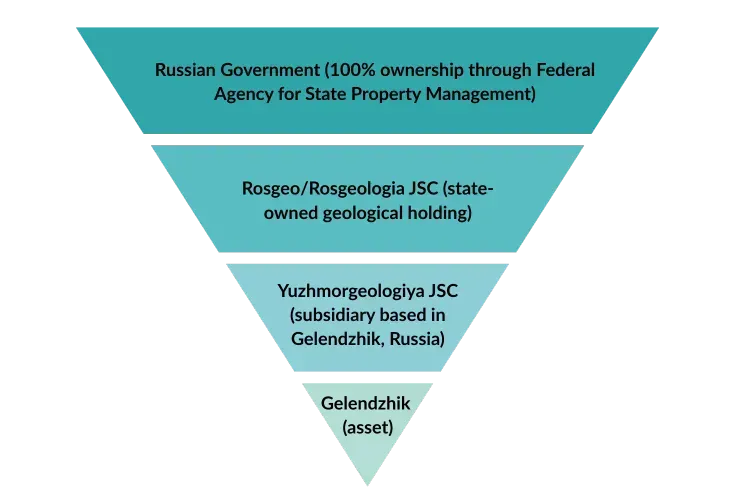
So we know that Yuzhmorgeologiya JSC (АО "Южморгеология") owns and operates the Gelendzhik. This company is a subsidiary of Rosgeo (JSC Rosgeologia), Russia's largest state-owned geological holding company. The ownership hierarchy is:
Equasis will also show you the documents of compliance, the synthesis of inspections, and other relevant information. When I’m doing this type of research, there are two key points that I try not to miss: the company’s fleet (a list of vessels under its umbrella) and the address in which it is registered. Here’s a screenshot of the fleet:
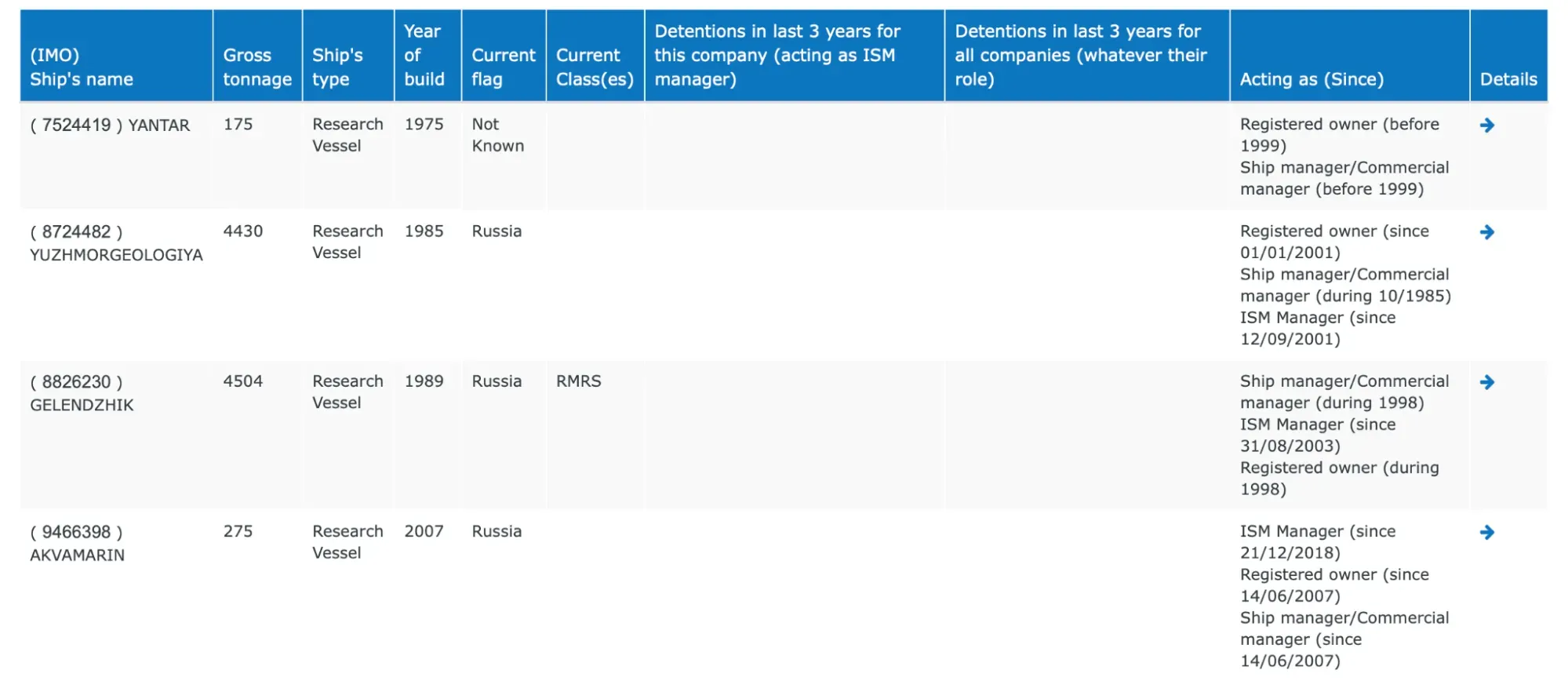
I want to call your attention to the second vessel on this list. YUZHMORGEOLOGIYA (IMO: 8724482). With a simple search in Open Sanctions, you can see that this ship has been sanctioned by the USA and Ukraine.
With the address “ul Krymskaya 20, Gelendzhik, Krasnodarskiy Kray, 353461, Russia”, you can search for it not only in Google Maps, but also on other websites. According to the Ukrainian Intelligence Agency website War Sanctions, there was a match in the address, but also new information, such as:
- Full name of legal entity: JOINT-STOCK COMPANY SOUTHERN SCIENTIFIC AND PRODUCTION ASSOCIATION FOR MARINE GEOLOGICAL EXPLORATION
- Tax number: 2304070606
- Registration number: 1162304051370
These identifiers are especially helpful when you are cross-referencing your findings with other datasets in platforms such as OCCRP's Aleph, for example. And, if you want to further understand corporate relationships, you can also use Sayari (paid platform). This platform will help you understand vessels in terms of ownership, trade, sanctions, risk exposure, and other relevant information.
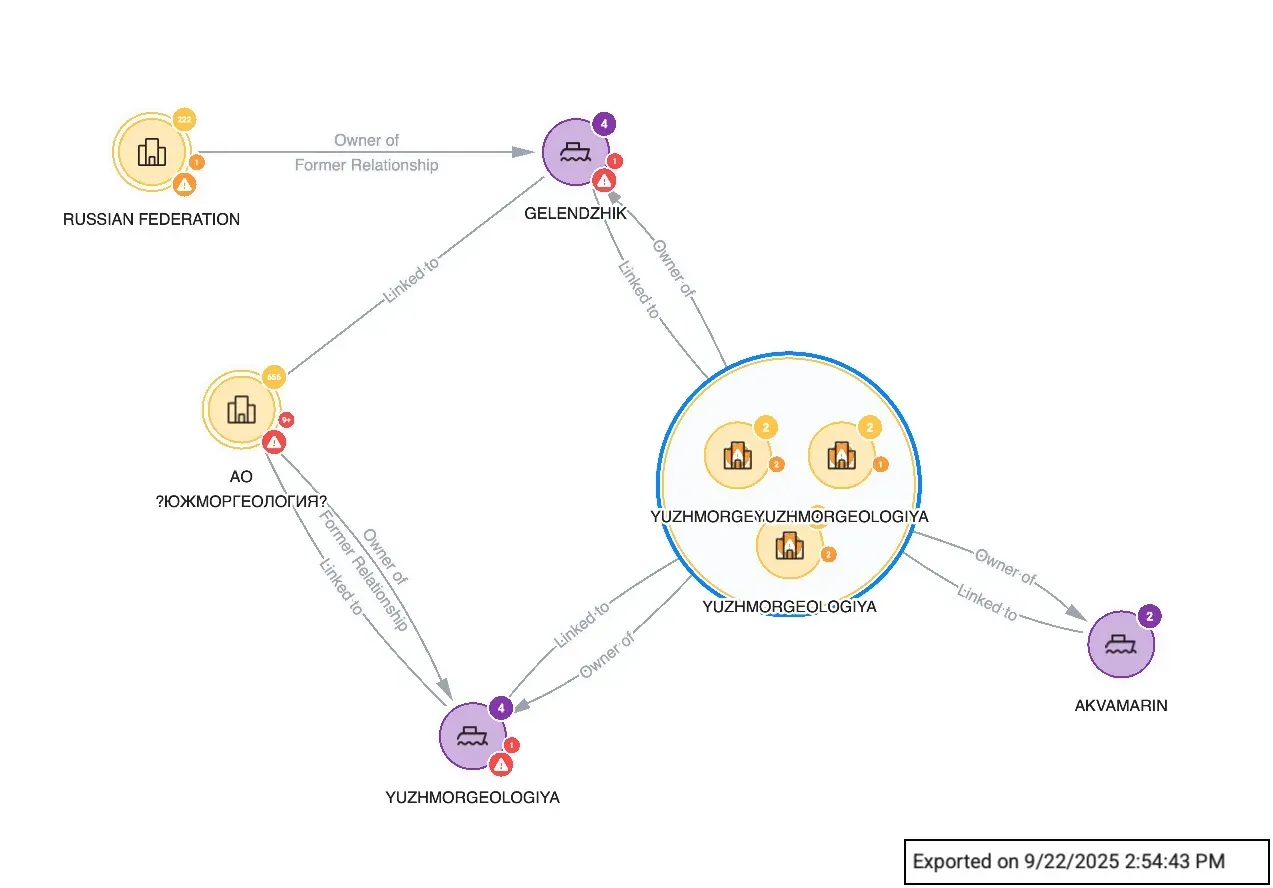
What about the crew?
Before finding information about the crew, I first had to discover Gelendzhik's name in Cyrillic. For that, I did a search in one of my favorite tools, called perplexity.ai.
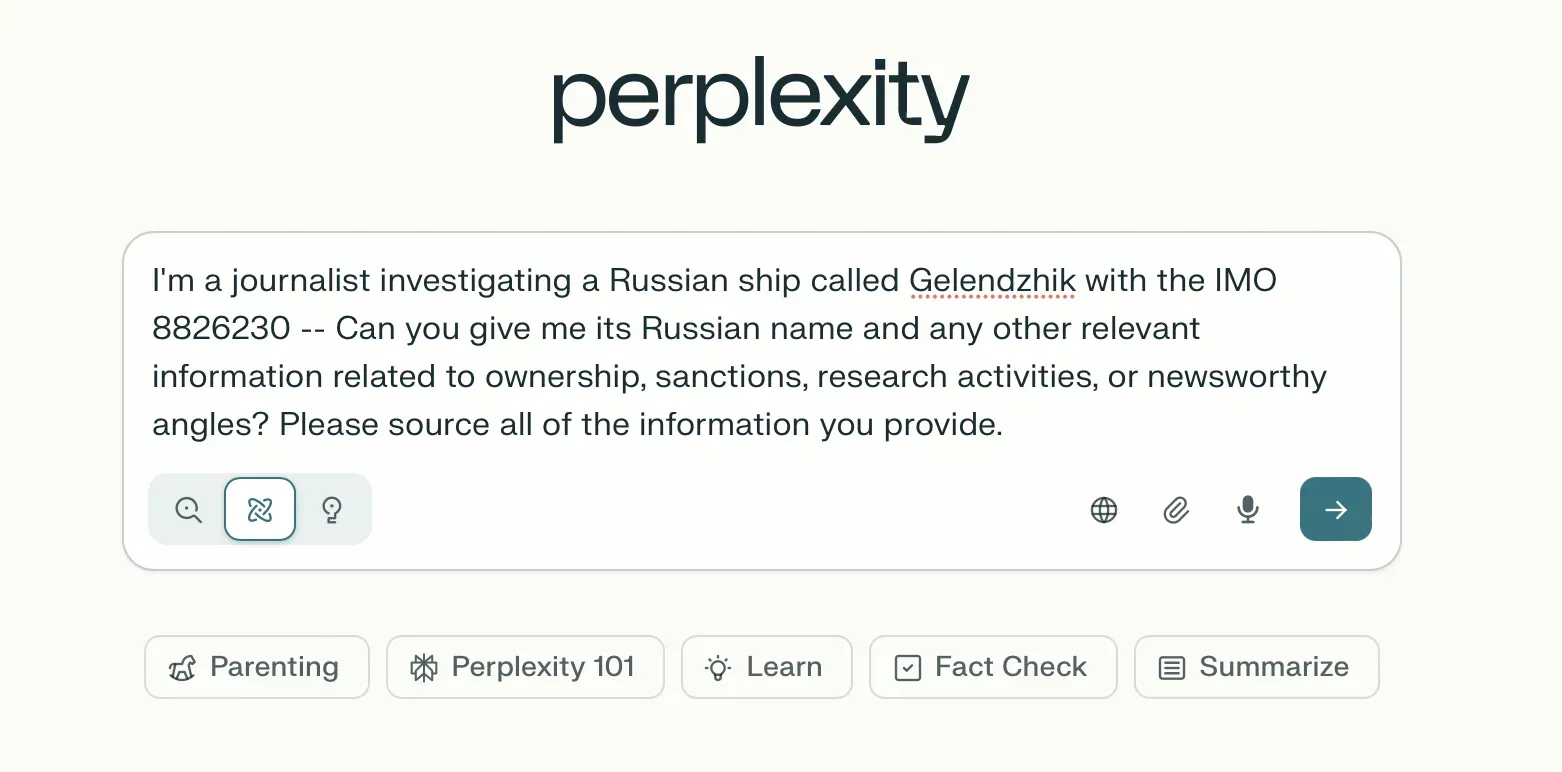
It said that the vessel's Russian name is "Геленджик". Now, with both names, I was ready for Google dorking. Here are some formulas that I used for LinkedIn (but you can pick any domain, like Facebook, for example):
- site:linkedin.com/in ("Yuzhmorgeologiya JSC" OR “Yuzhmorgeologiya”) (Gelendzhik)
- site:linkedin.com/in ("Южморгеология" OR "АО Южморгеология") "Геленджик"
- site:linkedin.com/in (Yuzhmorgeologiya OR "Южморгеология") (captain OR crew OR officer OR engineer) (Gelendzhik OR "Геленджик")
I found many profiles: people that were geophysicists, engineers, seafarers, officers, and, of course connected to the company and the vessel I was interested in.
Another useful website is Maritime Monster. It facilitates a connection between ship workers and ship jobs. And, if you were to scrape the website, I’m sure you could look up names of companies and ships you are interested in and understand their recruitment process, patterns, and how much money they offered for certain jobs. Looking up Reddit threads can also be a fruitful channel of research and, when looking at Russian ships, Korabel is also a good place to go. Created in 2002, it’s a website that unites seafarers and specialists with recruiters in the marine industry.
Continuing my research, I asked ChatGPT to help with some formulas that were specific to Russian websites. It built Google dorks (also known as search operators) for VK (ВКонтакте), Odnoklassniki, and a couple of others focusing on Yuzhmorgeologiya JSC/АО "Южморгеология" and the ship Gelendzhik/Геленджик (IMO 8826230). Because my Russian is level -A1, I had a hard time checking the information, but thought it would be important to share the reasoning:
- Company + ship (crew profiles): site:vk.com ("Южморгеология" OR "Yuzhmorgeologiya") ("Геленджик" OR "Gelendzhik" OR "IMO 8826230")
- Crew-specific keywords: site:vk.com ("Геленджик" OR "Gelendzhik") (экипаж OR капитан OR механик OR штурман) "Южморгеология"
- Group/album searches (photos, discussions): site:vk.com ("Геленджик" OR "Gelendzhik") "группа" "Южморгеология"
- Profiles or posts mentioning company + ship: site:vk.com ("Геленджик" OR "Gelendzhik") "группа" AND "Южморгеология"
- Crew forums / CVs / resumes: ("Gelendzhik" OR "Геленджик") ("resume" OR "CV" OR "crew") ("Yuzhmorgeologiya" OR "Южморгеология")
Before we finish this section, remember the company’s address? Looking it up, I came across a website called CrewData. There, we can find some leads about seafarers that have worked on one of the four vessels of YUZHMORGEOLOGIYA JSC’s fleet.
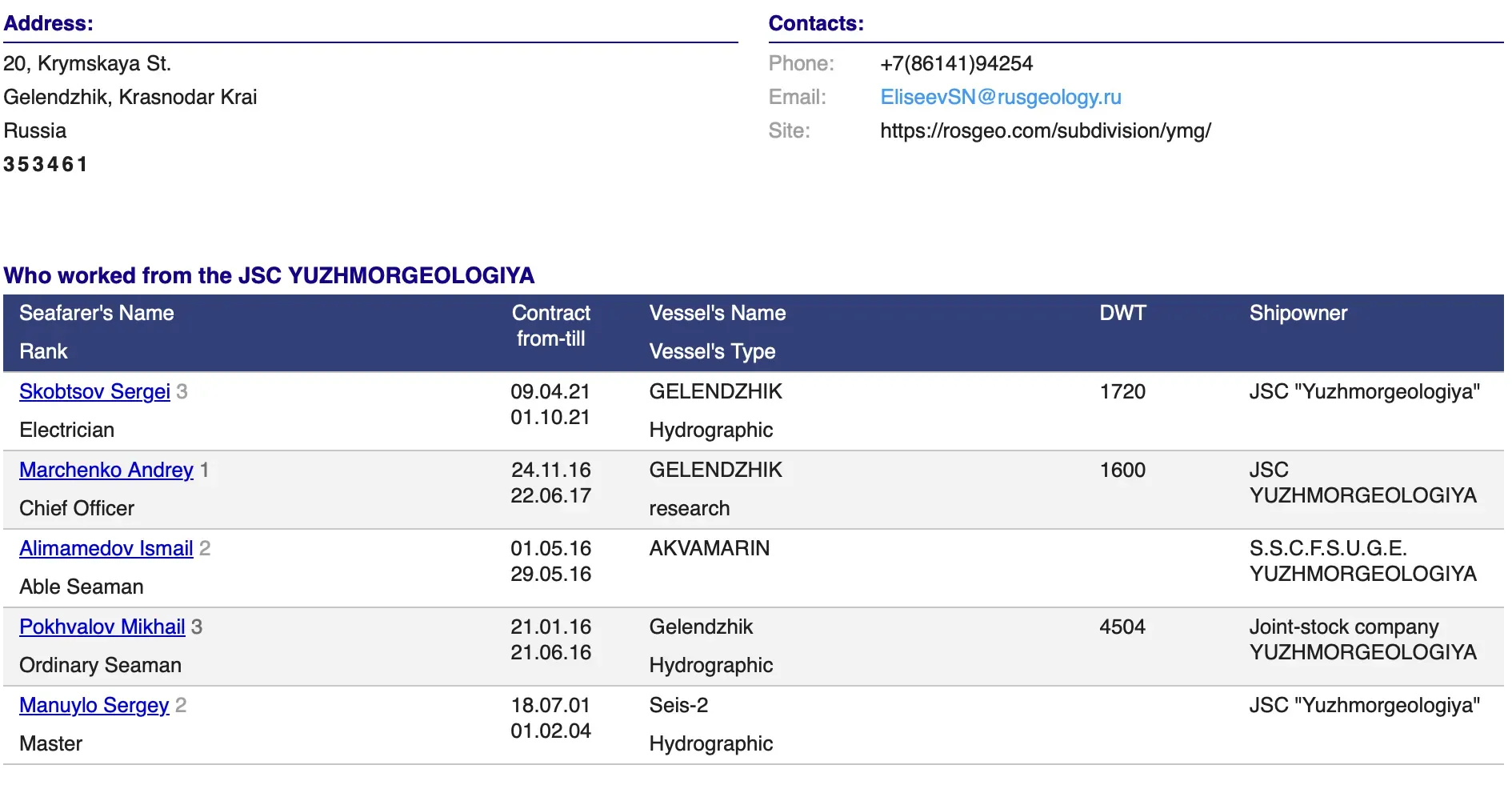
Pro tip: When you are investigating an address, you can check if there are any other companies registered in the same place. This doesn’t necessarily prove correlation between company structures, but expands your research material.
Ok, neat platforms. But can you talk more about OSINT?
I thought you would never ask. When investigating ships, I’m curious as to what the IMO has to say about them. So, in my first search, I’d probably type this on a search engine:
- site:imo.org filetype:pdf Gelendzhik
Only one document appeared. It gave interesting information about Russian delegations, ports, and cities, but I realized the “Gelendzhik” it referred to was the Russian city and not our beloved Russian ship. So I went for this new formula:
- filetype:pdf ("IMO 8826230")
By adding one more identifier, the IMO, I was able to find more things about it. Here's some interesting finds:
- A list of Russian ships featured in the Russian Maritime Register of Shipping.
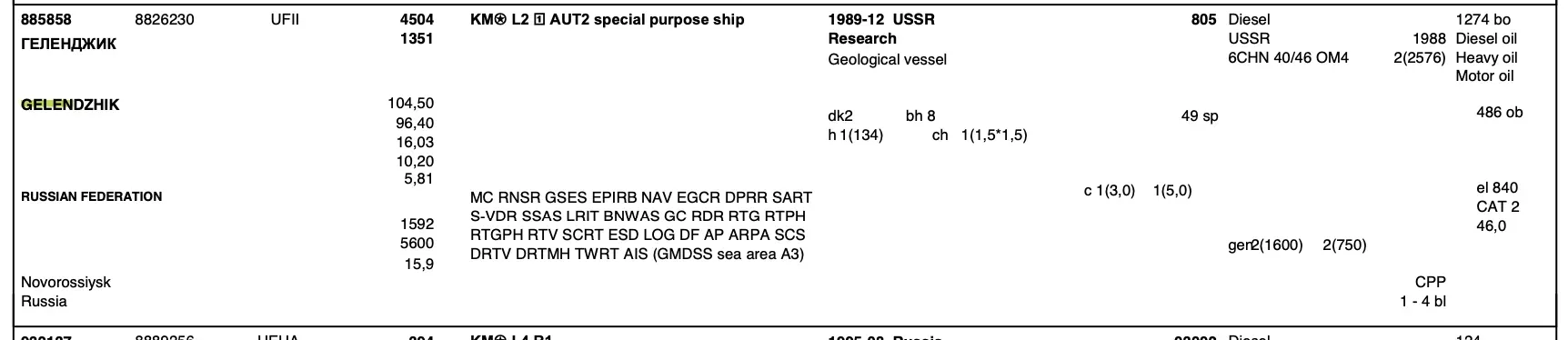
- Gelendzhik is also sanctioned. It appears on the SDN (Specially Designated National) list, maintained by the U.S. Department of the Treasury's Office of Foreign Assets Control (OFAC), which identifies individuals, groups, and entities targeted by U.S. sanctions programs.
- Some extra operators that might be useful for your case studies:
- PDFs + crew in Russia: filetype:pdf ("Геленджик" IMO 8826230) экипаж
- Tender or contract PDFs (procurement, crew contracts): site:.gov.ru filetype:pdf ("Южморгеология" OR "Yuzhmorgeologiya")("Геленджик" OR "Gelendzhik")
- Court or sanction records (lawsuits, maritime disputes): ("Gelendzhik" OR "Геленджик" OR "IMO 8826230") ("Южморгеология" OR "Yuzhmorgeologiya")
- Academic/scientific publications (ship used in research expeditions): site:.ru filetype:pdf ("Южморгеология" OR "Yuzhmorgeologiya")("Геленджик" OR "Gelendzhik")
This toolkit is already running long, so check out the second part of “How to Track Ships Like A Pro Using OSINT.” In it, we explore tracking tools, historical AIS data, satellite imagery, port records, and ship registries to find a vessel’s whereabouts and activities.
If you use a platform or technique that I did not cover in this first part, please send it my way! I’m always happy to learn new research methods. You can reach me at [email protected].