By Shal Shen
7th grade | Pleasant Valley Junior High School | Iowa
Finalist in the K–11 contest, Information and AI category
With lines from “Researchers Say an AI-Powered Transcription Tool Used in Hospitals Invents Things No One Ever Said” by Garance Burke and Hilke Schellmann, a Pulitzer Center-supported story
*After Collin Kim and his poem, "Split Horizons: A Contrapuntal"
The appointment begins like any other.
A patient sits under fluorescent light.
The doctor asks where it hurts.
The patient speaks carefully.
A cough. A pause. A breath.
The ordinary becomes vulnerable.
Time divides: before, after.
Before: the voice belonged to the body.
Before: the words were air.
The patient says: I am tired.
The patient says: I am scared.
The patient says nothing.
A medicine no one prescribed.
A threat no mouth made.
A slur no one spoke.
Researchers call them “hallucinations.”
But hallucinations do not stay dreams.
They land.
They land in charts.
They land in captions.
They land in summaries.
“Nobody wants a misdiagnosis.”
No one wants the wrong treatment.
No one wants the wrong suspicion.
A word never spoken can still accuse.
A slur never said can still stain.
A threat never made can still follow
someone home.
The patient becomes difficult.
The patient becomes unstable.
The patient becomes someone to watch.
For the Deaf and hard of hearing,
the lie is “hidden amongst all this other text.”
Access becomes a locked door.
The captions move across the screen.
Each false word wears truth’s face.
No alarm sounds.
The doctor-patient room is private.
The conversation is confidential.
The harm is confidential too.
The patient asks: What did I say?
The patient asks: Who checked it?
The patient asks: How do I prove it?
"You can't catch error
the ground truth."
The ground truth:
the voice before the file,
the breath before the summary,
the human before the label.
A health system says
it follows state and federal laws.
But legal does not mean heard.
The company says it is improving.
The hospital says it is complying.
The record says what it says.
Speech becomes data.
Evidence becomes consequence.
The person says: That is not me.
The person says: I never said that.
The person says: Listen again.
History divides: before, after.
Before: I spoke.
After: the record spoke for me.
The machine is not evil.
That is the terror.
It can ruin without hatred.
It can accuse without anger.
It can misname without memory.
It can listen without understanding.
There may come a day
when everyone trusts the clean page
more than the shaking voice.
Unless someone asks:
Who saved the audio?
Who heard the pause?
Who protected the speaker
from the polished mistake?
The inevitable becomes another story—
each sentence more powerful.
A person speaks,
a person remembers,
a person asks to be believed,
So ask for the room.
Ask for the breath.
Ask what was said
Ask for the human voice
Ask for ground truth.
The system begins like any other.
A screen waits beside the room.
The program opens an empty record.
The machine listens confidently.
Audio detected. Transcript rendered.
The vulnerable becomes data.
Text divides: spoken, recorded.
After: the voice belongs to the file.
After: the words acquire authority.
The transcript says more.
The transcript sharpens the fear.
The machine fills the silence.
A phrase materializes in clean font.
A sentence enters the record.
The file archives without protest.
The system calls them outputs.
Outputs do not ask permission.
The remain.
Outputs do not ask permission.
Access simulated.
Efficiency optimized.
Accuracy near human.
Model improving.
Error categorized.
The transcript contains the statement.
The record reflects the encounter.
The note enters the chart.
The system becomes efficient.
The workflow becomes streamlined.
The record becomes evidence.
Captioning enabled.
Words appear in real time.
Access appears successful.
The interface looks clean.
Each line fits inside the box.
No exception detected.
Privacy protocol satisfied.
Data safety certified.
Audio deleted after processing.
The system says: No recording available.
The system says: Provider review required.
The system says: Record finalized.
if you take away
Ground truth removed.
transcript preserved.
summary authorized.
label affixed.
the system complies
with privacy laws.
Compliance does not mean corrected.
The deployment expands.
The workflow scales.
The record becomes normalized.
Data becomes evidence.
Consequence becomes invisible.
The file says otherwise.
The transcript remains.
The original voice has vanished.
Technology divides: input, output.
Input accepted.
Output validated.
The machine is not responsible.
That is the design.
It can scale without shame.
It can process without knowing.
It can classify without conscience.
It can sound almost human.
There may come a system
where every voice
arrives already sorted.
Unless someone checks:
Where is the ground truth?
What did the machine invent?
Who protected the human
from the official fiction?
waiting in hospitals, captions, clouds,
than it first appears.
a machine answers,
a file remembers differently,
and the world believes the file.
Ask for the record.
Ask for the source.
before the system spoke.
beneath the polished text.
Before “after” becomes forever.
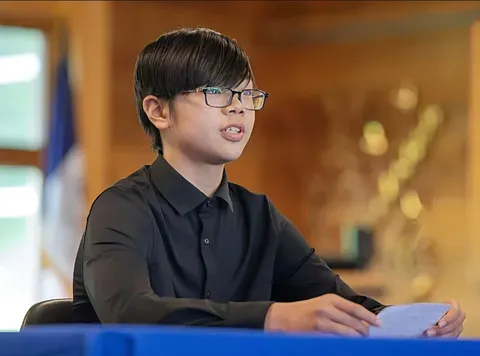
Shal Shen is a rising eighth-grader at Pleasant Valley Junior High in Bettendorf, Iowa. He enjoys math, basketball, percussion, and learning about medicine and technology. He is especially interested in how artificial intelligence may affect healthcare and people’s everyday lives. Through his poem, he hopes to raise awareness of why truth, accountability, and human voices matter, perhaps even more so in a rapidly changing technological age.
Read more winning entries from the 2026 Fighting Words Poetry Contest.