Pulitzer Center Update August 27, 2025
Weaving Global Issues into the Fabric of Everyday Learning
Country:

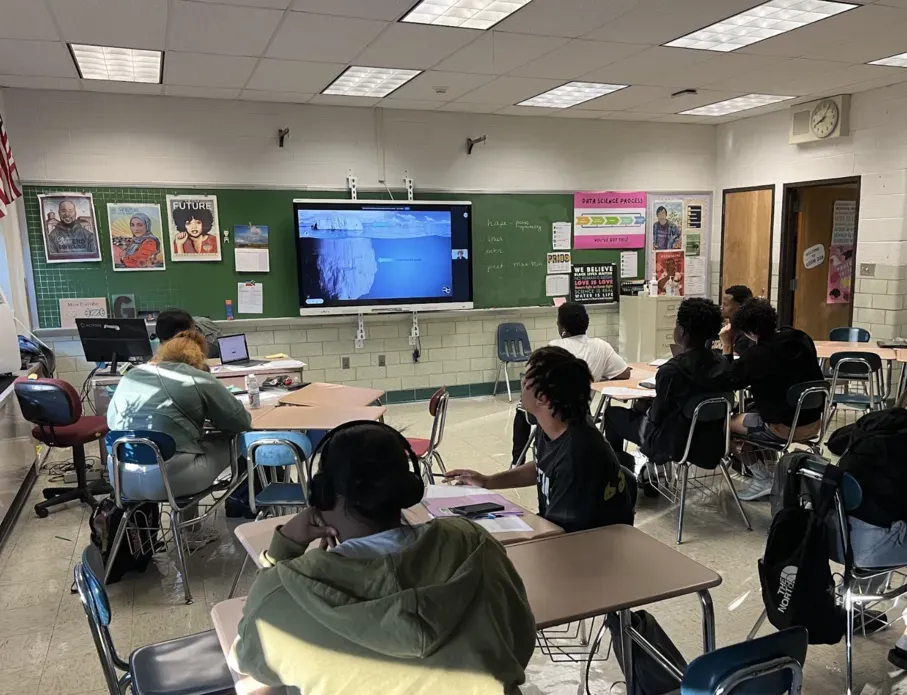
When a journalist Zooms into a classroom from thousands of miles away, the world suddenly feels smaller and more connected. In the first half of 2025, the Pulitzer Center’s virtual journalist visit program brought that experience to more than 2,600 students across 57 schools virtually. Through our 74 classroom visits, students engaged directly with reporters covering underreported stories across the Pulitzer Center’s five focus areas: Climate and Environment, Global Health, Human Rights, Information and Artificial Intelligence, and Peace and Conflict.
For many students, these conversations were the first time they’d spoken directly with someone on the front lines of global reporting. A middle school student in Chicago reflected, “Being a journalist is already putting your life on the line.” A high school student in Philadelphia shared, “After this presentation, I am inspired to do research and speak about things that are affecting people in many ways but it’s not on the news or on social media a lot.” These moments show what happens when complex, global issues become personal through storytelling.
Light Bulb Moments for Students
Teachers consistently describe these visits as moments when students make connections they wouldn’t otherwise. Christina Korbakis, a teacher at Talcott Elementary in Chicago, shared, “They were connecting the journalist with our study of [pioneering Black journalist] Ethel Payne. They right away heard and connected the fact that the Haitian Times is an online newspaper with how the Chicago Defender is now online only. They were extremely engaged and wanted to ask a lot more questions.”
Beyond teacher reflections, visits often aligned intentionally with curriculum in ways that surprised and engaged students. For example, we’ve connected classes studying local environmental issues with journalists reporting on global climate change, helping students see their community’s place in a larger story. In another case, a journalism class focusing on criminal justice connected with Pulitzer Center grantee Clarissa Sosin, whose in-depth series on police accountability and systemic racism in Baton Rouge, Louisiana, not only illustrated how investigative reporting can expose entrenched problems, but also showed students the role journalists play in pushing for reform and amplifying voices demanding justice. These pairings helped students view familiar topics from fresh perspectives and sparked cross-disciplinary conversations.
Survey responses reinforce these reflections:
- 85% of teachers said the visits deepened their understanding of the issue presented.
- 73% said the visits connected directly to their curriculum.
- 81% observed students demonstrated empathy for the people and places they learned about.
The visits don’t just complement instruction—they expand it, weaving global issues into the fabric of everyday learning. As one elementary teacher in Illinois put it: “Anti-racist education is crucial, and hearing it firsthand from a journalist made that real for my students.”
Students Discover the Power of Underreported Stories
For students, the impact goes beyond new facts—it’s about perspective. In post-visit student surveys, 86% said the story presented was important, and 79% said they gained a deeper understanding of the issue. Nearly all agreed that looking for underreported stories matters: “Because it makes you a global citizen,” one student explained.
Other reflections show how these visits spark agency. Students shared their thoughts:
- “After this presentation, I am inspired to help my community get more healthy foods.” — Elementary school student in Illinois
- “After this presentation, I am inspired to convince people to help the world become a better place by creating peace.” — Middle school student in Illinois
- “The most important thing I learned from the journalist’s presentation is that true humanity exists in the most extreme situation.” — High school student in Ohio
Students are not only learning about journalism, but also about themselves—their values, their capacity for empathy, and the role they might play in shaping solutions.
Journalists Humanize the Headlines
Between January and June 2025, 37 Pulitzer Center journalists joined classrooms from Arizona to New York, Hawaii to Florida, and even as far as Berlin and Sichuan, China. They brought with them reporting that spanned climate change, artificial intelligence, human rights, and other issues. Many visited multiple classrooms virtually, underscoring their commitment to engaging young audiences. As one New York City high school teacher reflected, “[Pulitzer Center grantee] Daniella Zalcman’s visit not only shed light about a marginalized community, but she gave us a glimpse of the courage and the commitment it takes for journalists to travel around the world and showcase stories for the world to listen to.”
For students, these visits turned ordinary classrooms into global newsrooms. Issues they once encountered only in textbooks or headlines became real and human. Hearing from grantees Julia Rendleman and Molly Parker helped a student learn that food deserts aren’t just statistics—they involve real people’s struggles, like walking long distances just for fresh food. “The most important thing I learned from the journalist’s presentation is that they helped write about this, and that they talked to people about it, and they are trying to help solve these problems we have. The only reason we have corner stores is for cheaper food. Most people can't go that far. Some would have to walk a mile just for some good fruit.” — Middle school student in Illinois
A high school student in Philadelphia shared how the presentation turned a distant, abstract issue into a human story, shifting their understanding. “I think that hearing the personal stories of the people that [grantee] Natalie Keyssar photographed was extremely impactful. Often in the news, when reading about a crisis such as a war, I don’t hear about the personal lives of people impacted, but only how they have been affected by the war. I think it was a unique perspective to hear about the people’s lives separated from the war and helped to humanize them amidst the situation and teach us a more holistic understanding of the war and how it has impacted people’s daily lives.”
These encounters show how powerful it is for students to meet the journalists behind the headlines—opening their eyes not just to world events, but to the human stories at their core.
Looking Ahead
The Pulitzer Center’s mission is to champion the power of stories to make complex issues relevant and inspire action. The first half of 2025 proved that when students and journalists meet stories do exactly that. They open doors to empathy, sharpen critical thinking, and show students that they, too, have a voice in the global conversation. In many ways, this work is about weaving global issues into the fabric of everyday learning—making the world’s most urgent challenges part of what students think about, question, and carry with them.
As we look ahead, our goal is to deepen the impact of the virtual visit program by bringing even more media professionals into classrooms to discuss underreported global issues. These conversations give students the chance to engage directly with journalists, ask questions and connect world events to their own lives in meaningful ways. Above all, we remain committed to ensuring that students everywhere have the opportunity to see beyond the headlines and understand the human stories that shape our world.
Educators can bring this experience directly into their classrooms this fall by requesting a free, virtual journalist visit from the Pulitzer Center. These interactive sessions connect students with reporters investigating underreported global issues across our five focus areas: Climate and Environment, Global Health, Human Rights, Information and Artificial Intelligence, and Peace and Conflict. Journalists share their reporting process, the stories behind their projects, and lead discussions that help students connect global challenges to their own lives and communities. Each visit is designed to spark curiosity, deepen critical understanding, and show students the power of journalism in shaping civic engagement.


