Pulitzer Center Update August 21, 2026
Chicago Students Compose Letters Empathizing With Migrating Peers
Country:

Lesson Plans
Ink and Empathy: Bridging Borders Through Letters
After exploring local reporting about immigration, students lean into dialectic journaling and then lean into the ‘lost art’ of letter writing as a way of building historical context, global...
Heather Ingram is a high school English teacher at Sarah E. Goode STEM Academy in Chicago, Illinois. Ingram created the lesson plan, “Ink and Empathy: Bridging Borders Through Letters” as a part of the Spring 2025 Teacher Fellowship for alumni, “Global Issues, Local Contexts: News for Civic Knowledge and Engagement.” Her lesson reached 90 students. At the conclusion of the fellowship, Ingram shared the following reflections on her experience developing and teaching the lesson.
How did you build this lesson with your community in mind?
As an African-American educator, mother, and Chicagoan, I was compelled to create this lesson through the lens of my layered identity markers, as well as those of my students; approximately half identify as Latinx, while the other half is of African ancestry. Throughout this school year, we have spent a substantial amount of time exploring matters of identity and the American Dream. While many of our readings stretch across time and place, our collective proximity to the Venezuelan migrant matter naturally compels us to consider this complex issue. Thus, the collection of Pulitzer Center-supported media made scholarly space for our students to lean into cross-cultural connection, historical context, and contemporary application.
What is the focus of your lesson plan, and why did you write this lesson for your community?
While literary devices and letter-writing mechanics play a pivotal role in this lesson, non-academic skills are equally important. Also of note, I situated this instruction in our American Dream unit. Thus, students brought a bit of prior knowledge to the topic. With that said, I wrote this plan because the whole of humanity benefits when our young people are critically aware, historically astute, compassionately empathetic, and solutions-minded. By framing a contemporary political conversation within the context of peer-to-peer friendly discourse, I tried to create space for scholarly and interpersonal bridge-building.
What did your students learn while engaging with this lesson?
Students gained more context about a humanitarian issue impacting their community and had the opportunity to engage in scholarly discourse centering their own lived reality and broadening their lens.
In early spring of 2022, Texas Governor Greg Abbott began shipping busloads of asylum-seeking people to self-identified sanctuary cities such as Chicago, New York, Denver, and Philadelphia. The bold political act was made with the pretense of requiring all parts of the country to grapple equally with the surging population of immigrants to the United States. Aside from legal and humanitarian concerns with Abbott’s actions, this maneuver begged another pressing question: How would sanctuary cities respond to waves of newcomers, both bureaucratically and amongst the people?
For my students, this question was not abstract, but part of an important community conversation in which there are a myriad of perspectives. Students developed their empathy and rhetorical comprehension skills (e.g. ethos/pathos/logos, author’s purpose, analysis) in order to compose open letters to migrating peers at the culmination of the lesson.
Here are some excerpts from student letters that demonstrate the impact of this lesson:
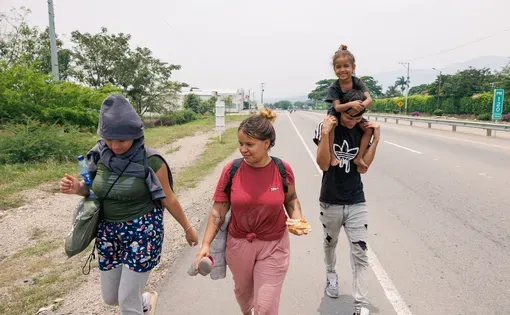
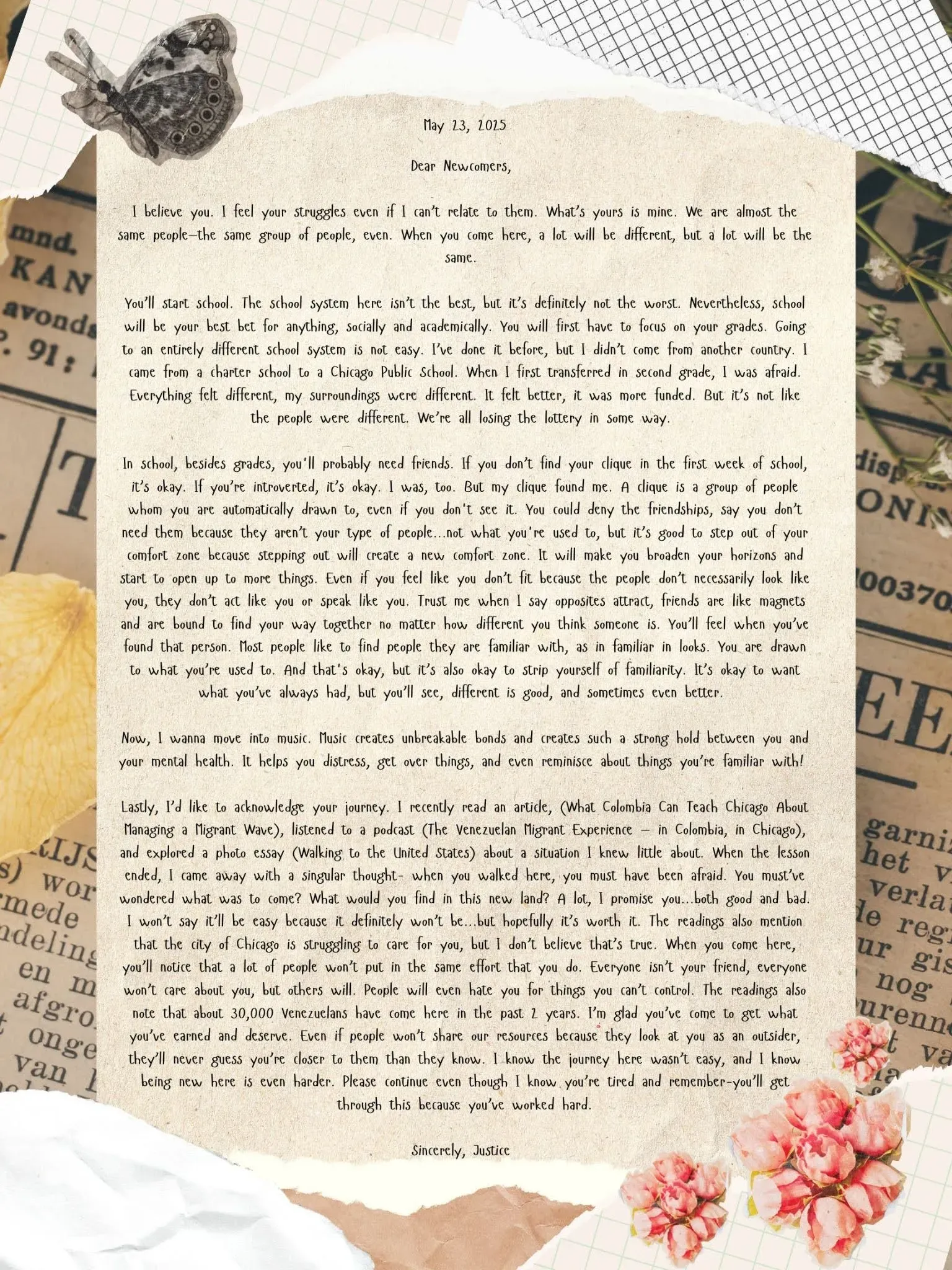
…Lastly, I’d like to acknowledge your journey. I recently read an article, ("What Colombia Can Teach Chicago About Managing a Migrant Wave"), listened to a podcast ("The Venezuelan Migrant Experience—in Colombia, in Chicago"), and explored a photo essay ("Walking to the United States") about a situation I knew little about. When the lesson ended, I came away with a singular thought—when you walked here, you must have been afraid. You must’ve wondered what was to come? What would you find in this new land? A lot, I promise you…both good and bad. I won’t say it’ll be easy because it definitely won’t be…but hopefully it’s worth it.
—Justice
Dear newcomers,
I can’t exactly relate to what you're going through, but I want to understand…
—Namiyah.
…On another note, there is one thing I have been meaning to ask—when you came here, did you leave your family behind? You know…your mom…dad…siblings? Have they already come to the U.S.? Whatever the case, I hope all goes well and they are okay. Talk to them as much as you can. I know you may not be physically close, but I’m pretty sure they need support just like you do. Trust me, life will look up…just take it one step at a time…no need to jump. Also, try not to pay any mind to some of the people who are already here; many don’t like the fact that you are here, but you are just as important as everyone else here. People have no right to treat you like you don’t belong. You deserve to feel valued and safe…we all do.
—Davina
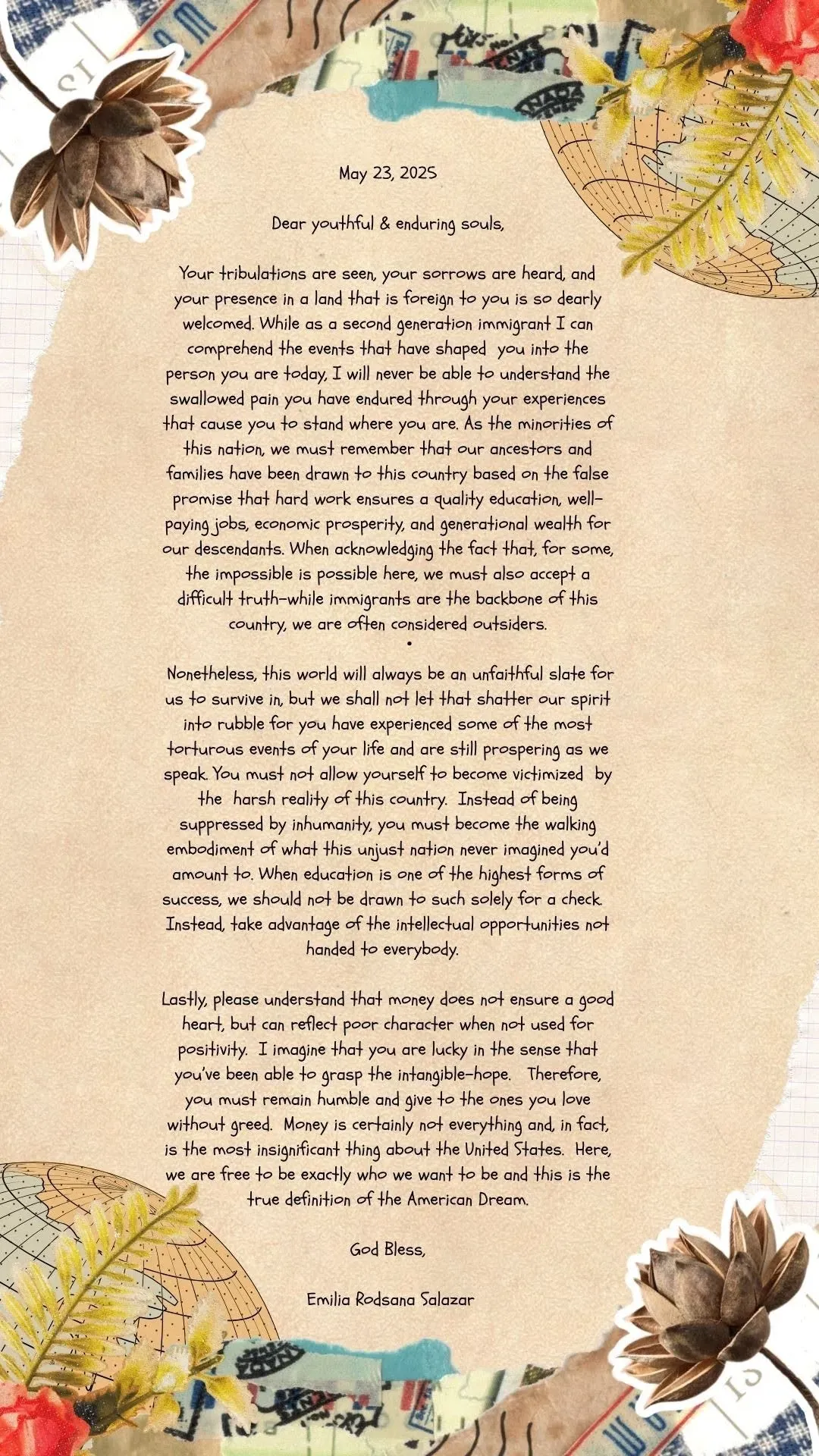
Dear youthful and enduring souls,
Your tribulations are seen, your sorrows are heard, and your presence in a land that is foreign to you is so dearly welcomed. While as a second generation immigrant I can comprehend the events that have shaped you into the person you are today, I will never be able to understand the swallowed pain you have endured through the experiences that force you to stand where you are…
—Emilia
What did you learn by creating and teaching this lesson?
“I have never encountered any children in any group who are not geniuses. There is no mystery on how to teach them. The first thing you do is treat them like human beings…”
—Dr. Asa Hilliard
While delivering Ink and Empathy, I have learned to more fully trust in the brilliance and humanity of our young people. Given these precarious political times, we can find solace in our students. By cultivating both academic and socio-emotional skills, educators have an opportunity to shift the tide toward collective healing and progress.
Examples of student letters:
May 23, 2025
Dear youthful & enduring souls,
Your tribulations are seen, your sorrows are heard, and your presence in a land that is foreign to you is so dearly welcomed. While as a second generation immigrant I can comprehend the events that have shaped you into the person you are today, I will never be able to understand the swallowed pain you have endured through your experiences that cause you to stand where you are. As the minorities of this nation, we must remember that our ancestors and families have been drawn to this country based on the false promise that hard work ensures a quality education, well- paying jobs, economic prosperity, and generational wealth for our descendants. When acknowledging the fact that, for some, the impossible is possible here, we must also accept a difficult truth-while immigrants are the backbone of this country, we are often considered outsiders.
Nonetheless, this world will always be an unfaithful slate for us to survive in, but we shall not let that shatter our spirit into rubble for you have experienced some of the most torturous events of your life and are still prospering as we speak. You must not allow yourself to become victimized by the harsh reality of this country. Instead of being suppressed by inhumanity, you must become the walking embodiment of what this unjust nation never imagined you'd amount to. When education is one of the highest forms of success, we should not be drawn to such solely for a check. Instead, take advantage of the intellectual opportunities not handed to everybody.
Lastly, please understand that money does not ensure a good heart, but can reflect poor character when not used for positivity. I imagine that you are lucky in the sense that you've been able to grasp the intangible-hope. Therefore, you must remain humble and give to the ones you love without greed. Money is certainly not everything and, in fact, is the most insignificant thing about the United States. Here, we are free to be exactly who we want to be and this is the true definition of the American Dream.
God Bless,
Emilia Rodsana Salazar
May 23, 2025
Dear Newcomers,
I believe you. I feel your struggles even if I can't relate to them. What's yours is mine. We are almost the same people-the same group of people, even. When you come here, a lot will be different, but a lot will be the same.
You'll start school. The school system here isn't the best, but it's definitely not the worst. Nevertheless, school will be your best bet for anything, socially and academically. You will first have to focus on your grades. Going to an entirely different school system is not easy. I've done it before, but I didn't come from another country. I came from a charter school to a Chicago Public School. When I first transferred in second grade, I was afraid. Everything felt different, my surroundings were different. It felt better, it was more funded. But it's not like the people were different. We're all losing the lottery in some way.
In school, besides grades, you'll probably need friends. If you don't find your clique in the first week of school, it's okay. If you're introverted, it's okay. I was, too. But my clique found me. A clique is a group of people whom you are automatically drawn to, even if you don't see it. You could deny the friendships, say you don't need them because they aren't your type of people...not what you're used to, but it's good to step out of your comfort zone because stepping out will create a new comfort zone. It will make you broaden your horizons and start to open up to more things. Even if you feel like you don't fit because the people don't necessarily look like you, they don't act like you or speak like you. Trust me when I say opposites attract, friends are like magnets and are bound to find your way together no matter how different you think someone is. You'll feel when you've found that person. Most people like to find people they are familiar with, as in familiar in looks. You are drawn to what you're used to. And that's okay, but it's also okay to strip yourself of familiarity. It's okay to want what you've always had, but you'll see, different is good, and sometimes even better.
Now, I wanna move into music. Music creates unbreakable bonds and creates such a strong hold between you and your mental health. It helps you distress, get over things, and even reminisce about things you're familiar with!
Lastly, I'd like to acknowledge your journey. I recently read an article, (What Colombia Can Teach Chicago About Managing a Migrant Wave), listened to a podcast (The Venezuelan Migrant Experience in Colombia, in Chicago), IJS and explored a photo essay (Walking to the United States) about a situation I knew little about. When the lesson ended, I came away with a singular thought- when you walked here, you must have been afraid. You must've wondered what was to come? What would you find in this new land? A lot, I promise you...both good and bad. I won't say it'll be easy because it definitely won't be...but hopefully it's worth it. The readings also mention that the city of Chicago is struggling to care for you, but I don't believe that's true. When you come here, you'll notice that a lot of people won't put in the same effort that you do. Everyone isn't your friend, everyone won't care about you, but others will. People will even hate you for things you can't control. The readings also note that about 30,000 Venezuelans have come here in the past 2 years. I'm glad you've come to get what you've earned and deserve. Even if people won't share our resources because they look at you as an outsider, they'll never guess you're closer to them than they know. I know the journey here wasn't easy, and I know being new here is even harder. Please continue even though I know you're tired and remember-you'll get through this because you've worked hard.
Sincerely, Justice