Event
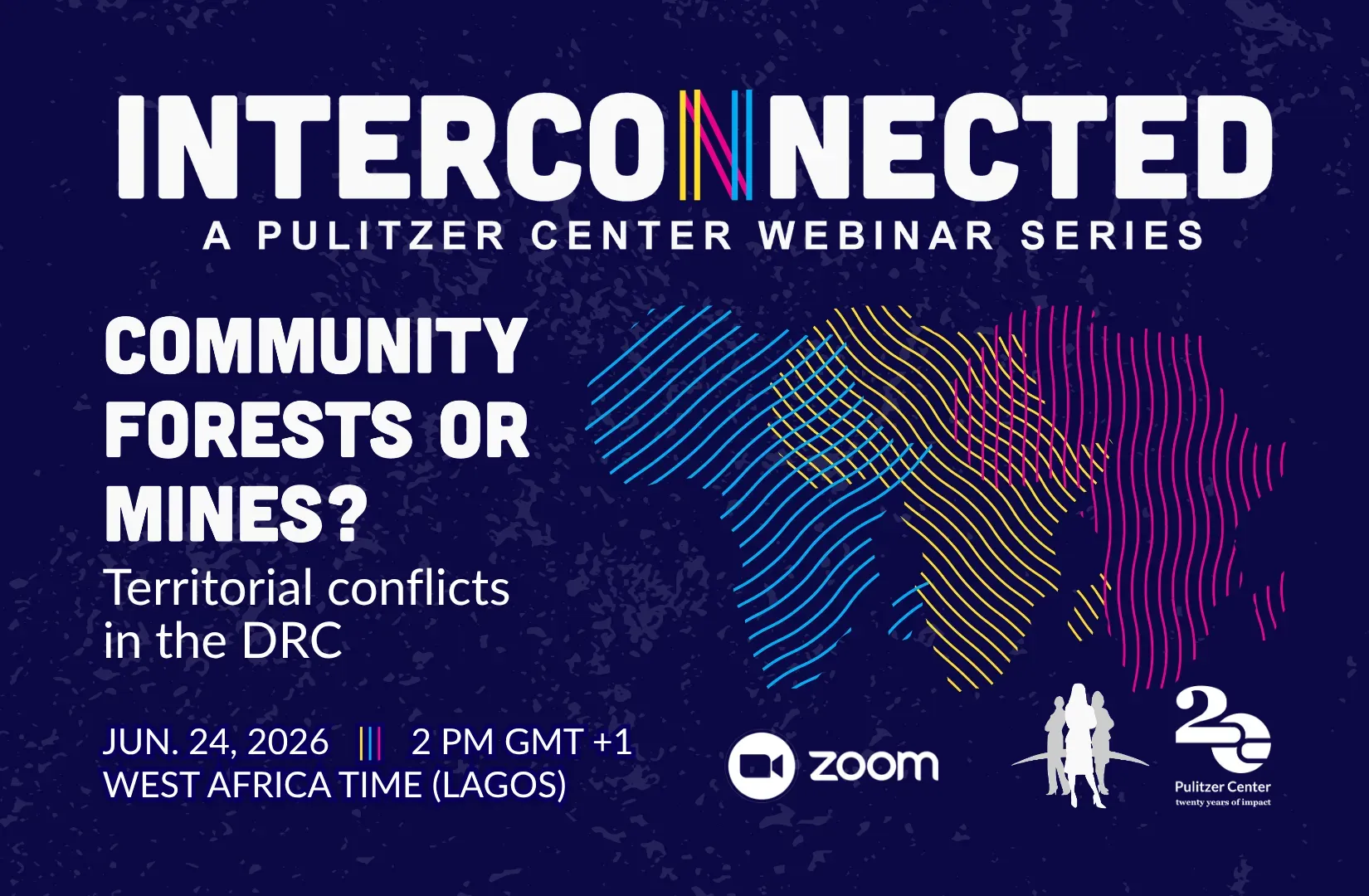
Interconnected Webinar Series 2026: Community Forests or Mines? Territorial Conflicts in the DRC
Event Date:
June 24, 2026 | 2:00 PM TO 4:00 PM WAT


Interconnected Webinar Series 2026: Climate, Environment, Governance
This webinar series will feature live Zoom interpretation in French.
Join us for an engaging webinar series where we will delve into the critical links between climate, the environment—including the ocean, forests, and other geographical landscapes—and governance. We will examine the impact of poorly regulated industries and inadequate law enforcement on the climate crisis, and brainstorm viable solutions to mitigate its consequences.
Featuring Pulitzer Center-supported stories, our discussions will bring together journalists, leaders from environmental and social movements, policymakers, and affected communities. This platform is designed to foster critical conversations on some of the most pressing and emerging issues of our time.
Community Forests or Mines? Territorial Conflicts in the DRC
More than one hundred active mining permits currently overlap with legally recognized community forests in the Democratic Republic of the Congo, raising urgent questions about land rights, environmental justice, and the future of forest governance.
In partnership with Oisillons Group and drawing on journalist Jonas Kiriko's investigation, "On Paper, It's a Community Forest. On the Map, It's a Mine," this webinar will explore how communities that have worked to protect their forests are confronting the growing pressures of mining projects driven by global demand for critical minerals. Through journalism as a starting point for dialogue, the conversation aims to deepen understanding of the complex issues surrounding critical mineral extraction and inspire further research, and civic engagement on this topic. Register here.
Speakers
- Jonas Kiriko is senior journalist at InfoNile and 2025 Rainforest Investigative Network (RIN) Fellow. Based in the Democratic Republic of Congo (DRC), he specializes in investigating environmental crimes and worked with Oxpeckers on transnational, multimedia, data-driven investigations into environmental crimes. Kiriko holds a degree in information and communication sciences (multimedia publishing) from the Université de l'Assomption au Congo.
- Jimmy Munguriek is a lawyer and a member of the Bar of the Ituri Court of Appeal. He is the country director for the Democratic Republic of Congo at Resource Matters, where he leads the organization's work in the country and its engagement with stakeholders on issues related to natural resource governance. Before joining Resource Matters, and for more than a decade, he coordinated the Ituri Civil Society Platform on Natural Resources and contributed to numerous research, advocacy, and policy initiatives on mining, petroleum, and energy governance. He has also been actively involved in the process of the Extractive Industries Transparency Initiative in the DRC, serving as a member of its Executive Committee between 2017 and 2024. He has also taught at the University of Bunia.
- Fabien Mayani is a researcher and lecturer at the Université Nouveaux Horizons in Lubumbashi, the Democratic Republic of Congo, where he teaches courses on the DRC’s mining policies, extractive industries, sustainable development, and the global metals market. Mayani is a senior analyst specializing in natural resource governance, human rights, environmental law, and climate justice in Africa. He is also an African Union expert on mining governance and the program director for extractive governance and climate justice at the Carter Center. Mayani served as rapporteur for the Sub-Committee on Social and Environmental Responsibility of Mining Companies within the 2002 Mining Code Review Committee, where he focused particularly on issues of transparency, community development, the protection of human rights, and the formalization of artisanal mining.
- Moderator: Flore Kayala is a journalist who specializes in mines and the environment at Oisillons Group in the Democratic Republic of Congo.
This webinar will:
- Examine the gap between rights recognized on paper and realities on the ground
- Explore what these overlapping claims reveal about governance challenges and the limits of existing protections
- Discuss how tools such as mapping, data analysis, and community organizing can help document impacts and support community rights
- Promote journalism as a starting point for dialogue that deepens understanding of the complex critical mineral issues and inspire further civic engagement
Don’t miss out! Join our engaging webinar series on climate and governance, where you get to hear from journalists, experts, and local voices as we explore innovative solutions and contribute to the conversation.