Pulitzer Center Update August 21, 2026
Pulitzer Reporting Helps Granger High School Students Build Trust in Local News Rooms
Country:

Stephanie King is a high school English Language Arts teacher at Granger High School in Washington. King’s created the lesson plan, “Global Issues Gallery Walk” as part of the Spring 2025 Teacher Fellowship for alumni, “Global Issues, Local Contexts: News for Civic Knowledge and Engagement.” Her lesson reached 50 students. At the conclusion of the fellowship, King shared the following reflections on her experience developing and teaching the lesson.
How did you build this lesson with your community in mind?
My students attend a small, rural school in eastern Washington. Our community is based on agriculture, so careers are limited, and thus so is income. I used this lesson with my two English 10 classes of roughly 25 students per class. I approached this lesson by having students think about different topics that affect our community. I knew they would pick some of the same topics from the articles that I was going to use for the lesson. Those included farmworkers, migrants, poverty, and drug use. Even though my students have not traveled much, although some grew up in another country, they are aware that the issues we have in our community are present in towns across the world. I did this lesson halfway through the year, so I already had strong relationships and a strong sense of trust established in my classroom.
What is the focus of your lesson plan, and why did you write this lesson for your community?
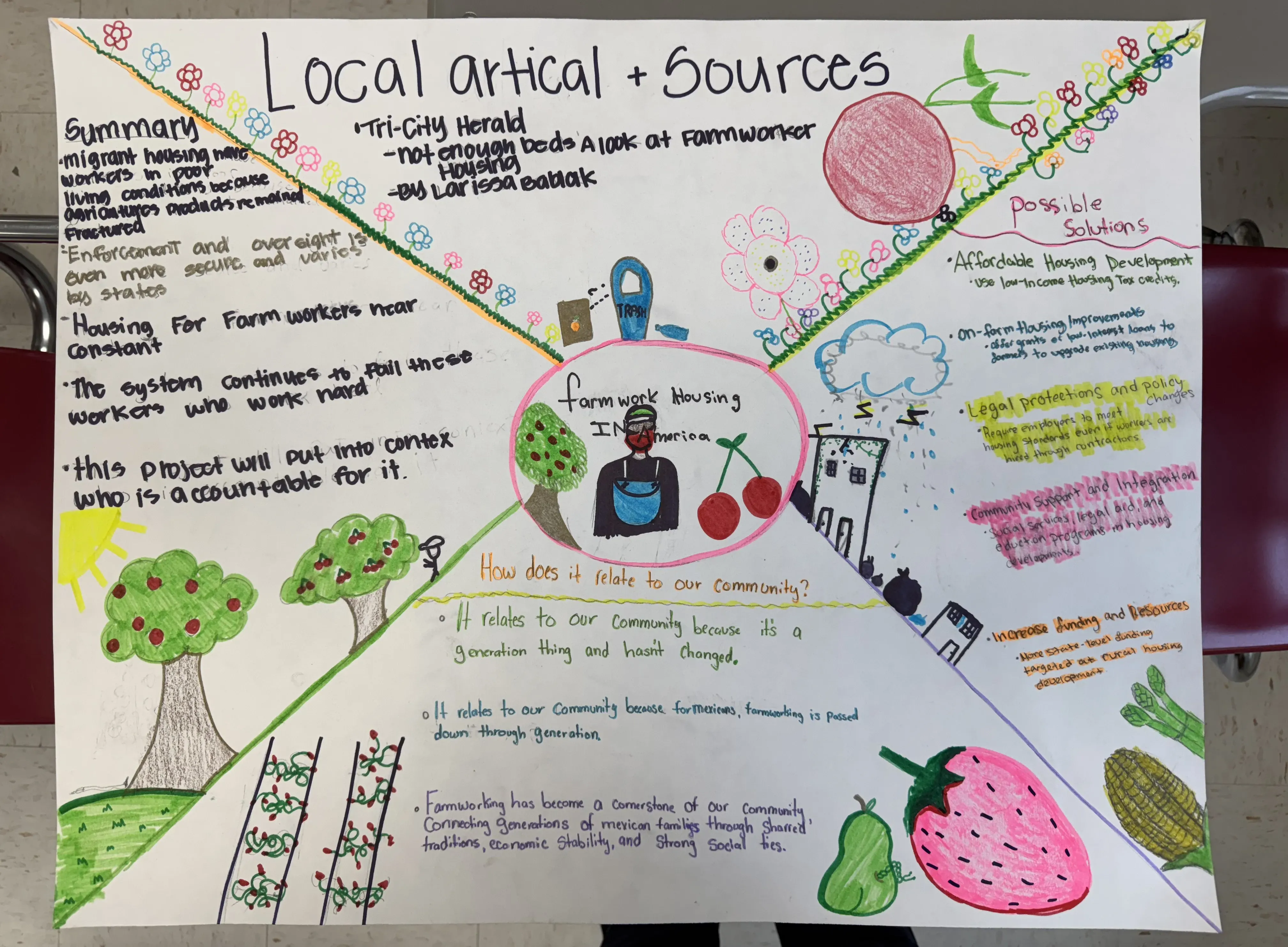
My lesson culminated in a gallery walk activity so that students could engage with multiple topics and articles. I used the gallery walk because my students are very social and have a hard time sitting still, reading, and annotating on their own. I thought this strategy would be better for my students so they could have genuine discussions and ask questions about these issues that are in our town and around the country. My goal was to expose students to local news outlets. I wanted them to discover that many underreported stories are covered, though not in mainstream media, and don’t get very much attention because of the topic or the subject. This is often due to the fact that the stories focus on marginalized communities or groups of people. For example the coverage of Missing and Murdered Indigenous Women compared to that of missing blonde, white women. Within Native American publications and communities, this topic is prominent (as my district is partially on a reservation). Whereas the same attention is not given nationally or even regionally.
My students were able to see that what they believe only affects our community is actually a cause of greater concern because the issues exist outside of our town. I teach about internalized violence and how my kids come to expect certain behavior from those around them. This lesson opened their eyes beyond their immediate surroundings.
What did your students learn while engaging with this lesson?
Students learned how to intentionally read articles with specific questions in mind that go against the grain of the story. They worked on their annotating skills and then collaborated in small groups to create their posters for the gallery walk. Students learned how to develop their abilities to hold and maintain a discussion with their peers without teacher interruption or redirection. Students helped develop their own questions to ask each other about their articles.
“The most important thing I learned in the lesson was how undervalued agriculture workers [are]. I always believed that they were much appreciated and acknowledged, because they are the base of agriculture, food, etc. Then I learned how they were standing up for their rights, but weren’t really given any spotlight.”
—Evalynne
"I think it is very important to look for underreported stories to understand global issues because if they're underreported, how can people know about the issue? Not only that, but also given the fact that it’s an issue that occurs all over the world. It is very dangerous, for example: drug overdose and the consequences [of] drug overdose are death. Something that causes death should never be underreported. Another reason why important global issues shouldn’t be underreported is because if people don’t know about the issue, how can we fix it? It’s important for us to know about these stories and not be underreported.”
—Ismael
What did you learn by creating and teaching this lesson?
Students need to learn about local news outlets and be given time to learn about what is going on in their communities. Many students get their information from social media, and they are aware of the news outlets in their area. Instead of watching news on TV or reading about news on a website, they rely on a post and then read the comments from random people around the area.
The main takeaway from this experience was that students do not trust what they read. Many students are actually very critical of what they see. They think that news organizations are either lying or that they use AI to create the stories that people read. Educators who may want to engage with this lesson plan should give students the websites where they can look for local news because many students may not know how to define local based on your geographic location.
Some advice for other educators is to understand your community beyond what you see in the classroom. Students perform one way in front of their peers and teachers, and are different at home. This is true no matter the context, and knowing your community and the good and the bad makes a big difference in how students will approach this lesson. If they trust you and feel free to be open and honest, they will be. If they know you have prejudice or bias, they will not want to partake and give their actual thoughts on any topic.