1
Dead poplar trees stand on the fringes of the Taklamakan desert. As the desert moves, whole swathes of trees can be eaten by the sand, reducing areas to forest graveyards.
1
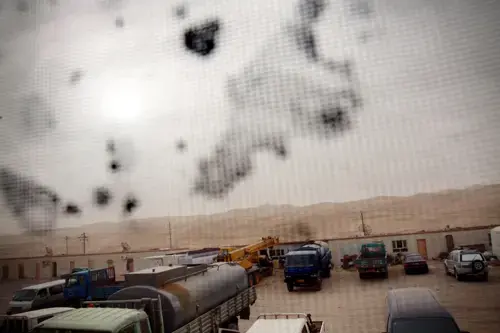
A view over the tiny town of Tazhong, created in the middle of the desert to house and service workers from the nearby oil fields.
1
The tarim-desert highway, which stretches 500km from one side of the desert to the other.
1
Sheep grazing on farmland near to the fringes of the Taklamakan desert, as yellow skies of a passing sandstorm hangs over them.
1
An oil-splattered sun hangs over the tiny town of Tazhong, created in the middle of the desert to house and service workers from the nearby oil fields.
1
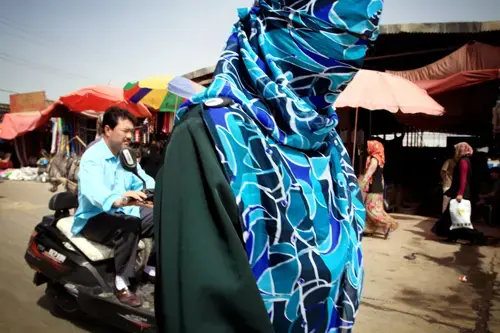
The people of the Taklamakan are of mostly Turkic origin, hence their appearance is not stereotypically "Chinese." The dominance of Islam in the region also helps form a special identity for the people in the west of the country.
1
Along the tarim-desert highway, swathes of sand-fixing plants have been planted in an effort to stabilize the soils and stop the sands moving.
1
Prospectors look for Jade in the Hetian River. Xinjiang's Jade is some of the most valuable in China and the world. After the river floods, hundreds of people flock to the river where pieces can be picked from the ground having been washed from the river's path through the Taklamakan desert.
1
The people of the Taklamakan are of mostly Turkic origin, hence their appearance is not stereotypically "Chinese." The dominance of Islam in the region also helps form a special identity for the people in the west of the country.
1
The people of the Taklamakan are of mostly Turkic origin, hence their appearance is not stereotypically "Chinese." The dominance of Islam in the region also helps form a special identity for the people in the west of the country.
1
At first glance, it appears that snow has fallen on the fringes of the Taklamakan desert. On closer inspection it can be seen that the white deposits are actually salt, left by the evaporating water under the intense heat of the desert.
1
1
1
1
1
1
1
1
1
1
1

The Taklamakan desert is a place of such epic proportions and intimidating size that its name in the local Uygur language translates as 'You can go in, but you will never come out'. After the great Sahara desert of northern Africa, the Taklamakan is the second biggest moving –sands desert in the world. Lying hidden underneath the immense sea of sand of the Taklamakan, lies the Tarim Basin oilfield. Covering 560,000 square kilometers, it is China's fourth largest oilfield with a reserve of some 16 billion tonnes. Apart from activity around the oilfields, the Taklamakan desert is a relatively lifeless place. The people of the Taklamakan, are mostly Uyghur, a Turkic ethnic group mainly found in Eastern and Central Asia, hence don't look stereotypically Chinese. As desertification becomes increasingly a national issue, the country may only need to look west to begin its search for effective ways to adapt to life in and around the moving sands.

Project

Desertification is one of the most important environmental challenges facing the world today, however it is arguably the most under-reported. Desertification is the gradual transformation of arable and habitable land into desert, usually caused by climate change and/or the improper use of land.
November 7, 2011 /
by Sean Gallagher
Sean Gallagher discusses China's environmental crises with students and faculty at Davidson College.
March 22, 2011 / Voice of America
by Peter Sawyer, Stephen Sapienza
As part of the DC Environmental Film Festival, four films explore the conflicts tied to water issues, as part of the annual World Water Day observance.